

Shopping for jewelry often brings up the confusing terms carat and karat, which can lead to uncertainty about what you are really buying. For anyone looking to invest in a special handcrafted piece, knowing the difference between carat—the gemstone’s weight—and karat—the purity of gold—makes all the difference in value and style. Clear understanding of these terms will empower you to ask smart questions and confidently select jewelry that meets your expectations.
Table of Contents
- Carat and Karat Explained Clearly
- How Carat Weight Affects Diamonds
- What Karat Means for Gold Quality
- Comparing Carat Weight and Karat Purity
- Buying Jewelry: Practical Tips and Mistakes
Key Takeaways
| Point | Details |
|---|---|
| Understand the Difference | Carat measures gemstone weight while karat measures gold purity, impacting value and quality. |
| Consider Diamond Weight | Carat weight significantly influences a diamond’s price, with larger sizes often commanding much higher prices. |
| Know Gold Purity Levels | Higher karat gold (like 24K) is purer but softer; lower karat options (like 10K) are more durable and suitable for daily wear. |
| Avoid Common Mistakes | Research thoroughly and verify quality factors such as metal purity and gemstone characteristics before purchasing. |
Carat and Karat Explained Clearly
When shopping for fine jewelry, understanding the difference between carat and karat is crucial for making an informed purchase. These two terms might sound similar, but they represent entirely different measurements in the jewelry world. Precise gemstone terminology can help you communicate more effectively with jewelers and make smarter buying decisions.
Let’s break down these essential terms:
-
Carat: A unit of weight specifically used for gemstones
- Equals exactly 200 milligrams
- Determines a gemstone’s size and value
- The higher the carat weight, the larger and typically more expensive the stone
-
Karat: A measurement of gold purity
- Expressed as a fraction of 24 total parts
- 24 karat represents pure gold (100% gold)
- Lower karat numbers indicate mixed metal alloys
For instance, understanding gold purity helps buyers recognize the actual gold content in their jewelry. An 18-karat gold piece contains 75% pure gold, while a 14-karat piece contains 58.3% gold, with the remaining percentage composed of other metals like silver or copper.
Pro tip: When comparing jewelry, always ask about both the carat weight of gemstones and the karat rating of the metal to ensure you understand the true value of your potential purchase.
How Carat Weight Affects Diamonds
Diamond carat weight is a critical factor in determining a stone’s value, appearance, and overall desirability. Diamond pricing dynamics reveal that weight influences cost exponentially, not just linearly. This means a 2-carat diamond isn’t simply twice the price of a 1-carat stone, but potentially much more expensive.
Understanding carat weight involves more than just numbers:
- Weight vs. Size: Carat measures mass, not visible dimensions
- Divided into 100 points for precise measurement
- Larger stones are rarer and command higher prices
- Cut and shape significantly impact perceived size
Key price thresholds exist in diamond purchasing:
- 0.5 carat: Entry-level milestone
- 1.0 carat: Significant price jump
- 1.5 carats: Luxury market segment
- 2.0 carats: Premium pricing tier
Diamond grading experts emphasize that carat weight interacts dynamically with other quality factors. A smaller diamond with exceptional cut, clarity, and color can appear more brilliant and valuable than a larger stone with inferior characteristics.
Carat weight is just one piece of the diamond value puzzle. Consider all four Cs: Cut, Color, Clarity, and Carat.
Pro tip: Consider purchasing diamonds just under popular carat weight thresholds to maximize value without sacrificing visual appeal.

What Karat Means for Gold Quality
Gold karat is the definitive measure of pure gold content in jewelry, revealing the intricate balance between precious metal purity and practical durability. Gold purity fundamentals demonstrate that the karat system divides gold into 24 parts, with each part representing a percentage of pure gold in an alloy.
Understanding gold karat ranges is crucial for making informed jewelry purchases:
-
24 Karat: 100% pure gold
- Softest and most malleable form
- Least suitable for everyday jewelry
- Brightest yellow color
-
18 Karat: 75% pure gold
- Ideal balance of purity and strength
- Rich color with improved durability
- Popular for fine jewelry
-
14 Karat: 58.3% pure gold
- Most common in American jewelry
- Significantly more durable
- More affordable than higher karat options
-
10 Karat: 41.7% pure gold
- Most resistant to wear and tear
- Least expensive gold option
- Ideal for everyday jewelry
Gold alloy composition plays a critical role in determining a piece’s overall quality. The additional metals mixed with pure gold not only enhance durability but also influence the final color and characteristics of the jewelry.
The lower the karat, the more durable the gold – but also the less pure and valuable the piece becomes.
Pro tip: Choose your gold karat based on both your budget and intended use, balancing between aesthetic appeal and practical wearability.
For gold jewelry shoppers, this table summarizes popular karat levels:
| Karat Level | Gold Percentage | Durability | Typical Uses |
|---|---|---|---|
| 24K | 100% | Very soft | Collectibles, luxury |
| 18K | 75% | Good balance | Fine jewelry, premium |
| 14K | 58.3% | High durability | Everyday wear |
| 10K | 41.7% | Highest durability | Affordable jewelry |
Comparing Carat Weight and Karat Purity
Carat and karat might sound similar, but they represent completely different measurements in the world of fine jewelry. Jewelry measurement fundamentals reveal these terms are often confused, yet they play distinct roles in determining a piece’s value and quality.
Key differences between carat and karat include:
-
Carat: Measures gemstone weight
- One carat equals 200 milligrams
- Applies to diamonds and other precious stones
- Directly impacts gem pricing and value
-
Karat: Measures gold purity
- Uses a 24-part scale
- Indicates percentage of pure gold
- Determines metal durability and appearance
Important comparison points:
-
Measurement focus
- Carat: Weight measurement
- Karat: Purity measurement
-
Impact on jewelry value
- Carat: Affects gemstone price
- Karat: Determines metal quality
Luxury jewelry experts emphasize that understanding these differences is crucial for making informed purchasing decisions. A high-carat diamond in a low-karat gold setting, for instance, might not represent the highest quality jewelry.
Precision matters: One measures weight, the other measures purity – both are essential in evaluating fine jewelry.
Pro tip: Always ask about both the carat weight of gemstones and the karat purity of metals when shopping for fine jewelry to ensure you’re getting true value.
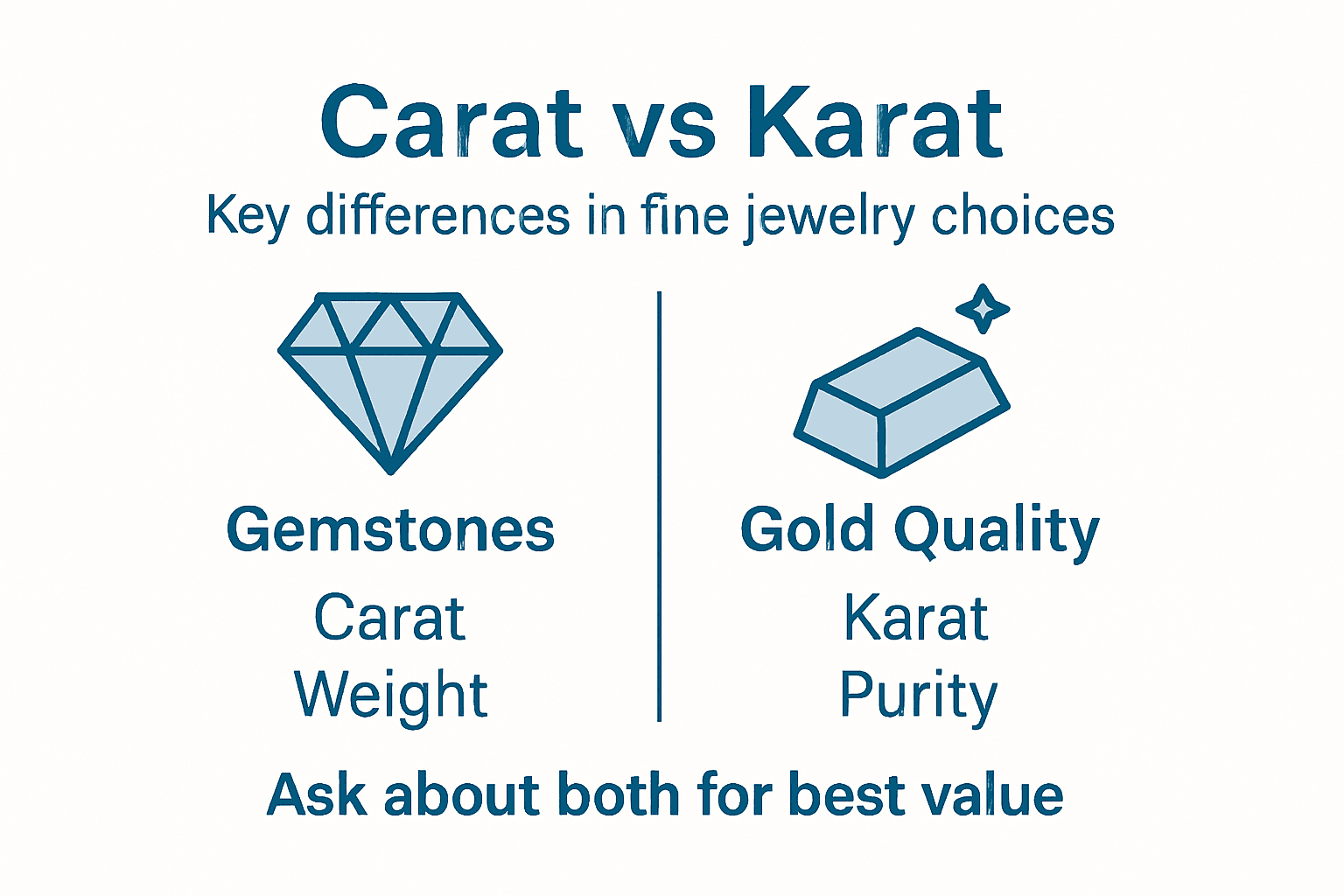
Here’s a quick reference comparing carat and karat for jewelry buyers:
| Aspect | Carat (Gemstones) | Karat (Gold) |
|---|---|---|
| What it Measures | Gemstone weight | Gold purity |
| Unit/Scale | 200 milligrams per carat | 24-point purity scale |
| Applies To | Diamonds, gemstones | Gold jewelry |
| Impact | Determines stone value | Defines gold durability |
| Buyer Questions | Ask about stone weight | Ask about gold content |
Buying Jewelry: Practical Tips and Mistakes
Purchasing fine jewelry requires careful consideration and strategic decision-making. Fine jewelry buying guide insights can help you navigate the complex world of jewelry selection and avoid common purchasing pitfalls.
Key mistakes to avoid when buying jewelry:
-
Overlooking Quality Factors
- Ignoring metal purity
- Neglecting gemstone characteristics
- Prioritizing size over craftsmanship
-
Budget Misconceptions
- Overspending without understanding value
- Choosing cheap materials that deteriorate quickly
- Failing to consider long-term investment potential
Essential buying strategies:
- Research before purchasing
- Understand metal and gemstone qualities
- Verify authenticity and certification
- Consider personal style and lifestyle
- Inspect craftsmanship details
Authentic jewelry requires careful evaluation across multiple dimensions. Understand the interplay between design, materials, craftsmanship, and personal aesthetic to make informed decisions.
Smart jewelry shopping means balancing emotional desire with practical considerations.
Pro tip: Always request and review detailed documentation, including material certifications and quality grading reports, before finalizing any jewelry purchase.
Master the Art of Choosing Fine Jewelry with Confidence
Understanding the difference between carat and karat is the first step to making a purchase you will cherish forever. Whether you are captivated by the sparkle of a diamond’s carat weight or the rich glow of 14k gold’s karat purity, you deserve jewelry that matches your style and lasts a lifetime. At Malibu Vibes Jewelry, we solve the challenge of navigating these critical details by offering handcrafted pieces where every carat and karat is clearly defined.

Explore our curated collections that spotlight both gemstone quality and gold purity. Discover luxurious, wearable artistry made in Los Angeles with meticulous craftsmanship and detailed descriptions to help you choose wisely. Don’t wait to elevate your jewelry experience with pieces that bring both emotional meaning and lasting value. Visit Malibu Vibes Jewelry today and start your journey toward elegant, well-informed choices in fine jewelry. For a closer look at how we blend quality and style check out our selection of rings, necklaces, earrings, and bracelets. Your perfect piece is waiting with clarity on every carat and karat.
Frequently Asked Questions
What is the difference between carat and karat?
Carat measures the weight of gemstones, equating to 200 milligrams. Karat measures the purity of gold on a scale of 24 parts, with 24 karat representing pure gold.
How does carat weight affect the value of a diamond?
Carat weight significantly impacts a diamond’s value and pricing. Diamonds increase in price exponentially with weight, meaning a 2-carat diamond can be much more expensive than a 1-carat stone due to rarity.
What does the karat rating indicate for gold jewelry?
The karat rating indicates the percentage of pure gold in an alloy. For example, 18 karat gold contains 75% pure gold, while 14 karat contains 58.3%. Higher karat ratings indicate higher gold content and typically greater value.
How can I choose the right carat weight for my diamond?
When selecting a diamond, consider your budget and the visual appeal at specific weight thresholds. Opting for a weight just below popular milestones (like 1 carat) can maximize value while maintaining size perception.
Recommended
- Complete Guide to Gold Karat Differences – Malibu Vibes Jewelry
- Understanding the Difference Between 14k and 18k Gold – Malibu Vibes Jewelry
- What is Fine Jewelry? Understanding Luxury and Craftsmanship – Malibu Vibes Jewelry
- Fine Jewelry Buying Tips for High-Quality Selections – Malibu Vibes Jewelry
- Role of Accessories in Fashion: Elevate Your Style
- What Makes a Watch Luxury – Key Factors Revealed