

TL;DR:
- Gemstones carry deep symbolism rooted in history, culture, color, rarity, and personal intention.
- Different cultures assign unique meanings to the same stones, reflecting diverse traditions and beliefs.
- Using gemstone symbolism in jewelry choices adds meaning, longevity, and personal connection beyond aesthetics.
Gemstones have captivated humans for thousands of years, but their true power goes far beyond sparkle and color. Every stone you wear carries a layered story rooted in history, culture, and personal intention. Whether you’re picking out a ring for yourself or searching for a gift that says something real, understanding gemstone symbolism changes everything. It turns a beautiful accessory into something that speaks. This guide walks you through what gemstone symbolism actually means, how it works across cultures, and how you can use it to make smarter, more meaningful jewelry choices every single time.
Table of Contents
- What is gemstone symbolism?
- Major types of gemstone symbolism: Color, rarity, tradition, and energy
- Gemstone symbolism across cultures: Surprising differences and stories
- How to use gemstone symbolism in your jewelry choices and gifts
- Why gemstone symbolism still matters in modern jewelry
- Find your meaningful gemstone jewelry
- Frequently asked questions
Key Takeaways
| Point | Details |
|---|---|
| Symbolism shapes choices | Understanding gemstone symbolism empowers you to select jewelry that aligns with your personal values and intentions. |
| Color and culture matter | The meaning of gemstones changes based on color and cultural tradition, making your choices highly personal. |
| Gift with intention | Choosing a gemstone with specific symbolism turns a piece of jewelry into a thoughtful, meaningful gift. |
| Layered meanings | You can combine color, rarity, tradition, and energy symbolism for jewelry that tells your unique story. |
What is gemstone symbolism?
Gemstone symbolism is the practice of assigning meaning, energy, or intention to a specific stone based on its color, rarity, origin, or cultural history. It’s not a modern trend. Humans have been doing this for millennia, and the reasons run deeper than superstition.
Think about why you’re drawn to a particular stone. Maybe it’s the deep blue of a sapphire that feels calm and grounding, or the fiery red of a ruby that feels bold and alive. That pull isn’t random. It’s tied to something much older than you might expect. Research shows that hominins collected crystals 780,000 years ago for non-utilitarian, symbolic reasons, long before written language or organized religion. The human instinct to find meaning in stones is literally ancient.
“A gemstone is never just a gemstone. It is a mirror of what the wearer values, hopes for, or wants to protect.”
Today, gemstone symbolism shows up in several powerful ways:
- Milestone gifting: Stones are chosen to mark births, anniversaries, graduations, and healing journeys.
- Personal intention: Wearing a stone that reflects a value you’re working toward, like courage, clarity, or love.
- Protection and luck: Many cultures use stones as talismans to ward off negative energy or invite good fortune.
- Identity and self-expression: Choosing a stone that resonates with your personality or spiritual beliefs.
Understanding why jewelry is meaningful starts with recognizing that the stones themselves carry weight. When you give someone an emerald, you’re not just giving them a green gem. You’re offering a symbol of growth, renewal, and abundance. That context transforms the object into something far more personal.
For modern jewelry lovers, gemstone symbolism is a tool. It helps you move beyond buying what looks pretty and start choosing what feels right. It makes your jewelry collection tell a story that’s uniquely yours.
Major types of gemstone symbolism: Color, rarity, tradition, and energy
With a foundation in what gemstone symbolism is, it’s important to break down the key types. Symbolism doesn’t come from one single source. It’s layered, and knowing the layers helps you make more intentional choices.
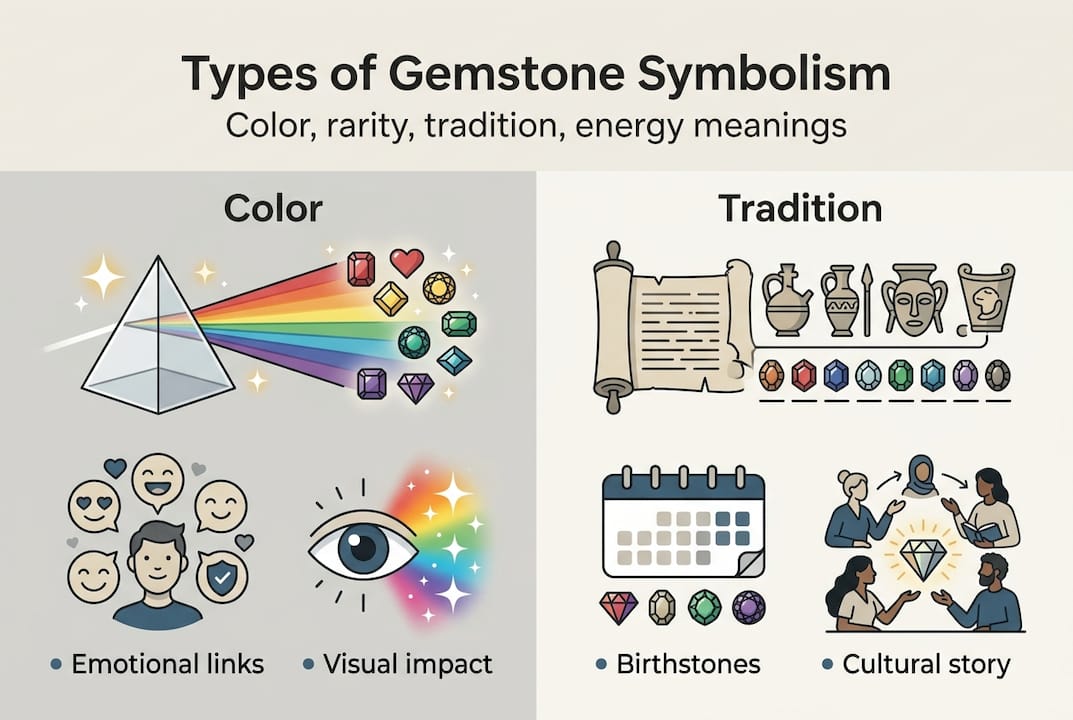
Color symbolism is the most immediate layer. Colors carry universal emotional associations that cross many cultural lines. Green suggests growth and renewal, which is why emeralds are linked to abundance. Blue evokes calm and trust, making sapphires a natural symbol of wisdom. Red signals passion and power, which explains the ruby’s long association with love and strength.
Rarity adds another dimension. A stone that’s difficult to find naturally carries a sense of exclusivity and preciousness. This is part of why diamonds, alexandrite, and tanzanite feel so significant as gifts. Their scarcity makes them feel worthy of major moments.
Tradition is where birthstones, chakra healing, and zodiac connections come in. Gemstone meanings are formed through color associations, rarity, chakra alignments, and astrological links, with birthstone traditions standardized as recently as 1912. That standardization made it easier for people to connect personally with a specific stone based on their birth month.
Here’s a quick look at how different symbolic layers compare:
| Symbolism type | Based on | Example |
|---|---|---|
| Color | Visual emotion | Blue sapphire = calm |
| Rarity | Scarcity and value | Diamond = preciousness |
| Birthstone | Birth month tradition | Garnet = January |
| Chakra | Energy centers | Amethyst = crown chakra |
| Zodiac | Astrological sign | Peridot = Virgo |
To layer multiple meanings when choosing a piece, try this approach:
- Start with your intention. What do you want this piece to represent?
- Check if your birthstone aligns with that intention.
- Consider the color and what it communicates emotionally.
- Look at rarity if the occasion calls for something extra special.
- Add a zodiac or chakra layer if those traditions resonate with you.
Pro Tip: You don’t have to follow one system. Mixing a birthstone with a color that matches your intention creates a piece that’s uniquely personal and deeply layered. Explore the meaning of different gemstones and birthstone color meanings to build your own symbolic framework.
Gemstone symbolism across cultures: Surprising differences and stories
Once you understand how symbolism is formed, it’s fascinating to see how differently the same gems are viewed around the globe. What one culture treats as a symbol of love, another may associate with power, protection, or even the divine.
Take diamonds. In the Western world, diamonds equal eternal love, largely because of a wildly successful 20th-century marketing campaign. But that meaning isn’t universal. Cultural gemstone meanings vary dramatically across traditions: in India, the Navaratna system links rubies to the sun and personal power; in China, jade represents purity and immortality and is valued more highly than diamonds; for Native American traditions, turquoise symbolizes sky and protection; and for the ancient Maya, jade outranked gold entirely.
Here’s a snapshot of how key stones are interpreted across cultures:
| Gemstone | Western meaning | Eastern or indigenous meaning |
|---|---|---|
| Diamond | Eternal love | Clarity, invincibility (Sanskrit tradition) |
| Ruby | Passion, romance | Sun, power, royalty (Indian Navaratna) |
| Jade | Luck | Purity, immortality (Chinese culture) |
| Turquoise | Bohemian style | Sky, protection (Native American) |
| Emerald | Wealth, renewal | Sacred to Venus (Roman), rebirth (Egyptian) |
These differences matter when you’re choosing jewelry with intention, especially as a gift. A stone that feels romantic in one context might carry a completely different weight for someone from another background.
What this also reveals is how much marketing shapes perception. The cultural and religious significance of fine jewelry runs far deeper than advertising, and understanding that history gives you a richer relationship with the pieces you wear.
Some key takeaways when drawing inspiration from global traditions:
- Research the origin story of a stone before assigning it a single meaning.
- Honor the cultural roots of a tradition rather than borrowing surface-level aesthetics.
- Use global symbolism as inspiration to build a personal meaning that feels authentic to you.
- Explore the history of jewelry design to understand how these traditions evolved over centuries.
The world of gemstone symbolism is genuinely global, and that richness is something to celebrate rather than flatten into one story.
How to use gemstone symbolism in your jewelry choices and gifts
Now that you know the global dimension, let’s get practical and see how to use gemstone symbolism to enhance your own style or gift-giving.
Choosing a stone for yourself is different from choosing one for someone else. Both require intention, but the process looks a little different.
For yourself, follow these steps:
- Identify what you want more of in your life right now. Confidence? Calm? Love? Clarity?
- Research which stones are traditionally linked to that quality.
- Check if the stone’s color resonates with you visually, because you’ll be wearing it.
- Consider the role of gemstones in jewelry and how different settings highlight a stone’s character.
- Choose a piece that fits your everyday style so you’ll actually wear it and feel connected to its meaning.
For gifting, the process shifts:
- Think about the recipient’s personality and what they’re going through right now.
- Check their birthstone as a starting point, it’s personal by nature.
- Consider the intention behind the gift. Is it celebratory, comforting, or empowering?
- Match the stone to that emotion using color symbolism as your guide.
- Add a note explaining the meaning behind the stone. That context turns a beautiful gift into a memorable one.
The psychology of jewelry meaning shows that objects carry emotional weight when they’re given with clear intention. Our evolutionary attraction to symbolic objects is deeply wired, which is why a thoughtfully chosen gemstone gift lands so differently than a generic one.
Pro Tip: When layering pieces, try pairing a birthstone ring with a stone that represents your current intention. For example, a garnet ring (January birthstone, passion) alongside an aquamarine bracelet (calm, clarity) creates a combination that’s both personal and visually striking.
Mixing symbolic meaning with personal style isn’t complicated. It just requires slowing down and asking what you want your jewelry to say.
Why gemstone symbolism still matters in modern jewelry
Fast fashion moves at a pace that makes everything feel disposable. Trends cycle in and out so quickly that a piece you bought six months ago can already feel dated. Gemstone symbolism is the antidote to that.
When you choose a stone with intention, you’re not following a trend. You’re making a decision rooted in something that has lasted thousands of years. That kind of choice ages well. An emerald chosen for its meaning of growth doesn’t go out of style when the season changes. It grows with you.
We’ve seen how social media and jewelry trends can push people toward pieces that look great in a photo but feel hollow in real life. The most powerful jewelry we’ve encountered is always the kind that was chosen with a reason. It doesn’t have to be expensive. It has to be intentional.
There’s also a practical angle here. Pieces chosen for their symbolic meaning tend to be worn more often, cared for better, and kept longer. That’s better for your wallet and better for the planet. Understanding symbolism isn’t just poetic. It’s a smarter way to invest in your jewelry collection.
Find your meaningful gemstone jewelry
Ready to embrace symbolism in your jewelry? At Malibu Vibes Jewelry, every piece is crafted in Los Angeles with the kind of care that makes symbolism feel tangible. Whether you’re looking for a stone that speaks to your personal journey or searching for a gift that goes beyond the surface, the right piece is waiting.

Browse the color gemstone ring collection to find stones that match your intention, or explore diamond earrings for a timeless symbol of clarity and strength. Curious about how each piece comes to life? Take a look at our jewelry making process and see the craftsmanship behind every meaningful detail. Your next favorite piece isn’t just beautiful. It means something.
Frequently asked questions
How do gemstone colors influence their meanings?
Color associations are a core part of gemstone symbolism, with shades like green representing renewal and blue evoking calm, guiding both personal selection and cultural traditions across centuries.
Why do some cultures value certain gemstones more than others?
Cultural beliefs, history, and local symbolism shape which stones are prized. Jade outranks diamonds in Chinese symbolism because it represents purity and immortality, values that run deeper than rarity alone.
How can I choose a gemstone with meaning for a gift?
Consider the recipient’s personality, birthstone, and current life chapter, then select a stone that reflects the emotion or intention you want to convey. Gemstones serve as symbolic gifts for milestones, wishes, and protection across virtually every culture.
Do all gemstones have universal symbolic meanings?
No. Gemstone symbolism varies significantly by culture and shifts over time, so researching both traditional and modern interpretations gives you the fullest picture before making a choice.
Recommended
- The Psychology of Jewelry: What Fine Jewelry Says About You – Malibu Vibes Jewelry
- Colorful Gemstone Earrings for Timeless Elegance – Malibu Vibes Jewelry
- Craft Your Story with Custom Jewelry Trends – Malibu Vibes Jewelry
- The Meaning of Different Gemstones – A Guide to Choosing Intentional J – Malibu Vibes Jewelry