

TL;DR:
- A hamsa hand ring is a protective talisman believed to ward off evil and invite blessings of health and luck. Its rich cultural history spans Jewish, Muslim, and Middle Eastern traditions, symbolizing protection, abundance, and unity. Made from materials like gold or silver with various design styles, it suits everyday wear and meaningful gift-giving.
A hamsa hand ring is a protective talisman worn on the finger, recognized across Jewish, Muslim, and Middle Eastern cultures as a symbol that wards off evil and draws in blessings of health, luck, and good fortune. Unlike most fashion rings, this piece carries centuries of spiritual weight behind its design. The open palm with an eye at its center is one of the most universally understood protective emblems in the world. In 2026, the hamsa symbol ring sits at the crossroads of intention-based jewelry and everyday wearable art, making it a meaningful choice for personal use and gifting alike.
What is the historical and cultural significance of the hamsa hand symbol?
The hamsa is one of the oldest protective symbols in human history. Its name comes from the Arabic word for “five,” referring to the five fingers of the open hand. Across North Africa, the Middle East, and the Mediterranean, the symbol predates both Islam and Judaism, appearing in ancient Carthaginian and Phoenician art as a hand of the goddess Tanit.
Different cultures absorbed the hamsa and gave it their own names and meanings. In Jewish tradition, it is called the Hand of Miriam, referencing the sister of Moses. In Islamic tradition, it is the Hand of Fatima, named after the daughter of the Prophet Muhammad. Both traditions share the core belief: the open hand deflects the evil eye and protects the wearer from harm.
The hamsa symbol carries specific layers of meaning depending on its orientation. A hand pointing downward is said to invite good fortune and abundance. A hand pointing upward acts as a shield against negativity. Most hamsa jewelry uses the downward position, which is why the symbol feels welcoming rather than defensive in its visual energy.
What makes the hamsa genuinely remarkable is its cross-cultural staying power. It is not owned by one religion or region. That universality is exactly why it translates so naturally into modern jewelry:
- Protection: The primary function across all cultures is defense against the evil eye and negative energy.
- Luck and fertility: In Middle Eastern traditions, the hamsa is also an emblem of luck and fertility, worn during major life transitions.
- Blessings and health: Wearing the symbol is believed to invite positive energy, health, and divine favor into daily life.
- Unity: The hamsa bridges religious and cultural divides, making it appropriate for wearers of any background.
These layered meanings are why a hamsa finger ring feels different from a decorative band. The symbolism is built into the object itself.
What materials and design styles are used in hamsa hand rings?
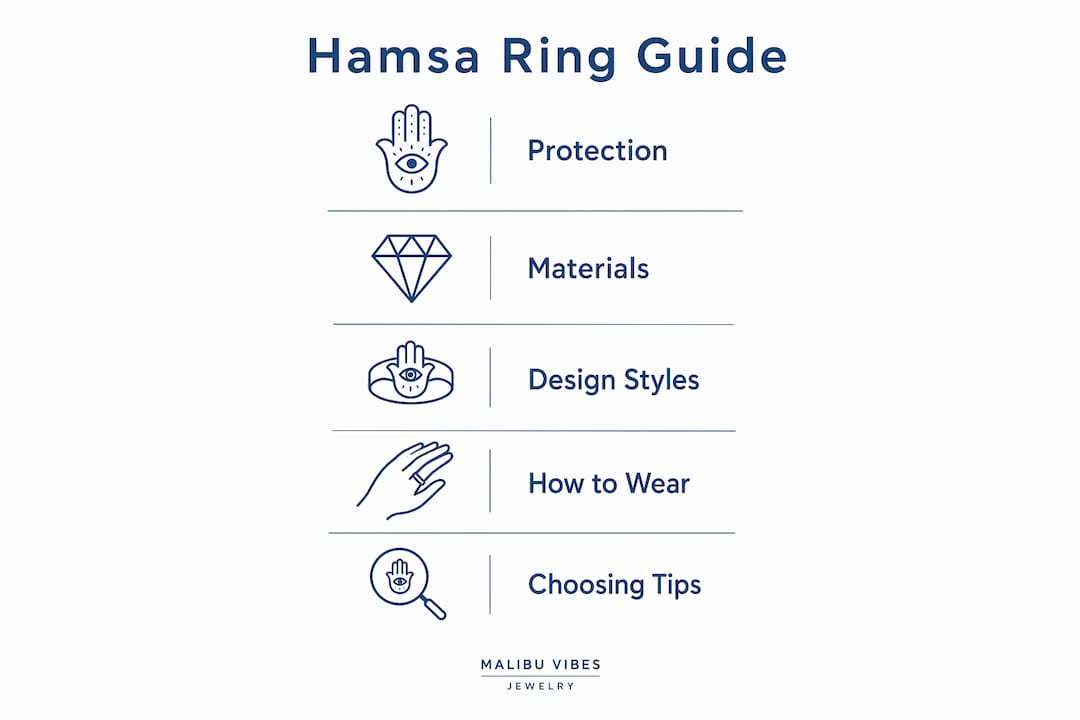
The material of a hamsa ring shapes both its durability and its symbolic resonance. The most common metals are 14k yellow gold, 14k white gold, 14k rose gold, and 925 sterling silver. Each carries its own aesthetic and, for many wearers, its own energetic quality.

925 sterling silver is favored for its ability to conduct and store positive energy, according to crystal healing traditions. It is also the most accessible price point for everyday hamsa jewelry. Gold, particularly 14k solid gold, offers greater durability and a warmer visual presence. Rose gold has grown in popularity for its softness and femininity, while white gold suits wearers who prefer a cooler, more modern look.
Gemstone accents add another layer of meaning and beauty. Diamonds, sapphires, opals, and turquoise are the most common choices for embellishing hamsa rings. Diamonds amplify the ring’s light and luxury. Turquoise has its own protective symbolism in Native American and Middle Eastern traditions. Sapphires bring depth and calm. Cubic zirconia offers a budget-friendly sparkle for those who want the look without the price of natural stones.
Design styles vary widely, and the right choice depends on how you plan to wear the piece:
- Filigree: Delicate metalwork surrounds the hamsa symbol, creating an intricate, antique feel. Best for formal or spiritual settings.
- Minimalist: A small, clean hamsa sits on a thin band. Works for everyday wear and stacking.
- Open band or wrap style: The band does not close fully, allowing for adjustable sizing that fits a range of finger sizes. Ideal for gifting.
- Statement: A large hamsa with bold gemstone accents dominates the finger. Designed to be noticed.
Pro Tip: If you are buying a hamsa ring as a gift and do not know the recipient’s ring size, choose an open-band or wrap-style design. These fit most fingers comfortably and require only occasional gentle tightening to maintain their shape.
Artisan hand-cut craftsmanship matters more in hamsa jewelry than in most other ring styles. When a piece is crafted with intention, the maker’s care becomes part of the object. That is not mysticism. It is the difference between a mass-produced stamp and a piece where a human hand shaped every detail.
How can you style and wear a hamsa hand ring for everyday life?
The hamsa ring’s versatility is one of its strongest qualities. The symbol fits naturally into professional meetings, casual outings, and spiritual practices like yoga or meditation. A small gold hamsa on a thin band reads as refined jewelry in a boardroom. The same ring worn with linen and sandals reads as intentional, relaxed style.
Stacking is one of the most effective ways to wear a hamsa symbol ring. Pair it with thin plain bands on adjacent fingers to frame the hamsa without competing with it. For a bolder look, stack it with a minimalist gemstone ring on the same hand. The key is keeping the hamsa as the focal point.
Here are four practical approaches to styling your hamsa ring:
- Daily wear: Choose a minimalist sterling silver or 14k gold hamsa on a thin band. Wear it on your index or middle finger for visibility without bulk.
- Stacked look: Combine the hamsa ring with two or three plain bands. Follow the guide on wearing stackable rings to balance proportions across your hand.
- Spiritual or yoga setting: Wear a single wrap-style hamsa on your dominant hand. The open-palm design mirrors the symbol’s protective gesture.
- Formal occasions: Choose a 14k gold hamsa with a diamond or sapphire accent. Pair it with a hamsa hand necklace in the same metal for a coordinated set.
Pro Tip: When gifting a hamsa ring, pair it with a short note explaining the symbol’s meaning. The context transforms the piece from jewelry into a personal blessing, which is what the giver actually intends.
Matching your hamsa ring to a hamsa bracelet in the same metal creates a cohesive hamsa hand accessories set without looking overdone. Keep the rest of your jewelry simple when you go this route.
What should you consider when choosing a hamsa hand ring?
Choosing the right hamsa ring comes down to four factors: material, size, craftsmanship, and intention.
Material durability is the starting point. Solid 14k gold lasts a lifetime with minimal care. Sterling silver requires occasional polishing to prevent tarnish but remains a strong everyday choice. Avoid gold-plated pieces if you plan to wear the ring daily. The plating wears through quickly, especially on a ring that contacts surfaces constantly.
Sizing is the most practical concern. Fixed-size rings require you to know the wearer’s exact ring size. Open-band and wrap-style designs solve this problem entirely. Adjustable hamsa rings fit a range of sizes comfortably, which is why they are the preferred choice for gifting.
Consider these factors before purchasing:
- Artisan vs. mass-produced: Hand-cut pieces carry more detail and personal energy than stamped factory rings. The craftsmanship shows in the finish.
- Gemstone sourcing: Ask whether stones are natural, lab-grown, or simulated. Natural and lab-grown stones hold value; simulated stones like CZ do not.
- Ethical metals: Look for recycled gold or silver, or ask about the brand’s sourcing practices. Malibuvibesjewelry, for example, emphasizes Los Angeles-based production and quality-focused craftsmanship.
- Occasion fit: A diamond-set 14k gold hamsa suits a milestone gift. A sterling silver wrap ring suits a casual birthday or friendship gift.
- Presentation: The packaging matters for gifting. A ring presented in a quality box with a card lands differently than one in a plastic bag.
The distinction between artisan and mass-produced is not just aesthetic. A piece made with care and intention functions as a true talisman. A factory-stamped version is decoration. Both are valid, but they serve different purposes for the wearer.
Key Takeaways
A hamsa hand ring is a protective talisman with deep cultural roots, and choosing the right one requires attention to material, craftsmanship, sizing, and the intention behind the piece.
| Point | Details |
|---|---|
| Symbol meaning | The hamsa represents protection, luck, and blessings across Jewish, Muslim, and Middle Eastern traditions. |
| Best materials | Solid 14k gold and 925 sterling silver offer durability and symbolic resonance for daily wear. |
| Sizing for gifts | Open-band and wrap-style rings adjust to fit most fingers, making them the top choice for gifting. |
| Styling versatility | A hamsa ring works in professional, casual, and spiritual settings when paired with the right band weight. |
| Craftsmanship matters | Hand-cut artisan pieces carry more detail and personal connection than mass-produced stamped rings. |
Why the hamsa ring is more than a trend
I have watched a lot of jewelry trends cycle through and fade. The hamsa has not faded. It keeps showing up because it does something most jewelry cannot: it gives the wearer a reason to put it on beyond aesthetics. That reason is protection, intention, and connection to something larger than a single moment or season.
What I find most compelling is how the hamsa works across contexts without losing its meaning. I have seen it worn by people who are deeply religious and by people who simply want a daily reminder to stay grounded. The symbol holds both. That kind of flexibility is rare in any object, let alone a piece of jewelry small enough to sit on one finger.
The craftsmanship question is where I get particular. A hand-cut hamsa in solid gold is a fundamentally different object from a stamped version in plated metal. The first one will look better in ten years than it does today. The second one will not survive daily wear. When someone tells me they want a meaningful piece, I always push them toward the version made by a human hand. The intention of the maker becomes part of what you carry.
— Ara
Malibuvibesjewelry’s collection of meaningful hamsa pieces
Malibuvibesjewelry crafts each piece in Los Angeles with a focus on quality over quantity, and that philosophy shows up directly in their hamsa offerings.

The brand’s artisan crafting process prioritizes hand-finished detail and intentional design, which is exactly what a protective talisman deserves. Their diamond rings collection includes solid gold options set with genuine stones, built for wearers who want both spiritual meaning and fine jewelry quality. For those drawn to sterling silver, the sterling silver collection offers minimalist and statement pieces that pair naturally with a hamsa ring. Whether you are choosing for yourself or selecting a gift, Malibuvibesjewelry gives you pieces made to last and mean something.
FAQ
What does a hamsa hand ring represent?
A hamsa hand ring represents protection against the evil eye, negative energy, and harm, while also inviting blessings of health, luck, and good fortune. The symbol is recognized across Jewish, Muslim, and Middle Eastern cultures with the same core meaning.
Which finger should you wear a hamsa ring on?
There is no fixed rule, but most wearers choose the index or middle finger to keep the hamsa symbol visible. The dominant hand is preferred in many spiritual traditions because it is the hand that acts in the world.
What metal is best for a hamsa ring?
Solid 14k gold is the most durable choice for daily wear, while 925 sterling silver is favored for its accessibility and its reputation for conducting positive energy. Avoid gold-plated options if you plan to wear the ring every day.
Are adjustable hamsa rings good for gifting?
Adjustable open-band rings are the best choice for gifting because they fit a range of finger sizes without requiring the recipient’s exact measurement. They do need occasional gentle reshaping to maintain their fit over time.
Can anyone wear a hamsa hand ring?
The hamsa’s universal sacred meaning makes it appropriate for wearers of any cultural or religious background. The symbol transcends any single tradition and carries a broadly shared message of protection and goodwill.