

TL;DR:
- A vintage wedding ring is at least 50 years old and draws from historical styles like Victorian, Edwardian, and Art Deco. These rings feature distinct design elements and unique stones that reflect their era, with some over 100 years old classified as antiques. Buyers should verify authenticity through provenance, ask for independent appraisals, and choose settings that protect irregular antique stones for daily wear.
A vintage wedding ring is defined as a ring that is at least 50 years old or designed to replicate the aesthetic of a specific historical era. The industry term for pieces over 100 years old is “antique,” while “retro” refers to styles from the 1930s through the 1950s. Vintage rings sit between those two categories, drawing from Art Deco, Edwardian, and Victorian craftsmanship to create jewelry that feels both timeless and deeply personal. Celebrities like Taylor Swift and Zendaya have made antique engagement rings a mainstream choice, and that visibility has pushed demand for old fashioned engagement rings to new heights in 2026.
What eras and styles define a vintage wedding ring?
A ring is typically considered vintage when it is at least 50 years old, covering styles from Art Deco (1920–1935), the Retro era (1939–1950), and Midcentury designs. Each era left a distinct fingerprint on jewelry design that collectors and couples still seek out today.
| Era | Date Range | Signature Style | Popular Stones |
|---|---|---|---|
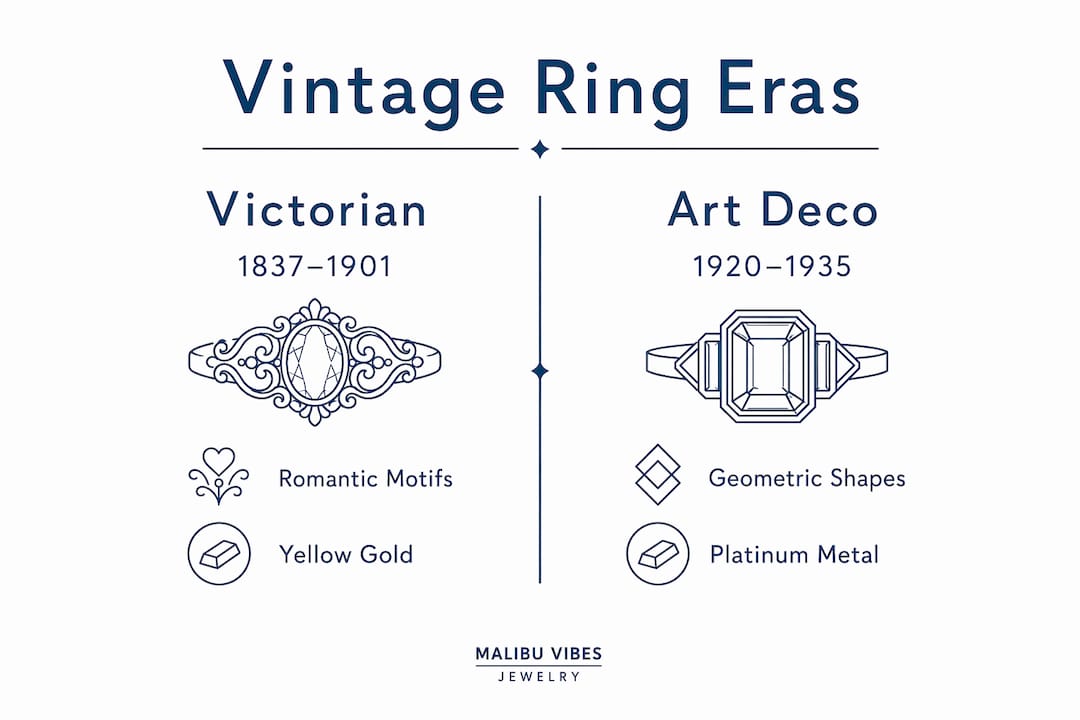
| Victorian | 1837–1901 | Romantic motifs, floral engraving, yellow gold | Rose-cut diamonds, sapphires, garnets |
| Edwardian | 1901–1910 | Lacy filigree, platinum, delicate milgrain | Old European-cut diamonds, pearls |
| Art Deco | 1920–1935 | Geometric patterns, bold symmetry, white metals | Emerald-cut diamonds, rubies, onyx |
| Retro | 1939–1950 | Large, sculptural gold settings, Hollywood glamour | Aquamarines, citrines, synthetic rubies |
| Midcentury | 1950–1970 | Clean lines, cluster settings, yellow and rose gold | Round brilliant diamonds, colored gems |
The Art Deco era produces the most recognizable antique engagement rings. Geometric shapes, strong symmetry, and high-contrast color combinations give Art Deco pieces an architectural quality that reads as modern even today. Edwardian rings take the opposite approach, using platinum filigree and milgrain detailing to create lace-like settings that feel delicate and romantic.
Victorian rings rely heavily on yellow gold and symbolic motifs such as serpents, flowers, and hearts. These pieces carry strong narrative weight, which is exactly why buyers drawn to historic wedding jewelry gravitate toward them. Retro era rings go bolder, with large gold settings and colored stones that reflect the optimism of post-war Hollywood.
Old European-cut and cushion-cut diamonds appear across nearly every vintage era. These hand-cut stones have a warmer, softer sparkle than modern brilliant cuts. That quality is not a flaw. It is the character that makes each stone irreplaceable.
How to choose the right vintage ring style for you
Choosing a vintage style wedding band starts with understanding your own lifestyle, not just your aesthetic preferences. A ring worn daily needs a setting that protects the stone. A ring worn for special occasions can afford more ornate detailing.
Follow these steps to narrow your choice:
- Identify your era. Study the table above and notice which design elements appeal to you. Geometric Art Deco lines and romantic Victorian florals require very different settings.
- Choose your metal. Platinum suits Edwardian and Art Deco styles. Yellow and rose gold align with Victorian, Retro, and Midcentury pieces. Vintage diamond wedding bands are available in 10K, 14K, and 18K solid gold with custom sizing and engraving options.
- Pick your setting type. Bezel settings protect irregular stones and work well for daily wear. Claw settings show more of the stone. Pavé and milgrain edges add texture without overwhelming the center stone.
- Let the stone lead. Experts in 2026 recommend prioritizing a stone’s individual character and historical context over strict GIA 4Cs grading. A hand-cut diamond with warmth and fire often outperforms a colorless modern stone in terms of visual impact.
- Consider modern vintage trends. East-west settings and bold, larger stones are gaining popularity in 2026. These orientations give antique stones a fresh, fashion-forward look without erasing their history. Browse modern engagement ring styles to see how vintage design intersects with current trends.
Pro Tip: Bezel and compass claw settings work especially well for antique stones that are slightly irregular in shape. Both settings balance proportions and protect the stone’s edges, which is a real concern with hand-cut gems that predate modern precision cutting.
Bezel settings help balance stones that may be irregular in shape, while compass claw settings enhance cushion and elongated cuts. This matters because most antique diamonds were cut by hand and do not conform to the perfectly symmetrical dimensions of modern stones.
Where to buy vintage wedding rings safely
Sourcing a genuine vintage wedding ring requires more due diligence than buying a new piece. The market includes authentic estate pieces, quality reproductions, and everything in between.
Reputable sources include:
- Estate jewelry stores. Established dealers specialize in authenticated pieces with known provenance. Ask for documentation on any stone above one carat.
- Auction houses. Sotheby’s offers antique rings with GIA certification and full provenance records. A platinum ring with a 5.57ct Old European-cut diamond sold through Sotheby’s illustrates the level of documentation serious buyers should expect.
- Trusted online retailers. Look for sellers who provide detailed photos, return policies, and independent appraisals. Classified listings on platforms like jewelry classifieds can surface unique finds, but always request a third-party appraisal before purchasing.
- Family heirlooms. Inherited rings carry the deepest personal meaning. A jeweler can assess condition and recommend remounting if the original setting is worn.
Before buying, ask these questions:
- Is the stone original to the ring, or has it been replaced?
- Does the stone sit properly within its setting?
- Are there signs of water damage, especially in Georgian-era pieces?
- Has the ring been resized, and if so, how many times?
- Does the seller provide an independent appraisal or GIA report?
Victorian era rings have open-back settings that allow light to pass through, making them better suited for daily wear. Georgian rings use closed-back settings with foil behind the stone, and water exposure can dull that foil permanently. Knowing this distinction helps you assess whether a ring fits your lifestyle before you commit.
Checking that a diamond sits properly within its setting is the fastest way to determine whether the stone is original to the piece. A loose fit or mismatched prong wear suggests the stone was replaced at some point, which affects both value and authenticity.
How to care for a vintage wedding ring
Vintage rings require more attentive care than modern pieces because their settings and stones reflect the technology and materials of their era. That is not a weakness. It is a reason to treat them with more intention.
Clean vintage rings with warm water and a soft brush. Avoid ultrasonic cleaners, which can loosen stones in older prong settings. Skip steam cleaning for any ring with enamel, foil-backed stones, or organic gems like pearls and coral. A mild dish soap solution and gentle scrubbing cover most cleaning needs safely.
Inspect your ring every six months for loose stones or worn prongs. Prongs on antique rings are often thinner than modern equivalents and can wear down faster with daily use. A jeweler can re-tip or replace prongs without altering the ring’s original character.
Pro Tip: Store your vintage ring separately from other jewelry. Harder stones like diamonds can scratch softer metals and gems. A soft pouch or a lined compartment in a jewelry box prevents surface damage between wearings.
Professional maintenance once a year keeps a vintage ring in wearable condition for decades. If the original setting is too fragile for daily wear, a skilled jeweler can remount the stone into a new setting that honors the original design while adding structural integrity. This is especially common with Georgian and early Victorian pieces. Consider insuring any vintage ring valued above a few hundred dollars. Standard homeowner policies often undervalue jewelry, so a dedicated jewelry rider or standalone policy gives you accurate replacement coverage.
Key takeaways
Vintage wedding rings offer unmatched character, historical depth, and personal meaning that no newly manufactured ring can replicate.
| Point | Details |
|---|---|
| Vintage means 50+ years old | Rings from Art Deco, Victorian, and Retro eras each carry distinct design signatures worth knowing before you shop. |
| Let the stone’s character lead | Prioritize fire and individuality in antique diamonds over strict GIA 4Cs grading for the most visually striking result. |
| Setting choice protects your investment | Bezel and compass claw settings balance irregular antique stones and protect edges during daily wear. |
| Verify authenticity before buying | Check stone fit, ask for provenance, and request a GIA report or independent appraisal from any reputable seller. |
| Care determines longevity | Avoid ultrasonic cleaners, inspect prongs every six months, and store vintage pieces separately to preserve them for generations. |
Why vintage rings are more than a trend
I have spent years watching couples choose between modern and vintage rings, and the pattern is consistent. The people who choose vintage are not just buying a style. They are buying a story.
What strikes me most is how the imperfections in antique stones become the point. A hand-cut Old European diamond does not have the mathematical symmetry of a modern brilliant. Its facets are slightly uneven, its proportions reflect the cutter’s judgment rather than a machine’s precision. That irregularity creates a warmth and depth that a perfect modern stone simply cannot match. Once you see it, you cannot unsee it.
The 2026 trend toward east-west settings is the clearest sign that vintage rings are evolving rather than just being preserved. Couples are taking antique stones and placing them in contemporary orientations, creating pieces that feel both rooted in history and entirely current. That combination is rare in any category of design.
Remounting a family heirloom stone is one of the most meaningful things a couple can do. The stone carries the history. The new setting reflects who you are now. The result is a ring that belongs to both the past and the present, which is exactly what the best jewelry does.
— Ara
Find your vintage-inspired ring at Malibuvibesjewelry
Malibuvibesjewelry designs and handcrafts fine jewelry in Los Angeles, with a focus on quality over quantity. Their bezel-set jewelry collection is a natural fit for anyone drawn to vintage aesthetics, since bezel settings complement antique stones and irregular cuts beautifully. Every piece is made from 14K gold or sterling silver, with diamonds and gemstones set by hand.

For couples who want a ring that reflects genuine craftsmanship, Malibuvibesjewelry’s fine jewelry process walks you through how each piece is made, from design to final finish. Custom sizing and engraving are available, making it possible to create a vintage-inspired piece that fits your exact vision. Their 14K gold diamond collection includes styles that echo the milgrain detailing and pavé settings that define the best vintage wedding bands.
FAQ
What makes a ring officially vintage?
A ring is considered vintage when it is at least 50 years old. Rings over 100 years old are classified as antique, while pieces designed to look old but made recently are called vintage-inspired or vintage-style.
Are antique engagement rings good for daily wear?
Victorian and later era rings with open-back settings are well-suited for daily wear. Georgian rings with closed-back foil settings are more fragile and better reserved for occasional use.
What is an Art Deco wedding ring?
An Art Deco wedding ring features geometric patterns, strong symmetry, and white metals like platinum, typically set with emerald-cut diamonds or colored stones like rubies and onyx. These rings were made between 1920 and 1935.
How do I know if a vintage ring’s stone is original?
Check that the stone sits snugly and evenly within its setting. Uneven prong wear or a loose fit suggests the stone was replaced at some point after the ring was made.
Should I get a vintage ring appraised before buying?
Yes. Request an independent appraisal or a GIA report for any vintage ring, especially those with stones above one carat. Reputable sellers like Sotheby’s provide full provenance documentation with high-value pieces.
Recommended
- Gold Wedding Rings: Your 2026 Style and Buying Guide – Malibu Vibes Jewelry
- Types of Ring for Engagement: Your 2026 Style Guide – Malibu Vibes Jewelry
- Engagement Ring Styles List: Your 2026 Style Guide – Malibu Vibes Jewelry
- Modern engagement ring styles: top types & trends 2026 – Malibu Vibes Jewelry