

TL;DR:
- Birthstones have deep historical, cultural, and symbolic roots dating back thousands of years.
- Modern birthstone choices are standardized for jewelry, with meanings emphasizing personal significance.
- Selecting birthstones intentionally reflects milestones, relationships, and personal stories beyond trends.
Birthstones are far more than colorful gems set into pretty rings and necklaces. Each stone carries centuries of symbolism, cultural history, and personal significance that shapes why people choose them for themselves or the people they love. The modern birthstone list was standardized in 1912 specifically to suit fine jewelry use, but the stories behind these stones stretch back thousands of years. Whether you are shopping for yourself or searching for a gift that truly means something, understanding what each birthstone represents transforms the experience from a simple purchase into a deeply personal act.
Table of Contents
- How birthstone meanings developed
- The modern birthstone chart: Meanings by month
- Choosing between traditional and modern birthstones
- How to use birthstone meanings for meaningful jewelry and gifts
- A modern perspective: Why birthstone meanings really matter today
- Find your perfect birthstone jewelry
- Frequently asked questions
Key Takeaways
| Point | Details |
|---|---|
| Meaningful symbolism | Every birthstone is tied to traditional qualities, making your fine jewelry personally significant. |
| Modern vs. traditional options | You can choose birthstones by style or meaning thanks to modern updates and alternatives. |
| Personal and gift versatility | Using birthstone meanings turns rings and necklaces into unique, story-rich gifts or personal heirlooms. |
| Easy to personalize | Stacking or combining stones lets you create jewelry with deep personal or symbolic resonance. |
How birthstone meanings developed
The roots of birthstone symbolism run surprisingly deep. Most historians trace the tradition back to the biblical story of Aaron’s breastplate, a ceremonial garment described in the book of Exodus featuring 12 gemstones representing the 12 tribes of Israel. Over centuries, scholars began connecting these 12 stones to the 12 months of the year and the 12 signs of the zodiac, creating a layered system of meaning that blended religion, astrology, and culture.
The history of birthstones shows how dramatically the lists shifted depending on geography and era. In ancient India, rubies symbolized the sun and held royal significance. In medieval Europe, gems were assigned based on planetary influence rather than birth month. Polish and Russian traditions maintained entirely different stones from those used in Western Europe. What one culture considered a stone of protection, another might associate with love or wisdom.
Here is a quick look at the key forces that shaped birthstone traditions over time:
- Biblical origins: The 12 stones of Aaron’s breastplate formed the earliest framework
- Astrological influence: Stones were linked to planets and zodiac signs across multiple cultures
- Regional variation: Available gemstones in different regions shaped local traditions
- Commercial standardization: The jewelry trade formalized the modern list in 1912 for practical use
- Modern updates: Lists have been revised to include newly discovered or more accessible gems
Birthstones originated from biblical references (Aaron’s breastplate) and evolved through astrological, cultural, and commercial standardization. Modern lists prioritize faceted gems suitable for fine jewelry.
The meanings of different gemstones we recognize today are largely symbolic rather than scientific, reflecting ideals like love, protection, clarity, and wisdom. That symbolic weight is exactly what makes birthstone jewelry feel so personal and lasting compared to trend-driven pieces.
With that context, let’s explore what each birthstone signifies.
The modern birthstone chart: Meanings by month
The modern birthstone list assigns specific gemstones to each month, with some months offering traditional alternatives that give you more flexibility in style and price. Understanding each stone’s meaning makes it easier to select jewelry by month or symbolism.
| Month | Primary stone | Alternative | Meaning |
|---|---|---|---|
| January | Garnet | None | Protection, strength |
| February | Amethyst | None | Calm, clarity, wisdom |
| March | Aquamarine | Bloodstone | Courage, serenity |
| April | Diamond | Rock crystal | Eternal love, purity |
| May | Emerald | None | Love, rebirth, fertility |
| June | Pearl | Alexandrite, Moonstone | Innocence, sincerity |
| July | Ruby | None | Passion, vitality |
| August | Peridot | Spinel, Sardonyx | Strength, good fortune |
| September | Sapphire | None | Loyalty, wisdom |
| October | Opal | Tourmaline | Hope, creativity |
| November | Topaz | Citrine | Healing, abundance |
| December | Tanzanite | Turquoise, Zircon | Clarity, good luck |
Notice that August now lists Peridot, Spinel, and Sardonyx, reflecting both modern updates and older traditions. December is equally flexible with Tanzanite, Turquoise, and Zircon all recognized as valid options.
Birthstone jewelry consistently ranks among the top gifting choices for women aged 18 to 45, particularly for birthdays, anniversaries, and milestone celebrations. The emotional resonance of a stone tied to someone’s birth month simply cannot be replicated by a generic gift.
Here is how symbolic meanings often drive real jewelry decisions:
- Choosing garnet for a friend who needs strength during a tough season
- Selecting sapphire for a partner to honor loyalty and commitment
- Gifting emerald to celebrate a new relationship or pregnancy
- Wearing your own ruby as a personal reminder of passion and purpose
Exploring birthstone ring styles and understanding the meaning of birthstone colors can help you narrow down the look that resonates most with the story you want to tell.
Choosing between traditional and modern birthstones
Now that you know the official and alternative stones, let’s see how the lists influence jewelry selection. The gap between traditional and modern birthstones is wider than most people realize, and knowing the difference gives you more creative freedom.
Traditional lists differ from modern birthstones based on historical availability and cultural beliefs. The 1912 standardization by the American National Retail Jewelers Association prioritized stones that were durable, widely available, and visually striking when faceted. That is why softer or rarer gems like pearl, coral, and cat’s eye appear on older lists but are less common in modern fine jewelry.
| Month | Traditional stone | Modern stone | Key difference |
|---|---|---|---|
| June | Pearl | Alexandrite | Durability and rarity |
| August | Sardonyx | Peridot | Availability and color |
| October | Tourmaline | Opal | Color range and appeal |
| November | Citrine | Topaz | Pricing and accessibility |
| December | Turquoise | Tanzanite | Regional tradition vs. modern discovery |
For a deeper look at how these lists compare, comparing birthstone lists side by side reveals just how much personal preference can play a role.
You might prefer an alternative stone for any of these reasons:
- The color of the traditional stone suits your wardrobe better
- A traditional gem carries family or cultural significance
- The modern alternative fits your budget without sacrificing beauty
- You simply connect more with the symbolism of an older version
Pro Tip: Mix and match traditional with modern stones for a unique, meaningful stack. A June birthday could pair pearl studs with an alexandrite ring for a look that honors both history and contemporary style.
If you love the idea of layering stones with different origins and meanings, personalize jewelry with stackable pieces to create combinations that feel entirely your own.
How to use birthstone meanings for meaningful jewelry and gifts
With these strategies, you can move from theory to creating jewelry with authentic significance. The process is simpler than you might think, and the result is jewelry that carries a story worth telling.
Birthstone meanings are symbolic, not scientific, but that is precisely what makes them so powerful for personalizing fine jewelry, especially for women aged 18 to 45 who want pieces that reflect real moments and relationships.
Here is a step-by-step approach to choosing birthstone jewelry with intention:
- Identify your intent. Are you buying for yourself or as a gift? Personal pieces can lean into your own birth month or a stone whose meaning resonates with your current life chapter.
- Select by month or meaning. If the recipient is a July birthday, ruby’s association with passion and energy makes it a natural fit. If meaning matters more than month, garnet for protection or amethyst for calm works for anyone.
- Pick the jewelry type. Rings make a bold statement, necklaces sit close to the heart for sentimental pieces, and earrings offer everyday wearability. Think about the recipient’s lifestyle.
- Personalize with style. Metal choice matters. A deep red garnet in 14k yellow gold feels warm and vintage. The same stone in sterling silver reads more modern and edgy.
Pro Tip: Layer birthstones of loved ones for a story-rich look. A mother stacking her children’s stones or a couple combining their birth months creates jewelry that is impossible to replicate.
Stackable rings and personalized necklaces are among the most popular formats for birthstone gifting because they invite ongoing customization. You can start with one stone and add more over time as relationships and milestones grow. Birthstone jewelry also makes a genuinely thoughtful gift for birthdays, Mother’s Day, anniversaries, and milestone moments like graduations or new beginnings.
For practical inspiration, check out gift ideas by birthstone or explore guides on designing your jewelry stack and stacking rings for style to see how other women are building meaningful collections.
A modern perspective: Why birthstone meanings really matter today
Let’s reflect on what this symbolism means for your modern jewelry journey. Here is something most birthstone guides will not tell you: the meaning of a stone matters far less than the act of choosing it intentionally.
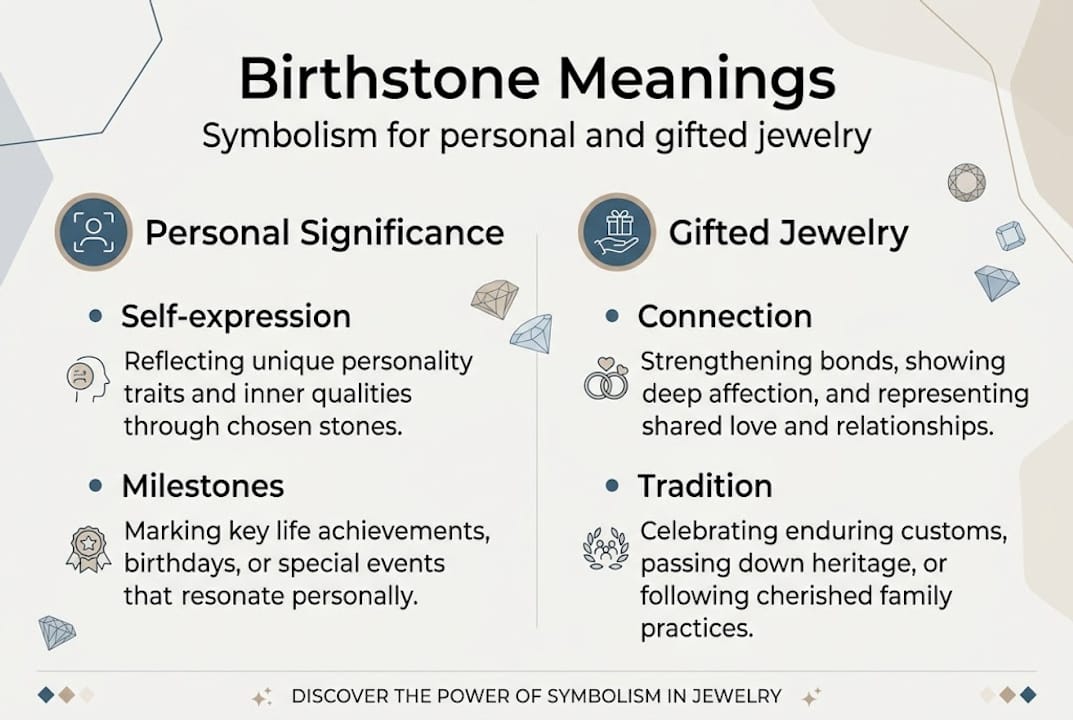
In a world flooded with fast fashion and disposable accessories, selecting a piece of jewelry because it represents something real about who you are or who you love is quietly radical. We see women layer their children’s birthstones not because garnet is objectively more beautiful than ruby, but because the combination tells their story. That is something no trend can manufacture.
What most people miss is that the process of researching, selecting, and gifting a birthstone piece is itself an act of care. It says you paid attention. You thought about what this person means to you and chose something that reflects that thought.
The right birthstone piece is more than a pretty trend. It’s a wearable reflection of milestones, connections, and hopes.
Personal storytelling through jewelry is one of the strongest style movements happening right now, and birthstones are at the center of it. If you want to build a collection that actually means something, start with making layered stacks meaningful rather than chasing whatever is trending this season.
Find your perfect birthstone jewelry
Ready to choose or give meaningful jewelry? At Malibu Vibes Jewelry, every piece is handcrafted in Los Angeles with the kind of attention to detail that makes a birthstone gift feel truly special.

Browse our collection of gold gemstone rings to find the stone and setting that matches your birth month or the meaning you want to carry. Looking for something to layer or gift? Our birthstone necklaces offer elegant options in 14k gold and sterling silver, perfect for stacking or wearing solo. Whether you are building your own story or honoring someone else’s, we have the pieces to make it wearable and lasting.
Frequently asked questions
What is the historical origin of birthstones?
Birthstones trace back to the 12 stones in Aaron’s biblical breastplate, later connected to the 12 months of the year and astrological traditions across multiple cultures.
Do birthstone meanings have scientific proof or are they symbolic?
Birthstone meanings are entirely symbolic, not scientifically proven. As meaning is symbolic, their value comes from centuries of tradition and the personal significance people attach to them.
Can I choose a birthstone that’s not my birth month?
Absolutely. Modern lists offer alternatives for style, affordability, and personal appeal, and many people choose stones based on meaning, color preference, or family tradition rather than birth month alone.
Which birthstones are considered best for gifting?
It depends on the message you want to send. Meanings by month guide gifting choices: garnet for protection, amethyst for calm, emerald for love, and ruby for passion are consistently popular options.
What’s the difference between modern and traditional birthstones?
Modern birthstones were selected in 1912 for durability and jewelry suitability, while traditional and modern lists reflect differing historical, cultural, and regional preferences that developed over centuries.