

TL;DR:
- True custom jewelry is a collaborative, human-led process that reflects your personal story and vision.
- The design journey involves multiple stages, from consultation and sketching to modeling and finishing.
- Using the right tools and clear communication ensures a meaningful, personalized jewelry creation.
Most people assume custom jewelry means choosing a birthstone or engraving a name on a pendant. The truth is far richer than that. True custom jewelry design is a deeply collaborative process that merges your personal story with a skilled jeweler’s technical mastery, resulting in a one-of-a-kind object that no algorithm could generate for you. This guide walks you through every stage of the process, from your first spark of inspiration to holding a finished piece in your hands, so you can move forward with confidence and clarity.
Table of Contents
- What custom jewelry design really means
- From concept to creation: The custom design process
- Artisanship and technology: Tools of the trade
- How to design your dream piece: Practical tips for collaboration
- What most guides won’t tell you about custom jewelry design
- Work with master jewelers to bring your vision to life
- Frequently asked questions
Key Takeaways
| Point | Details |
|---|---|
| Bespoke means personal | Authentic custom jewelry is guided by your story and crafted by skilled artisans. |
| Collaboration is key | Sharing inspiration and feedback with your jeweler ensures a truly personalized piece. |
| Tradition meets technology | Both time-honored skills and modern tools shape luxury custom designs. |
| Know your process | Understanding each production step helps you get the most from your custom experience. |
What custom jewelry design really means
Custom jewelry design is not the same as selecting options on a configurator website. When you truly go custom, you are inviting a craftsperson into your world, sharing memories, aesthetics, and intentions, and watching them translate all of that into metal and stone. The result is something that could not exist without you specifically.
Here is where a lot of confusion creeps in. Many brands label products as “personalized” when they simply allow you to pick a font for an engraving or swap one metal for another. That is automation, not bespoke craftsmanship. As true bespoke remains a human-led discipline, the defining quality is that a skilled jeweler interprets your vision using real insight and traditional skills, not a dropdown menu.
The emotional case for going custom is equally strong. Maybe you want a ring that incorporates your grandmother’s sapphire into a modern setting. Maybe you need a necklace that reflects a city, a year, or a relationship. Mass-market pieces, even beautiful ones, are designed for everyone. A truly custom piece is designed for no one else but you. That distinction carries weight every single time you put it on.
What separates custom from personalized jewelry:
- Custom: Designed from scratch based on your story and vision
- Personalized: Standard design with a name, date, or stone swap
- Bespoke: The most involved form, where every element is original
- Semi-custom: Existing design modified with your chosen details
“The moment a jeweler stops asking questions and starts presenting cookie-cutter options, the work is no longer truly bespoke. Bespoke begins with listening.”
If you want to understand more about what separates these categories, our full breakdown on what is custom jewelry is a great starting point.
From concept to creation: The custom design process
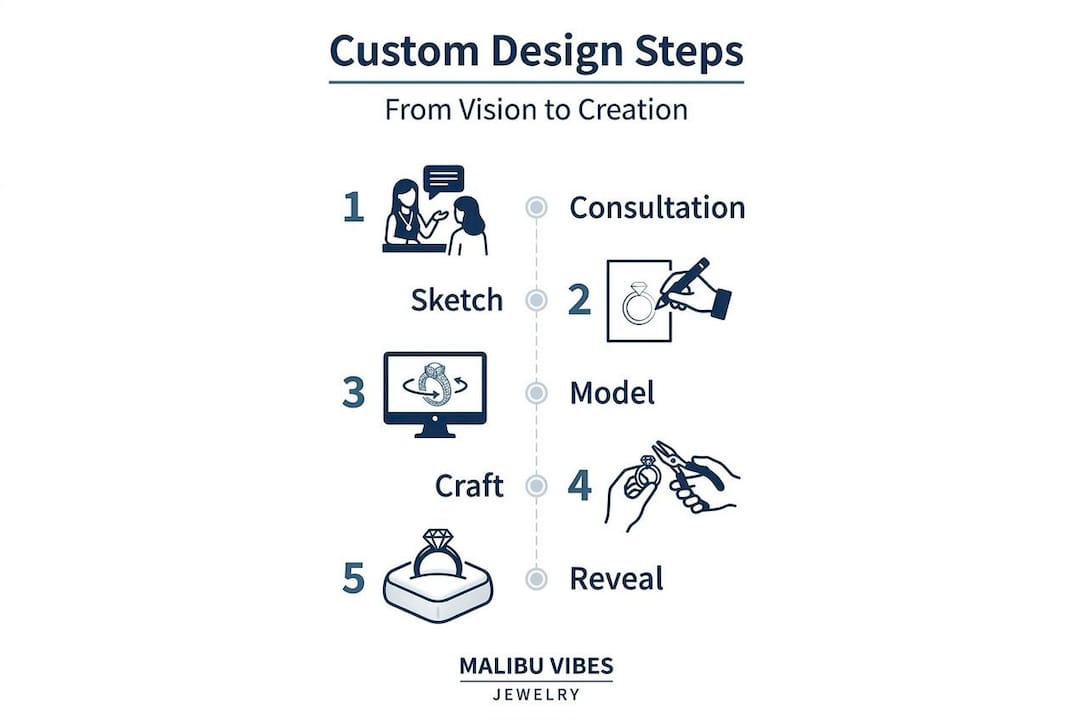
The custom jewelry journey follows a logical sequence, but it rarely feels mechanical. Each phase builds on the last, and good communication between you and your jeweler keeps everything aligned.
The key stages of a custom jewelry project:
- Initial consultation: You share your ideas, inspiration images, occasion, and budget. The jeweler listens and asks targeted questions about your lifestyle, preferences, and timeline.
- Concept sketching: Hand-drawn or digital sketches are produced to capture the general direction. Multiple options may be presented, giving you the chance to react and redirect.
- Design refinement: Based on your feedback, the sketches evolve into more detailed renderings. Dimensions, stone sizes, and proportions get pinned down at this stage.
- Modeling: Either a wax model is hand-carved or a 3D digital model is created using CAD (computer-aided design) software. You can often hold or view the model before any metal is committed.
- Casting: Using lost-wax investment casting, the wax model becomes the template for a metal mold. Molten precious metal is poured in, allowed to cool, and then the piece is removed.
- Setting and finishing: Gemstones are hand-set into the cast piece. The jeweler then polishes, textures, and finishes the surface to its final appearance.
- Quality review and delivery: The finished piece is inspected for structural integrity, stone security, and surface quality before being presented to you.
| Stage | What happens | Your role |
|---|---|---|
| Consultation | Share vision and budget | Communicate clearly |
| Sketching | Initial concepts drawn | Give honest feedback |
| Modeling | Wax or 3D model made | Approve or request changes |
| Casting | Metal piece formed | Wait and trust the process |
| Setting | Stones placed by hand | Confirm stone choices |
| Finishing | Polish and final detailing | Final approval |
| Delivery | Inspection and handoff | Enjoy your piece |
Pro Tip: Bring reference images to your consultation even if they are not jewelry at all. Architecture, fabric patterns, and nature photographs can communicate aesthetic direction more clearly than words alone.
Our fine jewelry making process page goes deeper into how each stage is handled with care. You can also explore the detailed custom jewelry design process overview for more phase-by-phase detail.
Understanding the journey helps make the process feel less mysterious. Now let’s look closer at the craftsmanship and tools behind each step.
Artisanship and technology: Tools of the trade
The best custom jewelry today sits at the intersection of centuries-old techniques and powerful new technology. Neither replaces the other. Together, they produce results that neither could achieve alone.
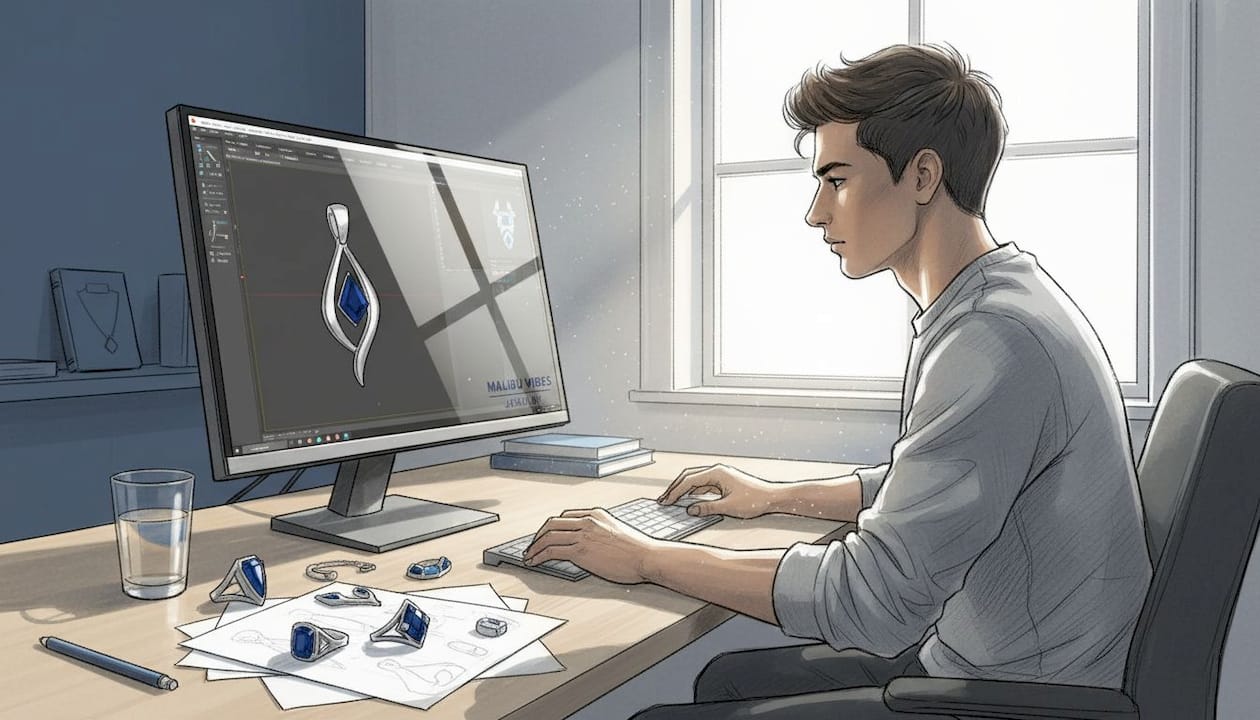
Hand sketching remains an essential first step because it allows a jeweler to think on paper in real time with you present. There is something irreplaceable about watching a professional translate your spoken words into a visual shape within minutes. Adjustments happen fluidly. The conversation guides the pencil.
CAD software entered the jewelry world and changed everything about precision. Three-dimensional modeling allows jewelers to show you exact proportions, stone placement, and structural details before a single gram of metal is committed. Clients can rotate a digital model on screen, view it from every angle, and request specific tweaks with confidence. This technology reduces costly errors and improves the fit between concept and reality.
| Tool | Strength | Limitation |
|---|---|---|
| Hand sketching | Speed, expression, real-time dialogue | Less precise for dimensions |
| CAD modeling | Precision, rotatable 3D views | Requires technical expertise |
| Wax carving | Tactile client preview | Time-intensive to revise |
| AI-generated imagery | Fast visual mood setting | Limited to pattern recognition |
Now, about AI. Artificial intelligence tools can produce stunning jewelry concept images from text prompts. They are useful for early mood-boarding and sparking ideas. But AI-generated concept images raise real questions about what bespoke means if ideas are produced from prompts rather than individualized human understanding of your story. An AI image has no memory of your grandmother’s ring, no awareness of your skin tone, and no sense of why this piece matters to you at 2 a.m. on a Tuesday. A skilled jeweler does.
Pro Tip: Ask your jeweler what software they use and whether you can see your piece in 3D before the model is built. This step alone can save you weeks of revision time.
Emerging custom jewelry trends show that clients increasingly want to be involved in every digital and physical stage of the process. Understanding how handcrafted jewelry is made gives you context for why certain steps take longer than others, and why that time is worth it. Social media has also changed how people discover design inspiration, and the impact of social media on jewelry trends is worth understanding before your consultation.
With an understanding of the interplay between technology and expertise, it is time to lay out how you can work with an expert to bring your vision to life.
How to design your dream piece: Practical tips for collaboration
Even the most talented jeweler needs your input to create something truly personal. The quality of your collaboration directly shapes the quality of the final piece. Here is how to show up prepared and communicate effectively throughout the process.
Gathering inspiration:
- Save jewelry images you love, even if you cannot explain why
- Collect images of colors, textures, and shapes from any source
- Note the pieces you already own and wear most often
- Identify which occasions you plan to wear this piece for
- Think about longevity: classic or statement design?
Communicating with your jeweler:
Be specific about what you do not like, not just what you love. Telling your jeweler “I hate anything too delicate” is as useful as showing them your favorite bold rings. Give feedback at every stage rather than waiting until the end. Silence mid-process often leads to surprises at delivery.
Ask key questions before you commit:
- What is your timeline for this project?
- Do you offer a wax or 3D model preview before casting?
- What happens if I am not satisfied with the final piece?
- How do you source your stones and metals?
- Can I see examples of previous custom work?
Common pitfalls to avoid:
One of the biggest mistakes is rushing the consultation phase. The more you share upfront, the fewer expensive revisions happen later. Another common error is choosing a jeweler based solely on price. Custom work requires expertise, and undercutting that expertise produces disappointing results.
As insight and interpretation define true bespoke processes, the jeweler needs room to exercise professional judgment. Micromanaging every millimeter can actually limit the artistry you are paying for. Trust is part of the transaction.
Whether you are designing something to express yourself with fine jewelry or building a curated everyday look, knowing how to layer and combine pieces also helps. Our jewelry stack guide is a useful companion resource as you think about how your custom piece fits into what you already own.
What most guides won’t tell you about custom jewelry design
Here is the uncomfortable truth that the industry rarely says out loud: the word “bespoke” has become a marketing shortcut. Brands attach it to products that involve almost no individualized human thought. A ring built from a configurator with swappable gemstone colors is not bespoke. It is a product with options.
Real bespoke work shows up in the questions a jeweler asks before they show you anything. If your first meeting involves a catalog, be skeptical. Genuine human-led design begins with curiosity about you, not a presentation of inventory.
We also think the digital tools conversation is more nuanced than most articles admit. CAD and 3D modeling genuinely improve precision and reduce waste. They are not enemies of craftsmanship. The issue arises when technology is used to skip the relational, interpretive work that makes a piece personal. A perfectly rendered 3D model of something generic is still generic.
True bespoke jewelry remains a human-led discipline precisely because it requires someone to hold your story in mind through every technical decision. The weight of the prongs, the depth of the setting, the finish on the band — each choice should reflect something specific about the person who will wear this piece forever.
Signs you are working with a genuinely skilled, human-led jeweler: they push back thoughtfully on ideas that would not translate well, they offer alternatives you had not considered, and they remember details from your first conversation weeks later. These are signals that your piece is in the right hands. Our deeper look at handcrafted jewelry artistry explains why that level of attention is both rare and worth seeking out.
Work with master jewelers to bring your vision to life
At Malibu Vibes Jewelry, custom design is not a side offering. It is central to everything we do. Our Los Angeles-based team combines traditional craftsmanship with modern tools to turn your vision into a finished piece that feels unmistakably personal.

You can explore our complete Malibu Vibes Jewelry process to understand exactly how we move from concept to creation. If you are not ready to start from scratch, our curated collections offer stunning starting points. Browse our color gemstone necklaces for bold, ready-to-gift options, or explore our gemstone rings collection for 14k pieces that celebrate color and character. Whether you want something designed entirely for you or a handcrafted piece ready to wear today, we are here to help you find it.
Frequently asked questions
How long does custom jewelry design take from start to finish?
A custom piece typically takes 4 to 10 weeks depending on design complexity, revision rounds, and your communication speed with the jeweler. More intricate designs with multiple stones or unusual shapes tend to run toward the longer end of that range.
What is lost-wax casting in jewelry making?
Lost-wax casting involves sculpting a model in wax, encasing it in a heat-resistant mold, melting the wax out, and then pouring molten metal into the resulting cavity to form the final piece. This core fabrication methodology is widely used in fine jewelry production because it captures fine detail with exceptional accuracy.
Is true bespoke jewelry always human-made?
Technology like CAD and 3D printing plays a real role in modern bespoke jewelry, but true bespoke remains a human-led discipline where the jeweler’s interpretation and skill guide every decision. The tools support the craftsperson rather than replacing them.
Can I use AI-generated designs for my custom jewelry?
AI images can serve as useful mood-board starting points, but AI-generated concept images carry limitations when it comes to true personalization, since they are produced from prompts rather than deep understanding of your individual story. A skilled jeweler bridges that gap.
What should I prepare before a custom design consultation?
Gather at least five to ten inspiration images from any source, not just jewelry, and think about the metals and stone colors you already wear most often. Clarify the occasion, your lifestyle, and your budget range so your jeweler can guide the conversation toward realistic and beautiful options from the very start.