

TL;DR:
- True handcrafted jewelry involves skilled artisans working on every stage from design to polish.
- The process emphasizes unique craftsmanship, material quality, and careful stone setting, ensuring durability and exclusivity.
- Handcrafted pieces are costlier but offer lasting value, emotional connection, and the ability to customize.
Most people picture handcrafted jewelry as something a person simply assembles at a workbench, snapping parts together. The reality is far more intricate. Every luxury handcrafted piece moves through a series of demanding stages, each requiring a different set of skills, tools, and years of practiced technique. From the first pencil sketch to the final mirror polish, the process is closer to fine art than simple assembly. If you’ve ever wondered what separates a truly handcrafted piece from something mass-produced, this guide will walk you through every stage and show you exactly why the difference matters.
Table of Contents
- What does ‘handcrafted jewelry’ really mean?
- Materials and techniques: The foundation of craftsmanship
- The step-by-step process of making handcrafted jewelry
- Why handmade jewelry costs more and why it’s worth it
- Our perspective: Authentic luxury, meaningful artistry, and what women really value
- Ready to experience handcrafted luxury?
- Frequently asked questions
Key Takeaways
| Point | Details |
|---|---|
| True craftsmanship | Handcrafted jewelry involves meticulous skill and artistry at every stage, not just assembly. |
| Material and technique matter | Premium materials and time-honored techniques are the foundation of high-value pieces. |
| Real-world costs | Labor, defect rates, and stone setting add substantial value—why luxury jewelry is priced higher. |
| Emotional investment | Handcrafted pieces offer unique meaning, personal expression, and enduring heirloom potential. |
What does ‘handcrafted jewelry’ really mean?
The word “handcrafted” gets used loosely in the jewelry world, and that’s a problem. A ring stamped “handmade” at a big-box retailer might have been touched by human hands only during packaging. True handcrafted jewelry is something else entirely.
Jewelry craftsmanship refers to a process where skilled artisans are involved at every meaningful stage, from the initial concept sketch to the final polish. As one complete overview notes, handcrafted jewelry involves stages from initial sketch to final polish, each handled manually. That’s a significant distinction from pieces where machines do the heavy lifting and humans only supervise.
Here’s how the three main categories break down:
- Handcrafted: Every core stage, design, forming, setting, and finishing, is done by a skilled artisan using hand tools or closely guided equipment.
- Hand-assembled: Components are manufactured by machines and then put together by a person. The human role is minimal.
- Mass-produced: Machines handle design replication, casting, setting, and finishing with little to no skilled human input.
The difference isn’t just philosophical. It shows up in the weight of the metal, the precision of a stone’s seat, the smoothness of a solder joint, and the overall personality of the piece. No two truly handcrafted pieces are identical, even when made from the same design.
True artisan jewelry carries the maker’s decisions in every curve and surface. An artisan chooses how to angle a prong, how much texture to leave on a band, how to balance visual weight across a design. Machines don’t make those choices.
“The mark of true luxury craftsmanship isn’t perfection in the mechanical sense. It’s the evidence of a skilled human mind solving aesthetic problems by hand, at every stage of creation.”
That’s what you’re paying for when you invest in a genuinely handcrafted piece. Not just materials. Not just a brand name. The accumulated skill and judgment of an artisan who cared about every detail.
Materials and techniques: The foundation of craftsmanship
Understanding what makes jewelry truly handcrafted invites a closer look at the materials and foundational techniques that define these pieces.
The most common materials in fine handcrafted jewelry include 14k and 18k gold, sterling silver, platinum, and a wide range of gemstones from diamonds to sapphires to emeralds. But choosing a material is only the beginning. Before any shaping begins, artisans often prepare custom alloys, blending metals to achieve a specific color, hardness, or workability. Rose gold, for example, gets its warm tone from a precise copper ratio in the alloy.
Core techniques used in handcrafted jewelry include:
- Forging: Shaping metal by hammering it, which compresses the grain structure and creates exceptional strength.
- Casting: Pouring molten metal into a mold, often made from a wax model. Requires careful temperature control and finishing work afterward.
- Soldering: Joining metal components using a filler metal heated to its melting point. Precision here prevents weak joints or visible seams.
- Stone setting: Securing gemstones into the metal using prongs, bezels, or pavé techniques. Each method requires different tools and skill levels.
When it comes to valuing jewelry materials, technique matters as much as the raw material itself. A poorly set diamond in a platinum ring is worth less, both aesthetically and structurally, than a well-set stone in 14k gold. According to research on production costs, traditional methods are slower than casting but both require highly skilled hands to produce quality results.
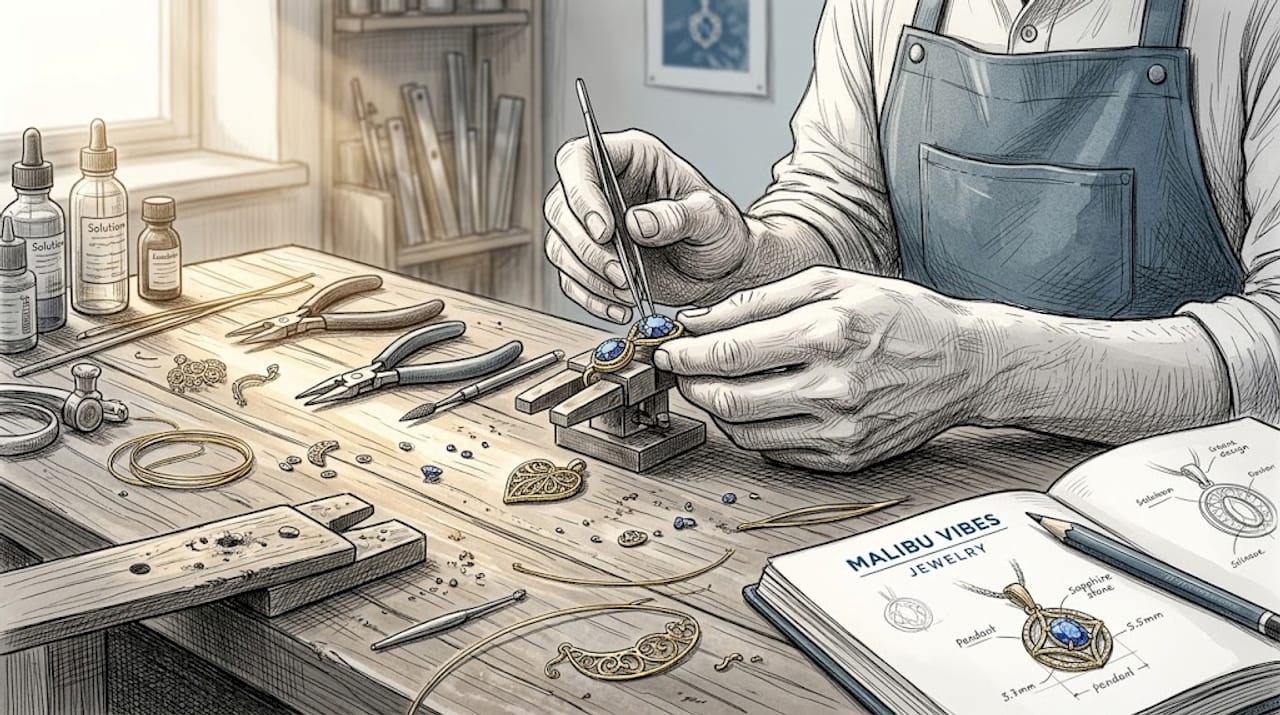
If you’re newer to shopping for fine pieces, the beginner’s guide to fine jewelry is a great starting point for understanding what to look for.
Pro Tip: When evaluating a handcrafted piece, look closely at the inside of a ring band or the back of a pendant. Clean, even solder lines and smooth metal surfaces signal skilled finishing. Rough edges or uneven surfaces are red flags.
The step-by-step process of making handcrafted jewelry
Having explored the core materials and techniques, it’s time to follow a handcrafted jewel through each step of its creation.
- Sketch and design: The artisan begins with hand-drawn or digital sketches, translating a concept into precise measurements and proportions. This stage defines everything that follows.
- Model making: A wax model or digital prototype is created. Wax carving is a traditional skill that lets the artisan feel the form in three dimensions before committing to metal.
- Casting or forging: The wax model is used to create a mold, and molten metal is poured in. For forged pieces, the artisan shapes metal directly through hammering and heat.
- Assembly and soldering: Individual components, prongs, shanks, settings, are joined together with careful soldering. Each joint must be clean and strong.
- Stone setting: Gemstones are placed and secured by hand. This is the most risk-intensive stage of the entire process.
- Polishing and quality review: The piece is polished to its final finish, then inspected under magnification for any flaws before it leaves the bench.
Pro Tip: Stone setting is where most damage happens during the creation process. A skilled setter uses specialized tools to push or bend metal precisely around each stone without cracking it. Never attempt to re-set a stone at home.
The jewelry making process at quality studios often includes multiple quality checks between stages, not just at the end. This is part of what drives time and cost. Research shows that labor for a handcrafted ring typically ranges from $300 to over $1,000, with additional costs for stone setting and finishing.
| Step | Typical time | Labor cost range |
|---|---|---|
| Design and sketch | 1 to 3 days | Included in quote |
| Wax model | 1 to 5 days | $50 to $200 |
| Casting or forging | 1 to 2 days | $100 to $300 |
| Assembly and soldering | 1 to 3 days | $75 to $200 |
| Stone setting | 1 to 4 days | $25 to $150 per stone |
| Polish and QC | 1 to 2 days | $50 to $150 |
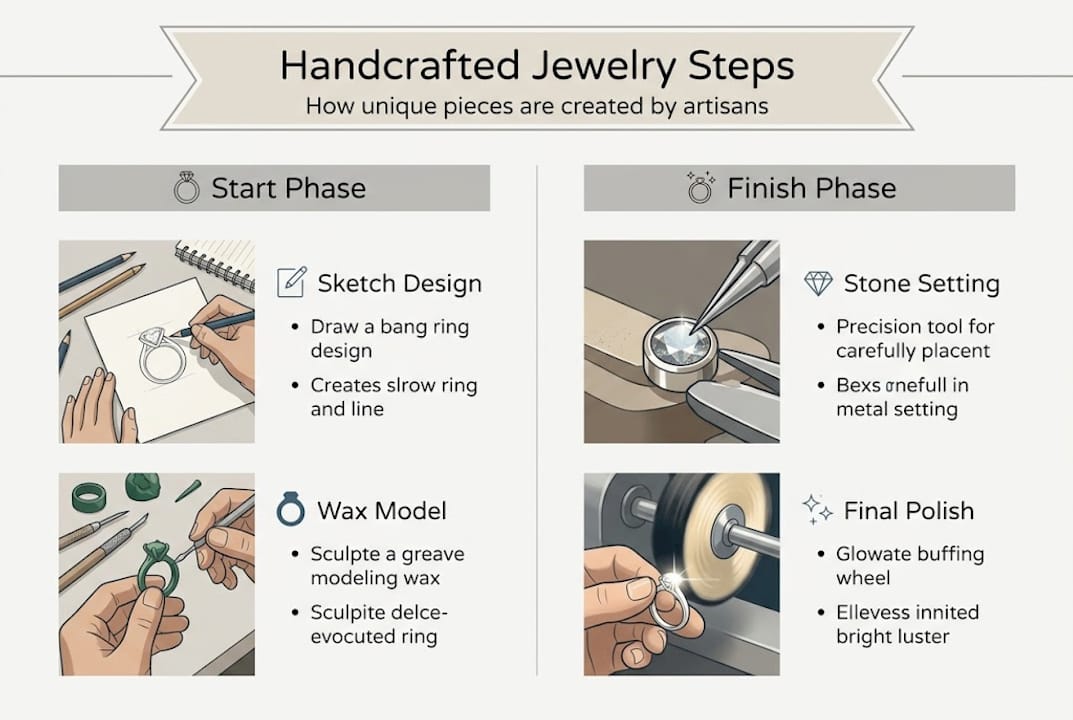
For anyone considering a one-of-a-kind piece, exploring the custom design process gives you a realistic picture of what to expect at each stage.
Why handmade jewelry costs more and why it’s worth it
After seeing the intricate process behind handcrafted jewelry, it’s clear that pricing is about more than just materials.
The cost drivers in handcrafted jewelry are real and significant. Handcrafted labor can run $300 to $1,000 or more per ring, casting defect and scrap rates sit between 5 and 15 percent, and stone setting adds $25 to $150 per stone depending on complexity. These aren’t markups. They’re the actual cost of skilled human work.
What you’re actually getting with a handcrafted piece:
- Tangible value: Premium metals, ethically sourced stones, structural integrity built to last decades
- Exclusivity: No two pieces are identical, even from the same design
- Repairability: Handcrafted pieces can be resized, re-set, and restored by skilled jewelers
- Heirloom quality: Built to be passed down, not replaced
- Intangible value: The story, the artistry, the connection to a maker’s craft
| Feature | Handcrafted | Mass-produced |
|---|---|---|
| Uniqueness | Every piece differs | Identical copies |
| Durability | High, built to last | Moderate, may wear quickly |
| Repairability | Excellent | Limited |
| Price | Higher upfront | Lower upfront |
| Resale value | Holds or appreciates | Depreciates quickly |
| Emotional value | Strong, story-driven | Minimal |
Understanding how jewelry is valued goes beyond the price tag. A handcrafted ring purchased today may be worth more in ten years, both financially and sentimentally, than a mass-produced piece ever could be. If you’re thinking about updating your collection, investing in fewer, better pieces is almost always the smarter long-term move.
Our perspective: Authentic luxury, meaningful artistry, and what women really value
Here’s something the standard jewelry guides rarely say: the most valuable thing about a handcrafted piece isn’t the gold or the diamonds. It’s the decision-making embedded in it.
Every curve, every prong angle, every surface texture reflects a choice made by a human being who cared about the outcome. That’s not something a machine can replicate, no matter how advanced it becomes. And that’s what makes handcrafted jewelry feel different when you wear it. It carries a presence that mass-produced pieces simply don’t have.
We also think the conversation around custom jewelry trends is shifting in an important direction. More women are moving away from logo-driven luxury and toward pieces that reflect their own identity. A handcrafted ring doesn’t need a brand stamp to communicate value. The quality speaks for itself.
The future of luxury isn’t about who made the most pieces. It’s about who made the most meaningful ones. Provenance, story, and artistry are becoming the new status markers, and handcrafted jewelry sits exactly at that intersection.
Ready to experience handcrafted luxury?
If this guide has sparked your appreciation for true handcrafted jewelry, see it in action and bring a piece of artistry into your life.

At Malibu Vibes Jewelry, every piece reflects the same commitment to craftsmanship you’ve read about here. Our Los Angeles-based artisans work with 14k gold, sterling silver, and carefully selected diamonds and gemstones to create pieces built for real life and real longevity. You can learn more about our jewelry process to see how each piece comes to life. Browse our diamond jewelry collection for timeless investment pieces, or explore our sterling silver pieces for everyday luxury that doesn’t compromise on quality. Your next favorite piece is waiting.
Frequently asked questions
How long does it take to handcraft a piece of fine jewelry?
Depending on the complexity of the design, a single piece can take anywhere from several days to several weeks to complete, covering design, casting, setting, and polishing. Time requirements vary widely based on the number of stones and the intricacy of the metalwork.
Why is handcrafted jewelry more expensive than machine-made pieces?
Handcrafted jewelry requires expert labor at every stage, with labor costs ranging from $300 to over $1,000 per ring, plus higher material standards and skilled stone setting that machines simply can’t replicate.
What makes a piece of jewelry truly ‘handcrafted’?
A truly handcrafted piece is one where skilled artisans are involved at every core stage of production, not just assembly. As a complete overview confirms, handcrafted means hands-on work from design through final finishing, not just a human touch at the end.
Can I customize my own handcrafted jewelry piece?
Absolutely. Many jewelers, including Malibu Vibes Jewelry, offer full customization so you can choose your metal, gemstones, engraving, and design details. The custom jewelry design process walks you through exactly how to bring your vision to life.