

TL;DR:
- Most Americans now buy fine jewelry for themselves, reflecting a shift toward personal style and intention. True designer jewelry is engineered for durability, comfort, and daily wear, setting it apart from mass-market pieces. Ethical sourcing, emotional utility, and functional design are now essential factors defining genuine luxury.
Fine jewelry used to come in a velvet box, delivered by someone else. That story is officially over. 80% of Americans now buy fine jewelry for themselves, flipping the script on who designer pieces are actually for. The modern woman isn’t waiting for a proposal or a milestone birthday to invest in something beautiful. She’s building a jewelry wardrobe the same way she builds her wardrobe in general: with intention, with taste, and with an eye for pieces that work as hard as she does. This article breaks down exactly what designer jewelry does for you, every single day.
Table of Contents
- What truly sets designer jewelry apart?
- Designer jewelry as personal expression and emotional utility
- Everyday luxury: comfort, materials, and versatility
- Sustainability and ethical responsibility in designer jewelry
- Why practical elegance—and not just price tag—defines real designer jewelry
- Where to find designer jewelry crafted for you
- Frequently asked questions
Key Takeaways
| Point | Details |
|---|---|
| Quality by design | True designer jewelry delivers both lasting beauty and daily comfort through fine materials and secure craftsmanship. |
| Self-expression | Wearing designer pieces is a powerful way to express your identity and celebrate key life moments. |
| Everyday luxury | Modern designs blend high-impact style with practical wearability for day-to-night versatility. |
| Sustainability matters | Today’s buyers value ethical sourcing and transparent practices alongside aesthetics. |
| Accessible elegance | You don’t have to sacrifice quality or story for value—affordable luxury is possible with the right designer. |
What truly sets designer jewelry apart?
There’s a common assumption that designer jewelry is just regular jewelry with a bigger price tag. Not true. The difference lives in the details that most people never think to look for until a clasp breaks, a stone falls out, or a ring digs into a finger after an hour.
True designer jewelry is engineered, not just designed. According to Timeless by Design, the core role of high-end jewelry is to convert aesthetic intent into durable, functional construction. That means every decorative choice has a structural counterpart: the curve of a band that distributes pressure evenly, the depth of a prong that holds a stone without snagging fabric, the polished interior of a ring that keeps skin comfortable over long wear.
“Designer jewelry is made for repeat wear, not just for display. The best pieces feel like nothing on your wrist, yet somehow change everything about the way an outfit lands.”
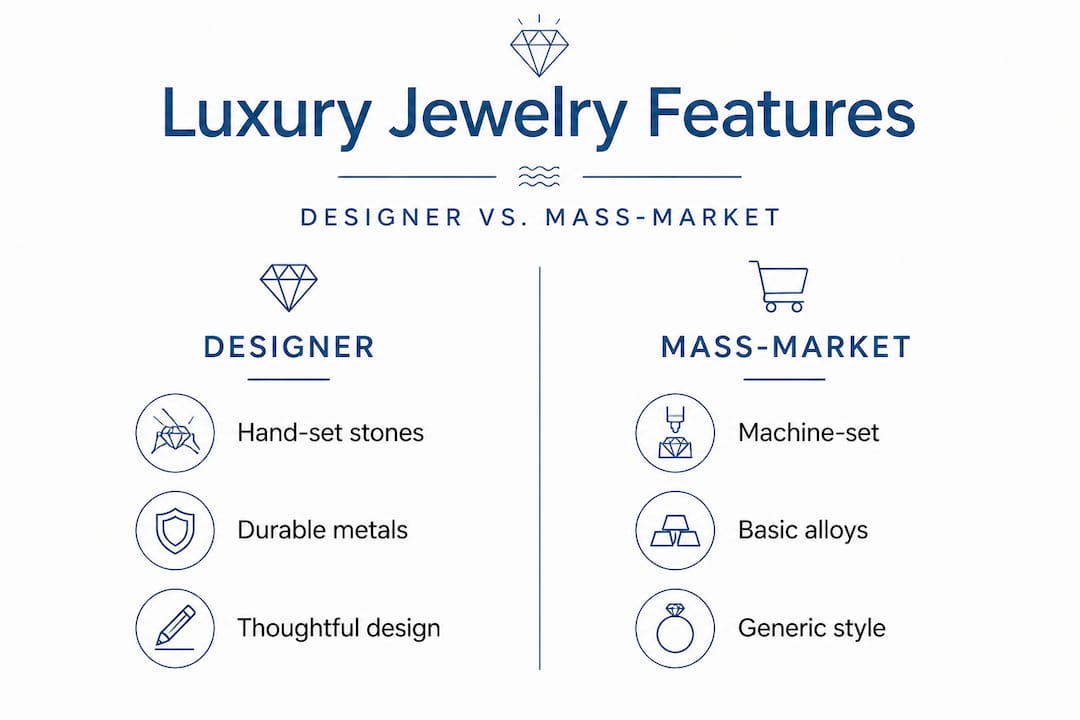
What makes a designer piece actually worth your investment? Here’s what separates it from mass-market alternatives:
- Precision stone setting: Stones are measured and placed individually, not pressed into generic molds
- Hand-finished surfaces: Edges are smoothed to remove micro-burrs that irritate skin
- Proportional design: Scale is calibrated to the human body, not just to look good on a flat product image
- Weight distribution: A well-made necklace hangs without twisting; a well-made ring sits flat without rotating
- Material integrity: Solid 14k gold vs. gold-plated or vermeil involves real differences in durability and longevity
| Feature | Designer jewelry | Mass-market jewelry |
|---|---|---|
| Stone setting | Hand-set, individually checked | Machine-pressed, batch process |
| Metal finish | Hand-polished inside and out | Surface-polished only |
| Clasp quality | Tested and reinforced | Standard production clasp |
| Comfort engineering | Built to the wrist/finger shape | One-size approach |
| Longevity expectation | Decades with proper care | 1 to 3 years typical |
Understanding what makes jewelry luxury goes beyond the price point. It’s about whether a piece was made to live with you or simply to be admired in a store window.
Pro Tip: Before buying any fine piece, run the back of your fingernail along the interior of a ring or the back of a pendant. If you feel roughness or edges, that’s a sign the finishing work was skipped. A truly well-crafted piece should feel silky smooth against your skin.
For deeper guidance on building a daily jewelry routine around these principles, everyday jewelry essentials is a great place to start.
Designer jewelry as personal expression and emotional utility
Now that we’ve established what separates real designer jewelry from the rest, the next question is why it matters beyond the physical. The answer is that great jewelry does something no handbag or shoe can fully replicate: it sits directly on your skin, travels everywhere with you, and quietly says something about who you are before you speak a single word.
Designers and industry insiders have begun using the phrase “emotional utility” to describe this function. As explored in this jewelry design feature, a well-made piece functions as an extension of identity and memory, not just a decorative object. Think about the necklace you reach for before every important meeting, or the ring you wore on the day something changed for you. That’s emotional utility at work.
The trend is real and growing. As noted earlier, fine jewelry is no longer mainly gift-driven; the majority of buyers are motivated by personal style and milestone meaning. Women are curating collections that reflect their evolving identity, not waiting for someone else to define what they should wear.
Self-expression in jewelry is increasingly a driving force in purchase decisions. Here are a few ways women are making designer pieces deeply personal:
- Initial or letter pendants: Worn close to the chest, often layered with other pieces
- Birthstone rings: Chosen to reflect personal history, not just birth month
- Symbolic motifs: Stars, moons, waves, and botanical forms that carry private meaning
- Stack rings: Built over time, one ring per chapter, creating a wearable timeline
- Heirloom-forward choices: Buying pieces with the explicit intention of passing them down
“Your jewelry collection should feel like a visual autobiography. Every piece a sentence, the full set a story.”
If you want a full breakdown of how to use fine jewelry as a vehicle for identity, express yourself with fine jewelry offers a detailed guide. And if you’ve ever wondered whether fine jewelry is worth the emotional and financial investment, why buy fine jewelry makes a compelling case.
Pro Tip: When building a personal jewelry collection, start with one anchor piece that represents your core aesthetic. Everything else should be able to orbit around it without competing. This approach makes getting dressed faster and makes your style more cohesive over time.
Everyday luxury: comfort, materials, and versatility
Personal meaning matters deeply, but jewelry also has to actually work in your daily life. This is where a lot of buyers get tripped up: they fall for a beautiful piece in a product photo and don’t think about how it will feel by 3 p.m. on a Tuesday or whether it will survive a yoga class.
Modern designer jewelry is increasingly built to bridge the gap. As covered in this feature on silk cord jewelry, fashion-forward luxury designers are now combining high-value materials with casual everyday formats, creating pieces that feel equally appropriate at brunch and at a dinner reservation. The standard is no longer “special occasion only.”

The biggest factor in everyday wearability? Setting choice. And according to GIA’s guidance on diamond selection, setting selection is fundamentally an engineering problem. It affects how a stone is secured, how likely it is to snag on fabric, and how much maintenance it will need over time.
| Setting type | Security | Snag risk | Maintenance level | Best use case |
|---|---|---|---|---|
| Prong | High | Medium | Moderate (prongs bend) | Rings, statement pendants |
| Bezel | Very high | Very low | Low | Everyday rings and bracelets |
| Pavé | Medium | Higher | Higher (small prongs) | Accent details, occasional wear |
| Channel | High | Low | Low | Bands, stacking rings |
Here are four ways to choose pieces that move easily from casual mornings to formal evenings:
- Choose bezel-set stones for active days. The stone is fully encased in metal, which protects it and eliminates the snag risk that plagues prong settings.
- Opt for smaller, more refined pieces as your daily base. A delicate 14k gold chain and simple stud earrings create a foundation that pairs with everything.
- Add statement pieces for occasions rather than replacing your base. This keeps your look adaptable without requiring full outfit-level planning.
- Invest in pieces with easy closures. Spring-ring clasps are standard; lobster clasps and toggle closures are more secure and easier to fasten solo.
For more guidance on building outfits around fine jewelry, styling fine jewelry everyday is worth reading. If you’re drawn to cleaner, less-is-more aesthetics, minimalist jewelry trends covers what’s resonating most right now.
Pro Tip: Most people don’t realize that long-term discomfort often comes from weight, not size. A small but heavy pendant can cause neck fatigue after a few hours. Ask about the gram weight of a necklace pendant before buying, especially if you plan to wear it daily.
For care tips that keep your pieces looking new for years, everyday jewelry care covers everything you need to know.
Sustainability and ethical responsibility in designer jewelry
Style and engineering matter, but in 2026, conscious consumers are adding a third question to every purchase: where did this come from, and was anyone harmed in the process?
Fine jewelry supply chains are notoriously complex. Gemstones pass through multiple countries and hands before they reach a finished piece. Metals are mined, refined, alloyed, and cast in different locations. This complexity creates real opportunities for harm, including conflict financing, environmental damage, and labor exploitation. As documented in the gems and jewellery industry, sustainability and ethical sourcing are now central to brand legitimacy, not optional extras.
Key statistic: A growing majority of fine jewelry buyers now ask about sourcing and want documented proof before completing a purchase. Responsible brands are responding with certifications, audited supply chains, and transparent origin documentation.
When evaluating a jewelry brand’s ethical standing, look for verifiable commitments across these areas:
- Conflict-free stone sourcing: The Kimberley Process is the minimum standard; ask for details beyond just compliance
- Responsible metal sourcing: Look for Fairmined or Fairtrade certified gold, which guarantees miner welfare and environmental standards
- No child labor policies: This should be written into supplier contracts, not just stated verbally
- Living wage guarantees: Especially important for polishing and handcraft workers
- Environmental impact reduction: Recycled metals, reduced water usage, and low-impact packaging are measurable indicators
- Third-party auditing: Self-reported ethics claims mean less than independently verified ones
Understanding ethical sourcing in jewelry helps you ask the right questions and recognize genuine accountability when you see it. For a broader view of how materials can be responsibly chosen from the ground up, sustainable practices in jewelry offers a detailed breakdown.
Pro Tip: When in doubt about a brand’s ethics, ask them directly in writing: “Can you tell me the origin of the gemstones and metal in this specific piece?” A confident, detailed answer is a good sign. A vague or defensive response tells you everything you need to know.
Why practical elegance—and not just price tag—defines real designer jewelry
Here’s a perspective most jewelry content won’t give you: the biggest myth in luxury jewelry is that the price tag is the point. It isn’t. The price is a byproduct of the actual point, which is that a piece was made to last, to feel good, to mean something, and to look as right in ten years as it does today.
We’ve seen this shift accelerate dramatically over the last few years. Younger buyers are not impressed by status alone. They want jewelry that tells a true story: where it was made, who made it, why the design decisions were what they were. Storytelling, emotional utility, and provable ethics are no longer bonus features. They’re baseline requirements.
The GIA design guidance makes a point that applies far beyond engagement rings: design cannot optimize only for sparkle. It must also reduce failure modes. Prongs that catch on clothing, loose stones that rattle, metals that fatigue under daily stress — these are design failures. The best pieces anticipate wear and engineer against it.
There’s also a compelling counterpoint to the idea that affordability and quality are always in conflict. As discussed in this feature on accessible luxury, meaningful luxury can be achieved through refined scale, material efficiency, and thoughtful proportion, without simply using cheaper components. A thinner band in solid 14k gold outperforms a thick band in gold-filled metal every time. Smart design is not a compromise.
“Real luxury jewelry doesn’t ask you to choose between beauty and practicality. The two are inseparable when the design is done right.”
What does this mean practically? It means when you’re evaluating a piece, key qualities of luxury jewelry are worth knowing cold. Ask not just “is this beautiful?” but “will it still be beautiful in five years of daily wear? Does the brand stand behind it? Can I trace where it came from?” These questions are not pedantic. They are the difference between a purchase you’ll love for decades and one you’ll quietly retire after a year.
Where to find designer jewelry crafted for you
Everything covered in this article — the craftsmanship, the personal meaning, the everyday wearability, the ethical accountability — is exactly what Malibu Vibes Jewelry was built around.
Handcrafted in Los Angeles using 14k gold, sterling silver, and carefully sourced diamonds and gemstones, every piece is designed to move with your life, not just sit in a drawer. Whether you’re looking for a signature everyday piece or something to mark a moment that matters, there’s a collection for that. Explore the diamond earrings collection for high-impact pieces that transition seamlessly from morning to evening, or browse sterling silver styles for designs that combine clean aesthetics with lasting durability. Want to see how the pieces are actually made? Our jewelry making process walks you through the craft behind every design.
Frequently asked questions
How can I tell if designer jewelry is truly high quality?
Look for comfort, secure stone settings, durable materials, and thoughtful design proportion — true quality means the piece was engineered for long-term wear, not just to photograph well.
What makes designer jewelry sustainable or ethical?
Genuine sustainability means a brand can document responsible sourcing, fair labor, and supply chain transparency — these standards are now considered baseline expectations for credible luxury brands.
Is designer jewelry practical for daily wear?
Yes, modern designer jewelry is intentionally built for both comfort and lifestyle flexibility, with setting choices and material selection matched to how the piece will actually be worn.
Why are more women buying designer jewelry for themselves?
Self-purchased fine jewelry gives women full control over their personal style and a lasting way to mark the moments that matter most on their own terms.
Recommended
- Your guide to everyday jewelry: style, essentials, and care – Malibu Vibes Jewelry
- How to style fine jewelry: everyday elegance made easy – Malibu Vibes Jewelry
- 7 Essential Fashion Jewelry Tips for Elegant Everyday Style – Malibu Vibes Jewelry
- How jewelry transforms your personal style: a complete guide – Malibu Vibes Jewelry
- Why Is Crystal Swarovski So Popular? – CrystalPlace