

TL;DR:
- The cut of a diamond significantly influences its sparkle and overall visual impact, often surpassing color and clarity. Popular cuts like round brilliant, princess, cushion, and emerald offer distinct styles, with each suited to different finger shapes and personal preferences. Choosing a high-quality cut and appropriate shape ensures lasting beauty and value in a diamond ring.
Different diamond cut rings are defined by their unique facet arrangements and geometric shapes, which directly control how much light a diamond captures, reflects, and returns to the eye. The cut is the single most powerful factor in a diamond’s visual impact, outranking color and clarity in most real-world viewing conditions. Whether you’re choosing types of diamond cuts for engagement rings or a special occasion piece, understanding the difference between round brilliant, princess, emerald, and specialty cuts will save you money and help you find a ring you’ll love for decades. This guide covers every major cut style, what each one does for your hand, and how to buy smart.
What are the most popular different diamond cut rings?
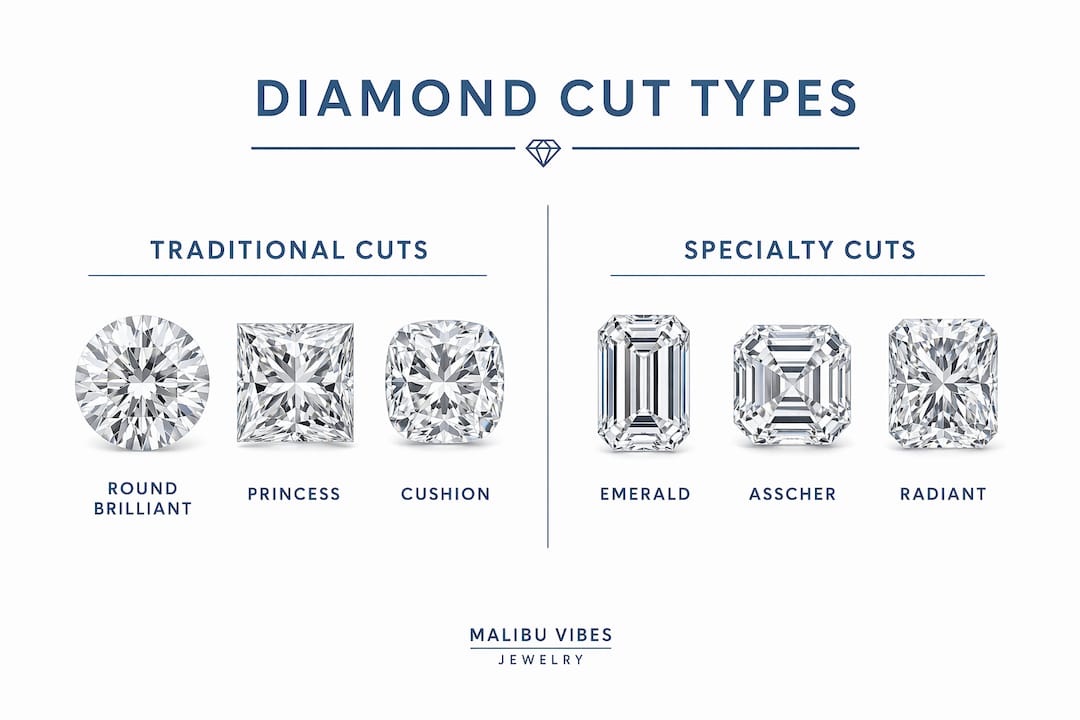
Round brilliant diamonds are the most popular worldwide and offer maximum brilliance due to their 58-facet arrangement. That facet count is engineered specifically to bounce light back through the top of the stone, producing the fiery sparkle most people picture when they think of a diamond ring. If you want the most light performance per dollar, round brilliant is the benchmark every other cut is measured against.
Princess cut is the second most requested shape in engagement rings. It features a square outline with pointed corners and a modified brilliant facet pattern underneath. The result is sharp, geometric, and modern. Princess cut rings suit buyers who want the brilliance of a round but prefer a contemporary square silhouette.
Cushion cut sits between round and square. Its soft, rounded corners give it a pillow-like outline that reads as romantic and vintage. Cushion cuts have surged in popularity over the past decade because they pair well with halo settings and carry a timeless quality that feels neither trendy nor dated.
Emerald cut is a step cut, meaning its facets run in parallel rows like a staircase rather than radiating from the center. This produces a quieter, more elegant sparkle often described as a “hall of mirrors” effect. Step-cut diamonds like emerald and Asscher provide an elegant and understated sparkle, which makes them the go-to choice for sophisticated, classic styles.
Here is a quick reference for the four most popular cuts:
- Round Brilliant: Maximum sparkle, universally flattering, commands the highest price
- Princess: Square shape, brilliant facets, modern and geometric
- Cushion: Soft corners, vintage appeal, works beautifully in halo settings
- Emerald: Step facets, understated elegance, requires higher clarity grades
Pro Tip: If you are drawn to the emerald cut, buy a stone graded VS1 or higher in clarity. Step-cut facets act like windows into the diamond, making inclusions far more visible than they would be in a brilliant cut.
How do specialty and modern diamond cuts differ from traditional cuts?
Specialty cuts fall into two broad categories: step cuts and fancy shapes. Each serves a different design purpose and carries its own tradeoffs in brilliance and clarity requirements.
Step cuts beyond emerald include the Asscher cut, a square version with deeply cropped corners, and the baguette, a slim rectangular stone used almost exclusively as a side stone or accent. Baguettes, kites, and shields are typically used as accent or side stones because their lower light return makes them better suited to supporting a center stone than starring as one. Their value is in design geometry, not raw sparkle.
Fancy shapes include marquise, pear, heart, oval, and radiant cuts. Each one expresses personality in a way that round and princess cuts do not. The marquise is a football-shaped stone with pointed ends that creates a dramatic, elongated look. The pear combines a round base with a single point, offering a teardrop silhouette that works equally well as a solitaire or pendant. The heart cut is the most overtly romantic option, though it requires a skilled setter to keep the two lobes symmetrical.
Radiant cut is the hybrid that most buyers overlook. It has the rectangular outline of an emerald cut but uses a brilliant-style facet pattern underneath, giving you the shape of a step cut with the fire of a round. This makes it one of the most forgiving cuts for buyers who want elegance without sacrificing sparkle.
Modern geometric cuts like hexagon, kite, and shield are growing in designer collections. Unique shapes like hexagon, kite, and shield offer geometric aesthetics primarily used in designer or accent roles, not as traditional center stones. They are the right choice if you want a ring that reads as art.
Here is a ranked comparison of specialty cuts by brilliance and clarity demand:
- Radiant cut: high brilliance, moderate clarity requirement
- Oval cut: high brilliance, moderate clarity requirement
- Marquise cut: high brilliance, moderate clarity requirement
- Pear cut: high brilliance, moderate clarity requirement
- Asscher cut: low brilliance, high clarity requirement
- Baguette: low brilliance, high clarity requirement
| Cut | Brilliance Level | Clarity Sensitivity | Best Use |
|---|---|---|---|
| Round Brilliant | Very High | Low | Center stone |
| Radiant | High | Moderate | Center stone |
| Marquise | High | Moderate | Center stone |
| Emerald | Low | High | Center stone, classic styles |
| Baguette | Low | High | Side stone, accent |
| Kite / Shield | Low | High | Accent, designer pieces |
Pro Tip: Fancy shapes like oval and marquise often cost 20–30% less per carat than round brilliants of the same quality. You get a larger-looking stone for the same budget.
Which diamond cut rings suit different finger types and styles?
The shape of a diamond ring changes how your hand looks. This is one of the most practical and least discussed factors in choosing between different cuts of diamond rings.
Elongated diamond shapes like oval, pear, and marquise create a lengthening effect on shorter fingers. Oval diamonds typically carry length-to-width ratios from 1.33 to 1.66 to achieve this slimming effect. That ratio is not arbitrary. It is the range where the stone reads as distinctly oval without looking stretched or stubby. If you have shorter or wider fingers, an oval, pear, or marquise will make your hand appear longer and slimmer.
Round, cushion, and princess cuts are the most versatile. They suit virtually every finger type because their proportions are balanced rather than directional. These cuts also work across the widest range of setting styles, from simple solitaires to elaborate pavé bands.
Style preference matters as much as finger shape. Round brilliant reads as timeless and traditional. Princess reads as modern and precise. Cushion reads as romantic and vintage. Emerald reads as sophisticated and understated. Radiant reads as bold and contemporary. Knowing which aesthetic you want narrows your choices faster than any other filter.
Consider these style-to-cut pairings when exploring types of engagement ring cuts:
- Classic and timeless: Round brilliant or cushion in a prong solitaire
- Modern and geometric: Princess or radiant in a bezel or tension setting
- Vintage and romantic: Cushion or Asscher in a halo or milgrain setting
- Bold and dramatic: Marquise or pear as a solitaire on a thin band
- Minimalist and elegant: Emerald cut in a simple four-prong setting
What practical factors should you consider when choosing a diamond cut ring?
Cut quality and diamond shape are two different things, and confusing them costs buyers money. Cut quality refers to how precisely the facets are proportioned and angled. Shape is simply the outline of the stone. A poorly cut round brilliant will sparkle less than a well-cut emerald, even though round brilliant is theoretically the more brilliant shape.
Round brilliant cuts command a price premium due to demand and the higher material waste during cutting. Specialty cuts may offer more cost-effective options, though step cuts show inclusions more readily. This means your budget stretches further with fancy shapes, but you may need to spend more on clarity to compensate.
Setting style directly affects how a cut performs visually. A bezel setting wraps the girdle of the stone in metal, protecting pointed corners on princess and marquise cuts but also reducing the amount of light entering from the sides. Prong settings expose more of the stone to light, maximizing brilliance. For step cuts, a clean four-prong or six-prong setting lets the stone’s natural elegance speak without visual competition.
Durability is a real consideration for pointed cuts. Princess, marquise, and pear cuts all have corners or points that are vulnerable to chipping. A bezel or V-prong setting protects those vulnerable edges. Round and cushion cuts have no points, making them the most durable options for active wearers.
Pro Tip: Always view a diamond in multiple lighting environments before buying. A stone that looks spectacular under bright jewelry store lighting may appear dull in natural daylight. Ask for images or video in natural light, especially for step cuts.
For a deeper look at how different cuts translate across types of gemstone cuts, the principles of facet arrangement apply well beyond diamonds.
How do cut quality and diamond shape actually differ?
Cut quality and shape are the most commonly confused terms in diamond buying. Shape is what you see from above: round, square, oval, pear. Cut quality refers to how well a diamond’s facets are proportioned and angled, which controls light performance. Two diamonds with identical shapes can look completely different if one is cut to ideal proportions and the other is not.
A well-cut diamond maximizes sparkle by optimizing light performance, and this factor is often more decisive than carat weight or color for visual impact. A 1-carat round brilliant with an Excellent cut grade will outshine a 1.5-carat round with a Good cut grade in almost every lighting condition. Buying a larger stone with a weaker cut is one of the most common and expensive mistakes in diamond shopping.
The GIA (Gemological Institute of America) grades cut quality on a scale from Excellent to Poor for round brilliants. For fancy shapes, no universal cut grade exists, which means you need to evaluate proportions manually or rely on a trusted jeweler. Length-to-width ratio, table percentage, and depth percentage are the three numbers that matter most for fancy shape evaluation.
| Term | Definition | What It Affects |
|---|---|---|
| Cut Quality | Facet proportions and angles | Sparkle, brilliance, fire |
| Shape | Outline of the stone | Style, finger appearance, setting options |
| Clarity | Internal inclusions | Visibility of flaws, especially in step cuts |
| Cut Grade | GIA rating (Excellent to Poor) | Light performance benchmark |
Key takeaways
The cut of a diamond, not its size or color, is the primary driver of sparkle, style, and value in any ring.
| Point | Details |
|---|---|
| Cut drives sparkle | A well-cut diamond outperforms a larger, poorly cut stone in every lighting condition. |
| Shape affects finger appearance | Elongated cuts like oval, pear, and marquise make fingers appear longer and slimmer. |
| Step cuts need higher clarity | Emerald and Asscher cuts expose inclusions more readily, so buy VS1 or better. |
| Fancy shapes save money | Oval, marquise, and pear cuts typically cost less per carat than round brilliants. |
| Setting protects pointed cuts | Princess and marquise corners chip easily without a bezel or V-prong setting. |
What i’ve learned after years of watching buyers choose diamond cuts
Most buyers walk in fixated on carat weight. They leave wishing they had focused on cut quality instead. A 0.9-carat round brilliant with an Excellent cut grade looks bigger and brighter than a 1.1-carat stone with a Good cut, and it usually costs less. The industry does not advertise this loudly, but it is the single most reliable way to get more ring for your money.
The other pattern I see constantly is buyers choosing a cut based on trend rather than their own hand. Oval became the dominant engagement ring shape around 2018 and has stayed popular since. That is not a reason to buy oval if your fingers are already long and slender. On a longer hand, oval can look stretched. A cushion or round will often look more balanced and proportionate.
I also think step cuts are underrated for buyers who want something genuinely different. Emerald and Asscher cuts have a quiet confidence that brilliant cuts do not. They do not shout. They draw people in. The tradeoff is real: you need to buy higher clarity, and the price reflects that. But the visual result is unlike anything a brilliant cut produces.
My honest recommendation is to look at your hand, identify your personal style, and then find the cut that serves both. Do not let marketing or trend pressure override what actually looks right on your finger. The modern engagement ring styles available in 2026 give you more options than any previous generation of buyers. Use that range.
— Ara
Find your perfect cut at Malibuvibesjewelry
Malibuvibesjewelry brings Los Angeles craftsmanship to every diamond ring in its collection, with pieces set in 14k gold and designed to wear beautifully for a lifetime. Whether you are drawn to the fire of a round brilliant, the elegance of an emerald cut, or the drama of a marquise, the collection covers the full range of diamond cut styles in settings built to last.

Every piece starts with Malibuvibesjewelry’s fine jewelry process, which prioritizes quality over volume and handcrafted precision over mass production. If you want expert guidance on which cut suits your hand, your style, and your budget, the team is ready to help you find the right ring without the pressure of a traditional jewelry store.
FAQ
What is the most brilliant diamond cut?
Round brilliant is the most brilliant diamond cut, engineered with 58 facets specifically to maximize light return and sparkle above all other shapes.
Do different cuts of diamond rings cost different amounts?
Round brilliant cuts command the highest price due to demand and cutting waste. Fancy shapes like oval, pear, and marquise typically cost less per carat for equivalent quality.
Which diamond cut makes fingers look longer?
Elongated shapes like oval, pear, and marquise create a lengthening effect on shorter fingers, with oval diamonds using length-to-width ratios of 1.33 to 1.66 to achieve this result.
What is the difference between cut quality and diamond shape?
Shape is the outline of the stone. Cut quality refers to how well the facets are proportioned and angled to control light performance, and it affects sparkle far more than shape alone.
Which diamond cuts show inclusions the most?
Step cuts like emerald and Asscher show inclusions most readily because their large, flat facets act like windows into the stone rather than masking flaws with reflected light.
Recommended
- Engagement Ring Styles List: Your 2026 Style Guide – Malibu Vibes Jewelry
- How to Choose Diamond Rings: A Step-by-Step Guide – Malibu Vibes Jewelry
- Diamond Buying Guide: How to Choose Diamonds in 2026 – Malibu Vibes Jewelry
- Diamond Buying Guide: How to Choose the Perfect Diamond – Malibu Vibes Jewelry