

TL;DR:
- Effective jewelry layering involves choosing an anchor piece and supporting layers with contrast and balance.
- Mixing metals follows the 70/30 rule, with a dominant metal complemented by accent pieces for cohesion.
- Personal confidence and experimentation are key to creating stylish stacks that reflect individual style.
You know that moment when you pile on three necklaces, step back, and think it looks chaotic rather than curated? Or you try to stack rings on every finger only to feel overdone instead of effortlessly cool? That struggle is universal, and it comes from one simple gap: knowing which pieces to combine and how to combine them with intention. This guide walks you through everything, from building your jewelry toolkit and executing flawless layers step by step, to mixing metals confidently and adapting your stack for any occasion, whether it’s a Tuesday morning or a Friday night out.
Table of Contents
- What you need to start layering jewelry
- How to create stunning layered looks: Step-by-step process
- Mixing metals and colors: Expert secrets for cohesion
- Adapting your stack for the occasion: Everyday to statement
- The truth about jewelry layering the experts won’t tell you
- Find your perfect stack with Malibu Vibes Jewelry
- Frequently asked questions
Key Takeaways
| Point | Details |
|---|---|
| Start with an anchor piece | Every stack should begin with a standout piece to build around for a cohesive look. |
| Mix metals mindfully | Use a dominant tone with subtle accent pieces to keep mixed-metal looks polished. |
| Adapt stacks for any occasion | Personalize your jewelry layers to suit work, casual, and special events. |
| Odd numbers look intentional | Using three or five pieces gives your stack a deliberately stylish feel. |
| Confidence beats perfection | Wear your stack with self-assurance—authenticity matters more than following every rule. |
What you need to start layering jewelry
Let’s look at exactly what you need to set yourself up for jewelry layering success.
Before you reach for a single chain, you need to understand the building blocks. Jewelry layering works best when you treat it like getting dressed: you need the right wardrobe of pieces, a few practical tools, and the mental flexibility to experiment without pressure.
The essential piece categories:
- Necklaces at staggered lengths: choker (14 to 16 inches), mid-length (18 to 20 inches), and long pendant (24 to 30 inches)
- Rings in varying widths: a bold statement band, a delicate stacking band, and a signet or gemstone accent
- Bracelets with texture variety: a cuff, a chain link bracelet, and a delicate charm or beaded style
- Earrings that complement without competing: studs, small hoops, or ear cuffs to anchor the ear zone
Understanding layering basics helps you see that each body zone (neck, wrists, fingers, ears) functions independently but contributes to an overall visual story. The secret is to treat each zone as its own composition, not just an afterthought.
Here’s a quick reference to help you build a starter layering kit:
| Piece type | Key feature to look for | Best starting length or size |
|---|---|---|
| Necklace (choker) | Delicate chain, simple pendant | 14 to 16 inches |
| Necklace (mid-length) | Lariat, bar pendant, or gemstone | 18 to 20 inches |
| Necklace (long) | Bold pendant, layered chain | 24 to 30 inches |
| Ring (anchor) | Statement stone or wide band | Your dominant hand |
| Bracelet (cuff) | Clean metal, minimal texture | Fits wrist comfortably |
| Earring (accent) | Small hoop or subtle ear cuff | Pairs with both studs and drops |
Beyond the pieces themselves, a few practical tools make the process much smoother. A flat jewelry tray or velvet roll lets you see all your options at once. A necklace detangler clasp is a game changer for keeping multiple chains separate throughout the day. Anti-tarnish pouches keep your fine metals looking fresh between wears.
As Vogue highlights, the most effective stacks start with one anchor or statement piece per category, then build with contrast in texture, weight, and metal. Odd numbers like three or five pieces tend to look more dynamic and intentional than even groupings.
Pro Tip: Before you start combining pieces on your body, lay everything flat on a clean surface or tray. This lets you visually edit combinations, spot clashes, and swap pieces without the frustration of clasping and unclasping repeatedly. Think of it as your jewelry mood board.
Check out these essential layering tips to sharpen your intuition before you even begin stacking.
How to create stunning layered looks: Step-by-step process
Now that you have your essentials ready, let’s dive into the exact process that takes your stack from basic to breathtaking.
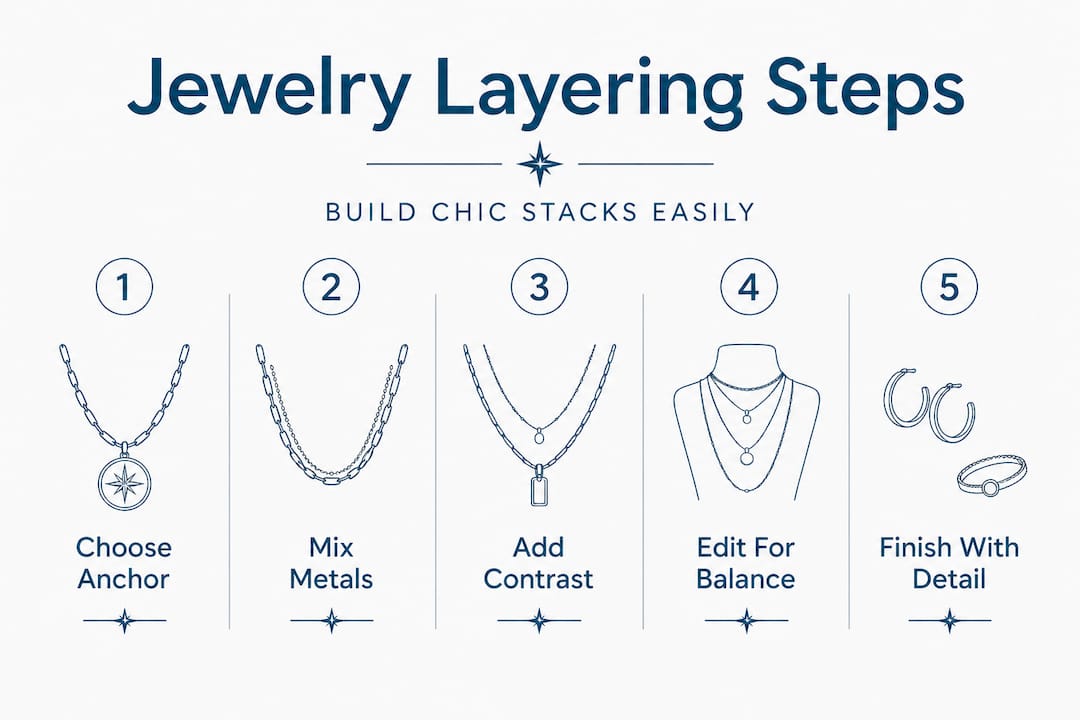
Layering jewelry is a skill, and like any skill, it gets better with a repeatable process. The goal is to build looks that feel effortless and personal, not thrown together. Here’s the workflow that actually works:
-
Choose your anchor piece first. Pick one statement piece per zone. For your neck, maybe it’s a bold gemstone pendant. For your fingers, it might be a wide gold band. Everything else supports this focal point rather than fighting it.
-
Layer supporting pieces by length or size. For necklaces, always go from shortest to longest. For rings, work from the boldest finger outward. Spacing matters: each layer should be visible and distinct, not sitting on top of the previous one.
-
Add visual interest through contrast. Mix a chunky textured chain with a fine delicate one. Pair a matte stone pendant with a high-polish chain. These contrasts create depth and make the eye travel across the stack rather than getting stuck in one place. Expert necklace layering workflow guides like this one explain exactly how to build that kind of layered tension.
-
Apply the odd number principle. Three necklaces almost always look more intentional than two or four. Five rings on one hand reads as deliberate. Even numbers can feel symmetrical and static, while odd numbers create visual rhythm.
-
Check your body zone balance. If your neckline is stacked and bold, keep your wrist game minimal or skip it entirely. If you’re going full ear party with layered earrings, let your neck breathe with just one simple chain. Balance across the body is what separates “styled” from “overloaded.”
-
Test, photograph, and adjust. Put the stack on, step back, and take a quick photo on your phone. A photo gives you an objective view that mirrors can’t always provide.
Here’s how different layering approaches compare:
| Approach | Best for | Key characteristic | Risk to avoid |
|---|---|---|---|
| Minimalist stack | Work, everyday wear | 2 to 3 carefully chosen pieces | Looking underdone if too sparse |
| Maximalist stack | Evenings, festivals | 5+ mixed metals and textures | Becoming visually chaotic |
| Tonal stack | Classic, polished events | Same metal family, varied textures | Feeling flat without contrast |
| Mixed stack | Weekend, creative events | Metals and stones from different families | Clashing without a bridge piece |
According to Vogue’s layering guide, starting with one anchor piece and building with contrast in weight and metal creates the most satisfying results, regardless of your style preference.
Pro Tip: Photograph your stack options on yourself rather than just holding pieces up. The way light hits jewelry at different angles on your body tells you far more about a combination than a flat lay photo ever could. Build a “stack library” of screenshots to refer back to on rushed mornings.
For more inspiration on how to build each layer with purpose, explore tips on styling layered necklaces that work for your specific necklines and outfit styles.
Mixing metals and colors: Expert secrets for cohesion
With your stack assembled, let’s tackle the often-intimidating challenge of mixing metals and colors like a pro.
The idea that you can only wear gold or only wear silver is officially outdated. Mixed metal stacking is one of the defining jewelry trends of 2026, but there’s a science to making it look intentional rather than accidental. The key is controlled contrast, not free-for-all mixing.
The 70/30 rule is your foundation. Choose one dominant metal to anchor at least 70% of your stack. If you lean gold, your anchor necklace, primary ring, and main bracelet should all be gold. The remaining 30% can introduce silver, rose gold, or even oxidized black metal as accent pieces. According to Vogue’s expert breakdown, using a 70/30 ratio with a dominant tone and bridging with a two-tone piece is the most effective approach for fine jewelry stacks.
Bridge pieces do the heavy lifting. A two-tone chain (one side gold, one side silver) or a gemstone piece that echoes both metals is your secret weapon. It makes the mix look intentional rather than indecisive. One well-chosen bridge piece can hold an entire mixed stack together.
What the experts recommend for cohesion:
- Stick to one warm metal family (yellow gold, rose gold) or one cool family (silver, white gold, platinum) as your dominant tone
- Use gemstones to bridge color families: a sapphire reads as both cool and warm depending on surrounding metals
- When mixing warm and cool metals, look for consistent undertones in your stones: all warm-toned gems or all cool-toned gems
- For minimalist stacking trends, stick to two metals maximum with clean, simple silhouettes to avoid visual noise
Maximalists operate differently. Stylists like Catherine Baba have built entire fashion identities around layering with no strict rules, allowing personal history and mood to drive every combination. Minimalists prefer a curated approach, often two or three pieces that share a consistent metal family. Both approaches work because both are intentional.
Pro Tip: Before you finalize your jewelry stack, look at your outfit. If your clothing is warm-toned (rust, camel, cream), lean into yellow gold. If you’re wearing cool tones (navy, gray, white), silver or white gold will feel more cohesive. Your outfit’s palette is one of your most powerful styling tools.
Explore mixing metals tips to see specific combinations that work beautifully for everyday and occasion wear.
Adapting your stack for the occasion: Everyday to statement
Once you master the core skills, it’s time to personalize your stack for any setting, from workdays to special nights out.
The beauty of layering is its flexibility. The same pieces you wear on a coffee run can be rearranged, scaled back, or amplified into something completely different for an evening event. Here’s how to think about stacking for different contexts:
Everyday wear: Keep it intentional but easy. A single mid-length necklace with a personal charm or initial pendant, two to three stacking rings, and simple stud earrings create a look that reads as polished without demanding attention. Meaningful elements like birthstone charms, initial pendants, or friendship bands make everyday stacks feel like a personal signature rather than just decoration.
Work or professional settings: Coordination is key. Choose two or three pieces that share the same metal tone, keep silhouettes clean, and avoid anything that catches on clothing or makes noise. A thin gold chain, a delicate ring, and small hoops or studs can look incredibly refined without trying too hard.
Special occasions and evenings: This is where you go bold. A larger anchor piece, an asymmetrical earring situation (different sizes or styles on each ear), layered rings across multiple fingers, and a cuff stacked with chain bracelets all come together for maximum impact. Asymmetry adds a modern, editorial edge that feels current and confident.
“Layering jewelry is ultimately about personalization. A stack with charms, initials, or meaningful stones turns into a wearable story about who you are and what matters to you.” Inspired by Vogue’s layering insight
Occasion-based layering checklist:
- Everyday: 1 to 2 necklaces, 2 to 3 rings, optional bracelet, simple earrings
- Work: Matching metals, minimal pieces, clean silhouettes
- Evening: Bold anchor, asymmetrical ear stack, layered wrists, mixed metals welcome
- Festivals or creative events: Maximum layering, personal statement pieces, no rules
Pro Tip: Use your jewelry stack to tell your personal style story. Don’t just dress for the occasion outwardly. Choose pieces that reflect your mood, your memories, or your aesthetic evolution. A ring you bought in a city you love or a necklace that was a gift tells a story that makes your stack uniquely yours.
For inspiration on elevating everyday and special looks with layered pieces, there’s a wealth of real-world styling ideas to explore.
The truth about jewelry layering the experts won’t tell you
Here’s the part most layering guides skip: all the rules we’ve covered are starting points, not verdicts. The most striking jewelry stacks you’ll ever see break at least one of them.
The Vogue approach to layering acknowledges two camps clearly: maximalists who embrace personal maximalism with no strict limits, and minimalists who prefer two to three curated pieces. Both camps agree on anchor and contrast as the foundation, but neither camp demands you stay in one lane forever.
What actually makes a stack look chic is not the price of the pieces or how perfectly they follow a formula. It’s confidence. When you wear a combination like you meant it, people read it as intentional. An asymmetrical earring situation that you pull off with ease looks like a fashion statement. The same combo worn with uncertainty looks like a mistake. The jewelry doesn’t change. Your energy does.
The most iconic stacks we’ve seen, on stylists, editors, and everyday women with killer personal style, share one trait: they evolved over time. Nobody woke up with a perfect layering aesthetic. They built it by mixing in one new piece here, retiring something that stopped feeling right there, and staying curious about what felt like them.
Check out our top layering tips for a deep dive into techniques that support, not constrain, your personal style journey.
The uncomfortable truth is that no guide can tell you what your signature stack looks like. Only you can discover that, through experimentation, through wearing pieces you love even when they don’t “match,” and through trusting that a well-worn piece you adore is always going to be more powerful than a technically correct one that means nothing to you.
Let your layers evolve with you. There is no wrong answer when you’re building something authentic.
Find your perfect stack with Malibu Vibes Jewelry
Ready to experiment with your own iconic layers? Explore how Malibu Vibes Jewelry can help bring your vision to life.
At Malibu Vibes Jewelry, every piece is handcrafted in Los Angeles with the kind of quality that holds up to daily stacking and special occasion wear alike. Whether you’re building your first intentional stack or refining a collection you’ve curated for years, our pieces are designed to mix, layer, and tell your story beautifully.

Browse our gemstone necklaces for anchor pieces that add color and personality to any length stack. Explore our sterling silver pieces for cool-toned layering options that pair beautifully with gold accents. Want to understand the craftsmanship behind every piece you stack? Take a look at our jewelry making process and see why quality-over-quantity always wins when it comes to building a stack that lasts.
Frequently asked questions
What is the easiest way to prevent necklace tangling when layering?
Use staggered lengths with at least two to four inches between each chain, and add a necklace detangler clasp to keep each layer separate and visible throughout the day.
How do I mix gold and silver jewelry without it looking messy?
Follow the 70/30 rule: choose one dominant metal for most of your pieces and bridge the two tones with a two-tone chain or a gemstone piece, as recommended by Vogue for cohesive fine jewelry stacks.
How many pieces should I wear for a chic stacked look?
Odd numbers like three or five pieces look the most intentional and dynamic, creating natural visual rhythm rather than a static, even grouping.
Can I layer bold statement pieces for both work and evening?
Yes. For work, stick to subtle and coordinated pieces with clean silhouettes, then swap in bolder anchor pieces and asymmetrical stacking for evening, as occasion-based styling makes the same jewelry wardrobe work harder for you.
Recommended
- How to design a jewelry stack: effortless layering guide – Malibu Vibes Jewelry
- 7 Essential Jewelry Layering Tips for Effortless Style – Malibu Vibes Jewelry
- Master stacking jewelry for effortless layered style – Malibu Vibes Jewelry
- Jewelry Layering Explained: Styling Tips and Trends – Malibu Vibes Jewelry
- How to match jewelry with outfits and elevate your style – Diamonds