

TL;DR:
- An eternity band ring features a continuous line of identically cut gemstones symbolizing love with no end. It is traditionally given after marriage to mark milestones like anniversaries, births, or vow renewals. The most practical style for daily wear is a half-eternity band, which balances brilliance, comfort, and resizing ability.
An eternity band ring is defined as a circular band set with a continuous line of identically cut gemstones, symbolizing love with no beginning and no end. Unlike a solitaire or three-stone ring, an eternity band has no focal point. Every stone carries equal weight, which is exactly the point. Diamonds are the most common choice, though sapphires, rubies, and emeralds appear frequently in modern designs. The ring’s unbroken circle is not just a design decision. It is a deliberate statement about permanence and commitment.
What is an eternity band ring and what does it symbolize?
An eternity band ring represents unending love, with the continuous gemstone setting reinforcing the idea that a relationship has no finish line. The design has no focal point, which separates it from virtually every other ring style. A solitaire draws the eye to one stone. An eternity band spreads meaning evenly across the entire circle.
The symbolism runs deeper than aesthetics. The circle itself has represented infinity across cultures for centuries, from ancient Egyptian scarab rings to Celtic knotwork. When you add an unbroken row of diamonds or gemstones to that circle, the message becomes layered. Each stone represents a moment, a year, or a shared experience.
The modern popularity of eternity rings owes much to a De Beers marketing campaign in the 1960s, which repositioned smaller diamonds as symbols of enduring love for married women. That campaign shifted the market away from single large diamonds and toward multiple smaller stones set continuously around a band. The cultural impact stuck, and eternity bands became a standard milestone gift in Western jewelry tradition.
What occasions are eternity bands traditionally given for?
Eternity bands are traditionally gifted after marriage, not at the wedding ceremony itself. The ring marks growth within a relationship rather than the start of one. That distinction matters because it changes what the gift communicates.
The most common gifting occasions include:
- Wedding anniversaries: The 1st, 5th, 10th, and 25th anniversaries are the most popular milestones for gifting eternity bands. Each milestone carries its own weight, and the ring becomes a physical record of time shared.
- Birth of a child: Many partners gift an eternity band to mark the arrival of a new family member. The symbolism of an unbroken circle maps naturally onto the idea of family.
- Vow renewals: Couples who renew their vows often exchange eternity bands as a second commitment ring, layering new meaning onto an existing marriage.
- Personal achievements: Career milestones, graduations, and major life transitions have all become accepted occasions for gifting or self-purchasing an eternity band.
- Push presents: The practice of gifting jewelry after childbirth has grown significantly, and eternity bands are among the most requested styles.
Cultural interpretation varies. In some traditions, the eternity band replaces the engagement ring after marriage. In others, it stacks alongside both the engagement and wedding rings as a third piece. The gifting occasion guide from Malibuvibesjewelry covers how these traditions are shifting in 2026, with more buyers choosing eternity bands as standalone self-purchase pieces rather than gifts.
The emotional logic behind the timing is consistent across cultures. An eternity band marks something that has already been proven, not something that is being promised. That is what separates it from an engagement ring.
What are the main design styles and setting variations?
Three primary configurations define the eternity band category, and each one makes a different trade-off between symbolism, comfort, and practicality.
| Style | Stone coverage | Resizable? | Best for |
|---|---|---|---|
| Full eternity | 100% of band | No | Maximum brilliance, special occasions |
| Three-quarter eternity | 75% of band | Limited | Balance of sparkle and comfort |
| Half eternity | Top 50% only | Yes | Daily wear, sizing flexibility |
The full eternity band wraps stones completely around the circumference. The visual impact is unmatched. Every angle catches light. The trade-off is that full bands cannot be resized because cutting into the setting would disrupt the continuous stone line. They also require more careful daily handling.
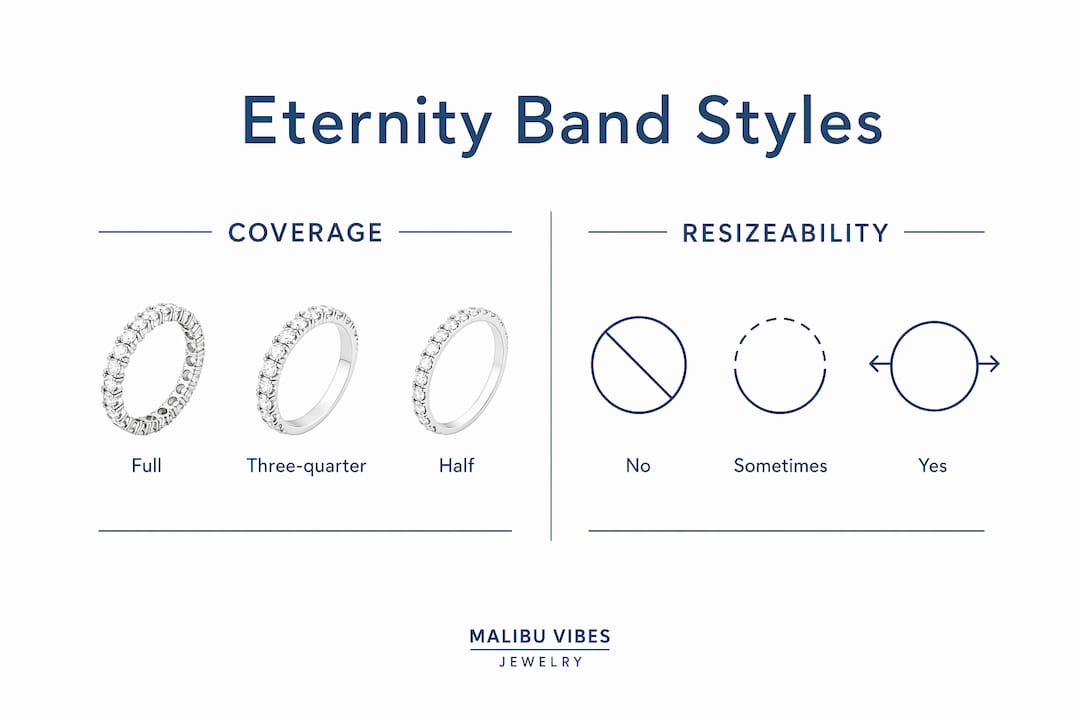
Three-quarter and half-eternity bands place stones only on the visible portion of the ring. The underside of the band remains plain metal. This makes resizing possible and reduces the risk of stones catching on fabric or surfaces. Half-eternity bands are the most practical choice for everyday wear.
Setting style also shapes the look and feel of the ring significantly. Claw settings lift each stone above the band, maximizing light entry and brilliance. Channel settings embed stones flush between two metal rails, creating a sleek, modern profile with strong stone protection. Rubover (also called bezel) settings wrap each stone in a metal collar, offering the most secure hold and a contemporary aesthetic.
Gemstone choice adds another layer of personalization. Diamonds remain the standard, but color gemstone rings in sapphire, ruby, and emerald have grown in popularity as buyers seek more personal expression. Sapphires rank as the most durable colored gemstone option after diamonds, scoring 9 on the Mohs hardness scale.
Pro Tip: If you plan to stack your eternity band with an engagement ring and wedding band, choose a half-eternity style. The flat underside sits flush against neighboring rings without creating gaps or pressure points.
How do eternity bands differ from wedding and engagement rings?
An eternity band is a symbol of ongoing love. A wedding band marks the moment of commitment. An engagement ring signals the intention to marry. These three rings serve distinct emotional functions, even when worn together on the same finger.
The key differences come down to timing, design, and meaning:
- Timing: Engagement rings come before marriage. Wedding bands are exchanged at the ceremony. Eternity bands arrive after marriage, often years later, when a milestone has been earned.
- Design: Engagement rings typically feature a prominent center stone. Wedding bands are often plain or lightly set. Eternity bands use a continuous gemstone setting with no dominant focal point.
- Symbolism: Engagement rings represent a promise. Wedding bands represent a vow. Eternity bands represent a history, a relationship that has grown and deepened over time.
- Stacking: All three rings are commonly worn together on the left ring finger. The eternity band typically sits outermost in the stack, though personal preference drives the final arrangement.
Styling an eternity band within a stack requires some thought. A thin half-eternity band in the same metal as your wedding ring creates a cohesive, intentional look. A contrasting metal or a band with colored stones adds visual separation and personality. The complete guide to wearing eternity rings from Malibuvibesjewelry covers stacking combinations in detail.
What practical considerations matter when choosing an eternity band?
Buying an eternity band requires more planning than buying a plain band. The continuous stone setting introduces real constraints that buyers often underestimate.
-
Get your size right the first time. Full eternity bands cannot be resized after purchase. A jeweler should measure your finger at the end of the day, when fingers are at their largest. Temperature, hydration, and weight changes all affect ring size over time.
-
Consider your lifestyle before choosing a setting. Claw settings offer maximum brilliance but snag on fabric and scratch more easily. Channel and rubover settings protect stones better during physical activity. If you work with your hands, a lower-profile setting is the practical choice.
-
Think about long-term sizing needs. Pregnancy, aging, and weight fluctuation all change finger size. Half or three-quarter bands are the better choice for anyone who anticipates size changes, since they can be resized without disrupting the stone setting.
-
Plan for maintenance. A continuous row of stones collects dirt and lotion faster than a plain band. Prong settings require periodic checking to confirm stones are secure. Professional cleaning every six to twelve months keeps the ring looking its best.
-
Match gemstone hardness to daily wear. Diamonds score 10 on the Mohs scale and handle daily wear without issue. Emeralds score 7.5–8 and are more brittle, making them better suited to occasional wear than everyday use. Sapphires and rubies at 9 are strong enough for daily wear.
Pro Tip: Ask your jeweler for a half-size larger than your measured size if you are buying a full eternity band. The extra room accounts for natural finger swelling and makes the ring easier to remove.
Key takeaways
An eternity band ring is the most symbolically direct piece of jewelry you can give after marriage. Its unbroken circle of stones says what words often cannot.
| Point | Details |
|---|---|
| Core definition | An eternity band features a continuous line of identically cut gemstones representing love with no end. |
| Best gifting occasions | Anniversaries, births, and vow renewals are the most meaningful and traditional moments to give one. |
| Style trade-offs | Full bands offer maximum brilliance but cannot be resized; half-eternity bands balance sparkle with practicality. |
| Sizing is permanent | Full eternity bands must be sized precisely before purchase since resizing is not possible after setting. |
| Stacking works best with half-eternity | A half-eternity band sits flush against wedding and engagement rings without gaps or discomfort. |
Why I think most buyers choose the wrong eternity band style
Most people walk into an eternity band purchase focused entirely on how the ring looks in a display case. That is understandable. A full eternity band under jewelry store lighting is genuinely stunning. Every stone fires at once, and the effect is hard to resist.
The problem shows up about three months into daily wear. Full eternity bands are not designed for hands that type, cook, garden, or grip a steering wheel. The stones on the underside of the band catch on everything. The ring becomes something you take off rather than something you wear. That defeats the entire purpose of a ring meant to symbolize something unending.
My honest recommendation is to start with a half-eternity band, especially for a first eternity ring. You get the sparkle where it counts, across the top of your finger where it is visible. The plain underside sits comfortably against your skin and stacks cleanly with other rings. If you fall in love with the style and want to add a full eternity band later for special occasions, that is a great second purchase.
The emotional value of an eternity band does not depend on how many stones it has. It depends on when you give it and what it marks. A well-chosen half-eternity band given on a tenth anniversary carries more meaning than a full band given without thought. Choose the style that fits the life you actually live, not the one that photographs best.
— Ara
Fine eternity bands and gemstone rings at Malibuvibesjewelry
Malibuvibesjewelry crafts fine jewelry from 14k gold and sterling silver, with stones set by hand in Los Angeles. The eternity band category sits at the center of what the brand does best: precise stone setting, quality materials, and designs built to wear every day without compromise.

Whether you are drawn to classic diamond jewelry or prefer the color of a sapphire or ruby set in solid gold, the collection covers both directions. The jewelry making process page explains how each piece moves from raw material to finished ring, which is worth reading before you buy. Quality at this level is visible in the details, and Malibuvibesjewelry makes those details easy to see.
FAQ
What is an eternity band ring, exactly?
An eternity band ring is a circular band set with a continuous line of identically cut gemstones, representing love with no beginning and no end. Diamonds are the most common stone, though sapphires, rubies, and emeralds are popular alternatives.
Can an eternity ring be resized?
Full eternity bands cannot be resized because stones run continuously around the entire band. Half-eternity and three-quarter eternity bands can be resized since the underside of the band remains plain metal.
When should you give an eternity ring?
Eternity rings are traditionally given after marriage to mark milestones such as anniversaries, the birth of a child, or a vow renewal. The 1st, 5th, 10th, and 25th anniversaries are the most common occasions.
What does an eternity ring mean when worn daily?
Wearing an eternity ring daily signals a commitment that has stood the test of time. The unbroken circle of stones communicates that the relationship it represents has no endpoint.
What is the difference between a half and full eternity band?
A full eternity band has stones set all the way around the band for maximum brilliance but cannot be resized. A half-eternity band has stones only on the top half, offering better comfort, durability, and the ability to resize as needed.
Recommended
- Infinity Symbol Engagement Ring: Meaning and Design Guide – Malibu Vibes Jewelry
- What is an Eternity Ring? Understanding Its Symbolism and Meaning – Malibu Vibes Jewelry
- How To Wear Eternity Ring - A Complete Guide – Malibu Vibes Jewelry
- What is an eternity ring for? 2026 guide to gifting – Malibu Vibes Jewelry