

TL;DR:
- Gold bullion jewelry is valued primarily for its high-purity gold content, resembling wearable gold bars more than fashion accessories. It features simple, geometric designs with certification and hallmarking essential for verifying purity, typically at 22K or 24K standards. Resale value closely aligns with spot gold prices, making it a practical investment if purchased with proper documentation from reputable sources.
Not all gold jewelry is created equal, and that gap matters enormously when money is on the line. Gold bullion jewelry occupies a specific and often misunderstood category: pieces priced by their gold content rather than their craftsmanship, design complexity, or brand name. While most consumers treat any gold necklace or ring as a vague store of value, bullion jewelry is priced by purity and weight, making it far closer to a gold bar you can wear than to a fashion accessory. This guide covers everything you need to decide whether it belongs in your collection.
Table of Contents
- Key takeaways
- What gold bullion jewelry actually is
- Design features that set bullion jewelry apart
- Investment potential and resale realities
- How to buy gold bullion jewelry with confidence
- Gold bullion vs. bullion jewelry vs. traditional gold jewelry
- My honest take on gold bullion jewelry
- Explore Malibuvibesjewelry’s gold collections
- FAQ
Key takeaways
| Point | Details |
|---|---|
| Purity determines value | Gold bullion jewelry is valued by gold content, so higher purity means greater investment potential. |
| Hallmarks are non-negotiable | Always verify hallmark numbers like 999 or 916 before any purchase to confirm genuine gold content. |
| Certification protects buyers | Assay cards or authenticity certificates confirm purity and support easier resale at fair prices. |
| Bullion jewelry beats fashion jewelry for resale | Designs with minimal making charges trade closer to spot gold price, reducing value loss at resale. |
| Know what you’re buying | Bullion-style pieces suit investors who want wearability; traditional jewelry suits those who prioritize aesthetics. |
What gold bullion jewelry actually is
Most people assume their 14K gold ring qualifies as a gold investment. It does not. True gold bullion jewelry is a specific product category where the piece is designed, priced, and sold based on its gold content first. A classic example is a pendant or bracelet housing a 1-gram bar of 24K/999.9 fine gold in a minimal metal frame. The gold itself is the asset. The mounting is just delivery.
This distinction matters because conventional jewelry pricing adds making charges, design markups, and brand premiums on top of the raw metal cost. When you go to resell, those extras rarely come back to you. Bullion jewelry sidesteps much of that by keeping design simple and gold content front and center.
Purity standards you need to recognize
The number stamped on any gold piece tells you exactly what you own. Hallmark numbers represent gold purity per thousand: 999 means 99.9% pure gold (24K), 916 means 91.6% (22K), and 750 means 75% (18K). These marks function as an international language of gold content that any buyer or dealer can verify regardless of where the piece was made.
For bullion-grade jewelry, you are generally looking at 999 or 916 marks. Anything below 750 is considered fine jewelry grade and starts losing its bullion investment character. Here is how common purity levels compare:
| Hallmark | Purity | Karat | Investment grade? |
|---|---|---|---|
| 999 | 99.9% | 24K | Yes |
| 916 | 91.6% | 22K | Yes |
| 750 | 75.0% | 18K | Marginal |
| 585 | 58.5% | 14K | No |
| 375 | 37.5% | 9K | No |
Pro Tip: When examining a piece, use a magnifying glass to locate the hallmark stamp. It is often placed on the clasp of a bracelet or the inner band of a ring. If a seller cannot show you the stamp, walk away.
Design features that set bullion jewelry apart
Gold bullion jewelry looks noticeably different from your typical fine jewelry. The designs tend to be geometric, minimal, and focused on showcasing the gold itself rather than ornate patterns or stone settings. You will often see flat bars, simple chain constructions, or bezel-style frames. Some products, like a 1 oz .9999 fine gold bracelet in protective cards, come with assay packaging that certifies exact gold content. You are essentially buying a bullion product that happens to be wearable.
Certification is what separates a legitimate bullion jewelry product from a piece marketed loosely as an “investment.” Look for these features when shopping:
- An assay card or sealed packaging that certifies weight and purity
- A serial number on the piece or its certificate
- Clear disclosure of the gold content in grams or troy ounces
- Confirmation of karatage matching the hallmark stamp
- Certificates of Authenticity for purity and weight
The trade-off in these designs is that they are not always the most visually dramatic pieces in a jewelry collection. A 22K rope chain bracelet is beautiful in its simplicity, but it will not compete with a diamond pavé set piece for sheer visual impact. That is by design. The goal is gold content with minimal craftsmanship markup, not decorative complexity. 22K bullion rope chain bracelets, for example, typically include Certificates of Authenticity and are priced primarily on their gold weight.
Pro Tip: If you want bullion jewelry that also works as everyday wear, look for heavier chain designs in 22K. They carry significant gold weight, hold up well through daily use, and resell easily because buyers can quickly verify their content.
Investment potential and resale realities
Here is where many buyers get surprised. Bullion jewelry trades closer to spot gold price with smaller premiums than traditional jewelry, because its valuation is anchored to purity and weight rather than craftsmanship or brand. That is a meaningful advantage when you want to exit your position.
Traditional jewelry, by contrast, is valued by dealers based on condition, design desirability, brand, and stone quality. A 14K gold ring you paid $800 for might sell for $150 at a pawn shop because the dealer is pricing only the raw gold content after stripping out all the things that made it valuable to you as a buyer.
Bullion jewelry narrows that gap significantly. The comparison below shows how resale dynamics differ:
| Type | Resale basis | Typical recovery vs. purchase price |
|---|---|---|
| Gold bullion bar | Spot price | 95-100% |
| Gold bullion jewelry | Spot price + small premium | 80-95% |
| Traditional gold jewelry | Craftsmanship + condition | 20-50% |
| Fashion gold jewelry | Scrap gold value | 10-30% |
That said, resale is not automatic. Making charges and ambiguous marketing can erode returns if the piece was sold as fashion jewelry rather than bullion jewelry. A piece marketed as “gold-inspired” or “gold-tone” is a red flag. You want explicit purity disclosure and certified weight, not vague language about gold content.
The market context matters too. When gold spot prices are rising, bullion jewelry benefits directly. When you are ready to sell, reputable bullion dealers, online gold buyers, and some jewelers will buy certified bullion jewelry at prices that reflect its actual gold content.
How to buy gold bullion jewelry with confidence
Buying well in this category takes a bit more due diligence than picking up a fashion ring, but the process is straightforward once you know what to look for. These steps will protect your purchase:
- Verify the hallmark before anything else. The stamp should clearly read 999, 916, or at minimum 750. Use a loupe or ask the seller to point it out. For tips on reading purity marks, check the Malibuvibesjewelry resource on metal purity.
- Request documentation. A legitimate bullion jewelry piece should come with a certificate of authenticity or assay card. Serialized products offer extra verification if the cert is lost.
- Buy from dealers with a clear track record. LBMA-accredited dealers set the standard for bullion integrity. Reputable jewelers who specialize in high-quality gold jewelry with transparent sourcing are also reliable options.
- Understand the local pricing environment. Import tariffs affect gold prices directly. A tariff increase from 6% to 15% can meaningfully impact what you pay and what you recover at resale in your region.
- Minimize making charges. For investment purposes, prioritize plain designs in 22K or 24K. Intricate designs add making charges that you likely will not recover at resale.
- Check for independent testing options. If you have any doubt about a piece, XRF (X-ray fluorescence) testing is affordable and gives a fast, accurate purity reading without damaging the piece.
Pro Tip: When comparing two pieces at similar gold weights, choose the simpler design every time if resale is your priority. A plain 22K bangle and an ornate 22K filigree cuff may cost the same, but the bangle will always be easier to resell at full gold value.
Gold bullion vs. bullion jewelry vs. traditional gold jewelry
Understanding where bullion jewelry sits relative to other gold products helps you pick the right vehicle for your goals.
Gold bars and coins are the purest investment form. They carry the highest purity (usually 999.9), the lowest premiums over spot, and the greatest liquidity. But they offer no wearability, no cultural expression, and no aesthetic value.
Traditional gold jewelry sits at the other end. It prioritizes design, craftsmanship, and emotional resonance. Its gold content is often secondary, and resale value suffers as a result. However, it carries cultural weight, particularly in communities where gold jewelry is a traditional form of savings.
Gold bullion jewelry occupies the middle ground. It is designed to give you gold exposure at near-bullion pricing while remaining wearable and socially meaningful.
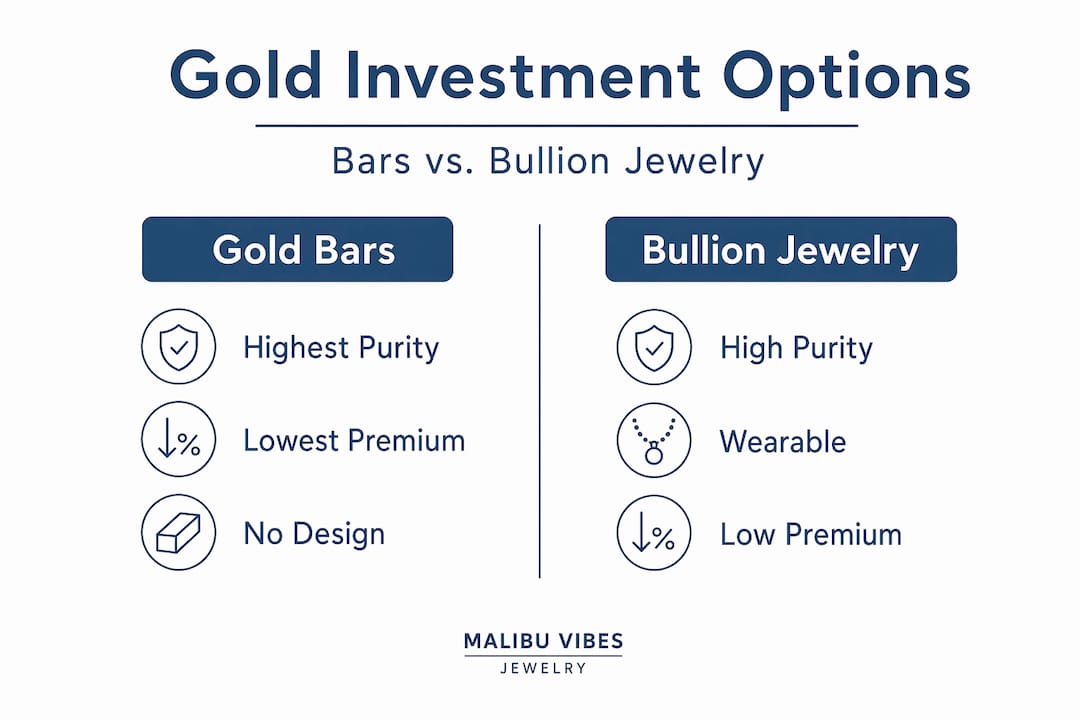
| Factor | Gold bars | Bullion jewelry | Traditional jewelry |
|---|---|---|---|
| Purity | 999.9 (24K) | 916-999 (22K-24K) | 375-750 (9K-18K) |
| Liquidity | Very high | High | Low to moderate |
| Resale value | Closest to spot | Near spot | Well below purchase price |
| Wearability | None | High | High |
| Cultural/emotional value | Low | Moderate | High |
| Making charge impact | None | Low | High |
The right choice depends on your purpose. If you are purely preserving wealth in gold, a bar is more efficient. If you want gold exposure you can wear to a dinner or pass down as a gift, bullion jewelry makes real sense.
My honest take on gold bullion jewelry
I’ve watched plenty of buyers make the mistake of treating their 14K gold bracelet as a gold investment, then feel genuinely blindsided when a dealer offers them a fraction of what they paid. The truth I’ve come to after spending years around fine jewelry and precious metals is simple: most gold jewelry is a fashion product first, and the “investment” framing is marketing.
Gold bullion jewelry is different, but only when you buy it right. I’ve seen people pay bullion premiums for pieces that turned out to be marketed loosely, with no assay card, no serial number, and ambiguous karatage. At resale, those pieces got priced like fashion jewelry. The buyers lost real money.
What I find genuinely useful about this category is the combination of cultural acceptance and real gold exposure. In many households, a heavy gold chain or bangle is both family wealth and something you actually want to wear. Bullion bars do not offer that. Done correctly, with certified purity and documented weight, investing in gold jewelry of the bullion variety is one of the most practical ways to hold physical gold in your life. Just do not skip the paperwork.
— Ara
Explore Malibuvibesjewelry’s gold collections
If you are ready to move from research to purchase, Malibuvibesjewelry brings the same commitment to documented quality and real craftsmanship to every piece. Their solid gold necklaces collection features pieces made from genuine precious metals with transparent specifications, so you know exactly what you own. For buyers who want to understand how quality is built into every step, the fine jewelry making process page walks you through sourcing, metalwork, and quality assurance from start to finish. Los Angeles-made, with craftsmanship and materials you can verify, Malibuvibesjewelry is the kind of place where the details actually check out.
FAQ
What is gold bullion jewelry?
Gold bullion jewelry is wearable jewelry priced primarily by its gold content, using high-purity gold (22K or 24K) as the core asset. Unlike traditional jewelry, its value is tied closely to the gold spot price rather than design or craftsmanship.
How do I verify the purity of gold bullion jewelry?
Look for a hallmark stamp reading 999 (24K) or 916 (22K) on the piece, and request an assay card or certificate of authenticity. Independent XRF testing is an affordable option if you want additional confirmation.
Is gold bullion jewelry a good investment?
It can be, because bullion jewelry resale is anchored to gold spot price rather than design premiums. The key is buying certified pieces with minimal making charges and keeping documentation intact.
What is the difference between a gold bullion bracelet and a regular gold bracelet?
A gold bullion bracelet is made from high-purity gold (22K or 24K) and priced by its actual gold weight, often with an assay certificate. A regular gold bracelet is typically 10K to 18K and priced largely on design, brand, and craftsmanship.
Where can I buy reliable gold bullion jewelry?
Buy from LBMA-accredited bullion dealers, reputable jewelers with clear purity documentation, or trusted online retailers that provide assay certificates and serialized products. Always confirm the hallmark before purchasing.
Recommended
- Understanding Why Invest in Gold Jewelry: A Comprehensive Guide – Malibu Vibes Jewelry
- Gold vs Silver Jewelry: Style, Luxury & Buying Tips – Malibu Vibes Jewelry
- Explore the World of Precious Metals in Jewelry – Malibu Vibes Jewelry
- Investment Gold Jewelry: Why Handcrafted 30% Boosts Value – Malibu Vibes Jewelry