

TL;DR:
- Buying fine jewelry online is safest when you verify seller credentials, confirm verifiable certifications like GIA or AGS, and pay only with credit cards for dispute protection. Clear product descriptions, transparent return policies, and proper sizing measures reduce risks and enhance satisfaction. Trustworthy retailers share detailed information proactively and follow FTC guidelines, ensuring confident and secure purchases.
Buying fine jewelry online is defined as purchasing precious metal and gemstone pieces through verified digital retailers, with full confidence in authenticity, certification, and payment security. You can do this safely and successfully by following three core steps: verifying seller credentials, reading grading reports from labs like GIA or AGS, and paying by credit card for chargeback protection. The FTC’s online shopping guidance sets clear expectations for sellers, including shipping timelines and payment transparency. Retailers like James Allen and Blue Nile have built their reputations on exactly these standards. This guide gives you the same framework for every purchase you make.
How to buy fine jewelry online from a trustworthy retailer
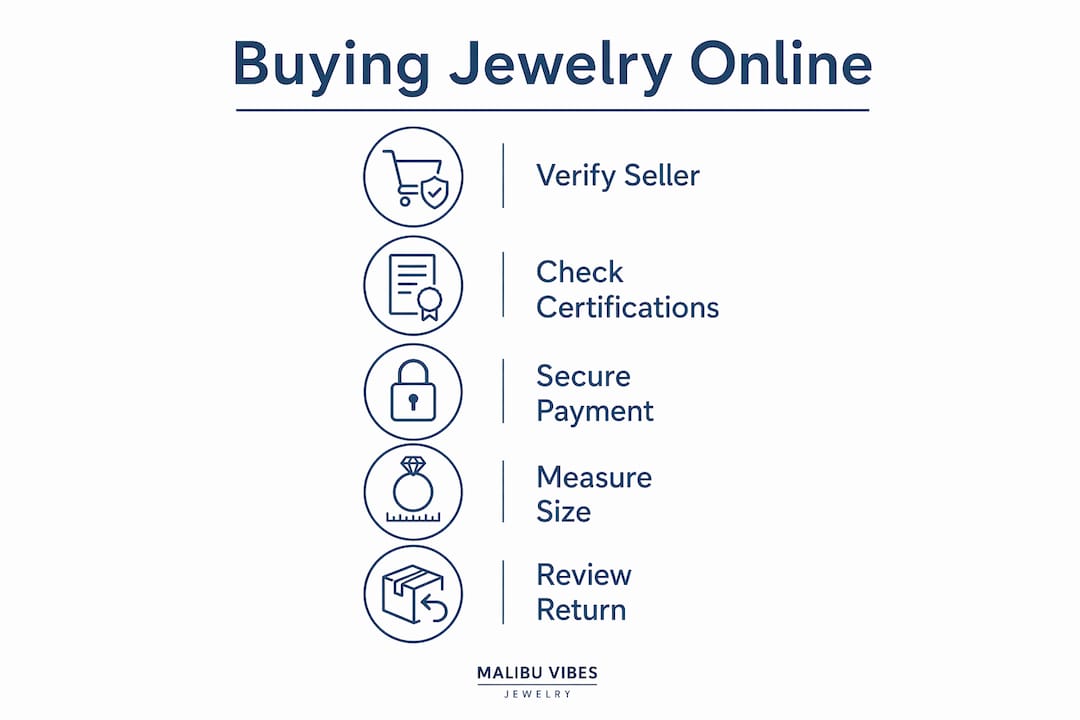
The single most reliable signal of a trustworthy online jewelry seller is a complete, verifiable business identity. Reliable sellers display a physical address, direct customer service contact, and clearly written return and shipping policies. If a retailer’s “About” page reads like a template with no city, no team, and no story, treat that as a warning.

Independent reviews are your second line of defense. Check Google Reviews, Trustpilot, and the Better Business Bureau before placing any order. A pattern of complaints about delayed shipping, misrepresented stones, or ignored return requests tells you more than any marketing copy ever will.
Watch for these red flags before you buy:
- Prices dramatically below market value for gold or diamond pieces
- Vague product descriptions with no metal purity stamp (e.g., 14k, 925 sterling)
- No stated return window or a policy buried in fine print
- Only generic “certified quality” claims with no lab name attached
- Contact limited to a web form with no phone number or email address
Pro Tip: Use the FTC’s consumer watchdog resources and your state attorney general’s database to check whether a retailer has unresolved complaints before you spend a dollar.
Transparency in product descriptions is non-negotiable for fine jewelry. Every listing should state metal type, purity, stone weight in carats, and any treatments applied. The Forbes Vetted best online jewelry store ranking consistently rewards retailers who provide this level of detail. When a seller volunteers that information without being asked, that is a strong sign they stand behind what they sell.
What jewelry certifications actually mean
A grading report and an appraisal are not the same document, and confusing them is one of the most common mistakes online jewelry buyers make. Certificates provide grading details like cut, color, and clarity for objective quality comparison, while appraisals estimate retail replacement value for insurance purposes. You need the grading report to evaluate what you are buying. You need the appraisal after you own it.
The most respected certifying labs in the industry are GIA (Gemological Institute of America) and AGS (American Gem Society). Both assign report numbers to individual stones that you can verify directly on their websites. If a listing references a certificate but provides no report number, the claim is unverifiable and should be treated with skepticism.
| Document type | Purpose | What to verify |
|---|---|---|
| GIA grading report | Objective stone quality assessment | Report number on GIA’s website |
| AGS certificate | Cut quality and light performance | Report number on AGS’s website |
| Independent appraisal | Insurance replacement value | Appraiser credentials (GIA Graduate Gemologist) |
| Generic “quality certificate” | No standardized meaning | Treat as marketing, not documentation |
The FTC’s updated jewelry guidelines require sellers to disclose treatments like heat enhancement or fracture filling, as well as gemstone origin when it affects value. This matters most for colored stones: a heat-treated ruby and an untreated ruby of the same size can differ in price by thousands of dollars. If a listing does not address treatment status, ask directly before purchasing.
Pro Tip: Request a digital copy of the grading report before checkout. Any reputable seller will send it. If they hesitate or offer to include it only after payment, walk away.
Learning to identify quality gemstones before you shop gives you a meaningful advantage when reading listings and comparing stones across retailers.
Best payment practices when buying luxury jewelry online
Credit cards are the correct payment method for every fine jewelry purchase online. The FTC recommends credit cards specifically because they offer dispute rights and chargeback protections that no other payment method matches. If a seller ships the wrong item, misrepresents a stone, or disappears after payment, your credit card issuer can reverse the charge.
Never pay for fine jewelry with a wire transfer, gift card, cryptocurrency, or peer-to-peer app like Venmo or Zelle. These methods are irreversible. Once the money leaves your account, recovery is nearly impossible regardless of what the seller promised.
Secure checkout is a baseline requirement, not a bonus feature. Look for HTTPS in the URL bar and a padlock icon before entering any payment information. Beyond that, insisting on insured shipping with signature confirmation protects you against loss or theft in transit. A $2,000 ring shipped without insurance and without signature confirmation has no recovery path if it goes missing.
Keep every record of your transaction: order confirmation emails, product description screenshots, and any written communication with the seller. These records are your evidence if a dispute arises. The FTC requires sellers without a stated shipping timeline to ship within 30 days of payment. If your order approaches that window without movement, contact the seller in writing and document the response.
How to measure fit and assess product details virtually
Getting the right fit for a ring purchased online requires more than a single measurement. Take your ring size reading at least three times across different times of day, since fingers swell slightly in heat and shrink in cold. Measure the specific finger you plan to wear the ring on, not a different finger on the other hand.
Follow these steps for accurate virtual fit assessment:
- Use a printable ring sizer from a reputable jeweler or measure the inner diameter of a ring that already fits well on the correct finger.
- Account for band width. Wider bands (over 6mm) fit tighter than narrow bands at the same nominal size, so size up by half a size for wide styles.
- For necklaces, use a soft measuring tape around your neck and compare that measurement to the chain lengths listed. A 16-inch chain sits at the collarbone; 18 inches falls just below it.
- Check pendant drop measurements separately from chain length. A 2-inch drop on a 16-inch chain sits very differently than a 0.5-inch drop.
- Request additional photos or a short video showing the piece on a hand or neck model for true scale and color reference.
Proper ring sizing and necklace length assessment done carefully before purchase reduces returns and improves satisfaction significantly. Product photography, even when excellent, compresses scale in ways that surprise buyers at unboxing. Always cross-reference the listed dimensions in millimeters against a physical ruler before ordering.
Pro Tip: Ask the retailer about their resizing policy and warranty coverage before you buy. Many fine jewelry sellers offer one free resize within 60 days. Knowing this upfront removes the pressure of getting it perfect on the first try.
What to look for in return policies and warranties
Return policies for fine jewelry vary more than in almost any other product category, and the details matter. Return policies can include restocking fees or final sale terms that significantly limit your options after purchase. Read the full policy before you add anything to your cart.
Key questions to answer before purchasing:
- Does the return window start from the purchase date or the delivery date? A 30-day window starting at purchase can shrink to two weeks by the time shipping is factored in.
- Who pays return shipping, and is the item required to be insured in transit?
- Are custom, engraved, or resized pieces excluded from returns entirely?
- Does the warranty cover stone loss, prong damage, and manufacturing defects, or only the metal setting?
- Are there restocking fees, and if so, what percentage?
| Policy element | What to look for | Red flag |
|---|---|---|
| Return window | 30 days from delivery | Window starts at purchase date |
| Return shipping | Seller-paid or prepaid label | Buyer pays uninsured return |
| Warranty coverage | Craftsmanship and stone setting | Metal only, no stone protection |
| Final sale items | Clearly labeled before purchase | Discovered only after checkout |
Document the condition of every piece immediately upon arrival. Photograph the packaging, the item itself, and any certificates or paperwork included. This protects you if a return dispute arises over whether damage was pre-existing or occurred after delivery.
Key takeaways
Buying fine jewelry online is reliable when you verify seller credentials, read grading reports from GIA or AGS, pay by credit card, and document every step of the transaction.
| Point | Details |
|---|---|
| Verify seller identity | Confirm physical address, contact info, and transparent policies before purchasing. |
| Read certifications correctly | GIA and AGS grading reports are verifiable; generic “certified quality” claims are not. |
| Pay by credit card only | Credit cards provide chargeback rights that wire transfers and crypto cannot match. |
| Measure fit precisely | Account for band width and time of day when sizing rings; always check pendant drop separately. |
| Document everything | Photograph items on arrival and save all purchase records to support any future dispute. |
What I’ve learned from years of watching buyers get this wrong
The most expensive mistake I see online jewelry buyers make is not overpaying for a stone. It is paying the right price for a piece they cannot verify, from a seller they cannot hold accountable, using a payment method they cannot reverse. Those three errors compound each other.
The second mistake is treating emotional urgency as a substitute for due diligence. Engagement ring purchases are the clearest example. Buyers under deadline pressure skip the certification check, accept a vague return policy, and pay by bank transfer because the seller offers a small discount for it. Every one of those shortcuts is a trap. Jewelers who connect emotionally and offer consistent service across channels increase buyer trust precisely because they do not pressure you into shortcuts.
What actually builds confidence in an online fine jewelry purchase is the seller’s willingness to be transparent before you ask. A retailer who proactively shares the GIA report number, states their return policy on the product page, and answers sizing questions with specific measurements is telling you something important about how they operate. That transparency is the product, as much as the jewelry itself.
The jewelry buying checklist approach works because it removes emotion from the verification process. Run through the same questions on every purchase regardless of price point, and you will make far fewer regrettable decisions.
— Ara
Discover Malibuvibesjewelry’s handcrafted fine jewelry collections
Malibuvibesjewelry applies every standard covered in this guide to every piece it produces. Each item comes with clear metal purity disclosures, detailed gemstone descriptions, and transparent pricing. The Los Angeles-based production process is documented on the jewelry crafting process page, so you can see exactly how each piece is made before you buy. Collections span certified diamond jewelry, celestial designs, bezel-set pieces, and 14k gold gemstone rings, all built for buyers who want luxury without the guesswork. Free shipping and a clear return policy remove the last barriers to confident online fine jewelry shopping.
FAQ
How do I verify a jewelry seller is legitimate online?
Check for a physical business address, direct contact information, and independently verified customer reviews on platforms like Trustpilot or the Better Business Bureau. Reliable sellers display transparent return policies and product descriptions with specific metal purity and stone details.
What is the difference between a GIA certificate and an appraisal?
A GIA grading report objectively grades a stone’s cut, color, clarity, and carat weight with a verifiable report number. An appraisal estimates the retail replacement value for insurance purposes and does not substitute for a grading report when evaluating quality.
Is it safe to buy engagement rings online?
Buying engagement rings online is safe when you pay by credit card, confirm the GIA or AGS report number, and review the full return and resizing policy before purchasing. Avoid sellers who accept only wire transfers or offer discounts for irreversible payment methods.
What payment method should I use for fine jewelry purchases?
The FTC recommends credit cards for online purchases because they provide dispute rights and chargeback protections. Never use gift cards, wire transfers, or cryptocurrency for high-value jewelry transactions.
How do I find my ring size for an online purchase?
Measure the correct finger at least three times at different times of day, and account for band width. Wider bands require sizing up by half a size. Many retailers offer printable ring sizers, and most reputable sellers include at least one free resize within 60 days of delivery.
Recommended
- Fine Jewelry Buying Tips for High-Quality Selections – Malibu Vibes Jewelry
- Jewelry gift buying guide: choose the perfect piece – Malibu Vibes Jewelry
- How to identify quality jewelry: a 2026 buyer’s guide – Malibu Vibes Jewelry
- Jewelry buying checklist: essential tips for 2026 – Malibu Vibes Jewelry