

TL;DR:
- Verifying diamond authenticity involves home tests like the fog and water tests, but they are not definitive. Certified gemological reports from GIA or IGI are essential for confirming origin, especially for high-value or lab-grown diamonds. Combining multiple home tests with professional certification ensures the most accurate identification and protects your investment.
Diamond authenticity is defined as the confirmed status of a stone as a genuine diamond, whether natural or lab-grown, rather than a simulant like cubic zirconia or moissanite. Knowing how to check diamond authenticity before you buy protects your investment and your confidence in the piece. The good news: you can run reliable tests at home using nothing more than your breath and a glass of water, then back those results with a GIA or IGI grading report for complete assurance. This guide walks you through every method, from quick fog tests to professional certification checks, so you never have to guess.
What tools do you need before testing a diamond?
The right setup makes every diamond authenticity test more accurate. Rushing in without preparation leads to false results and wasted effort.
For home testing, gather these items before you start:
- A jeweler’s loupe (10x magnification minimum) to inspect inclusions and surface marks
- A clear glass of water filled to about three-quarters for the water test
- A clean, white piece of paper for the read-through test
- A well-lit space with both natural and artificial light to observe sparkle
- A clean stone: wipe the diamond with a lint-free cloth to remove oils or residue that distort results
For professional-grade testing, certified appraisers use calibrated thermal and electrical conductivity testers, high-powered microscopes, and UV light sources. You can purchase basic thermal testers online for around $20–$50, but their limitations are significant, which is covered in detail below.
Pro Tip: Before buying any testing tool, check reviews from verified gemology communities like the Gemological Institute of America (GIA) forums. Cheap testers from unknown brands frequently give false positives.
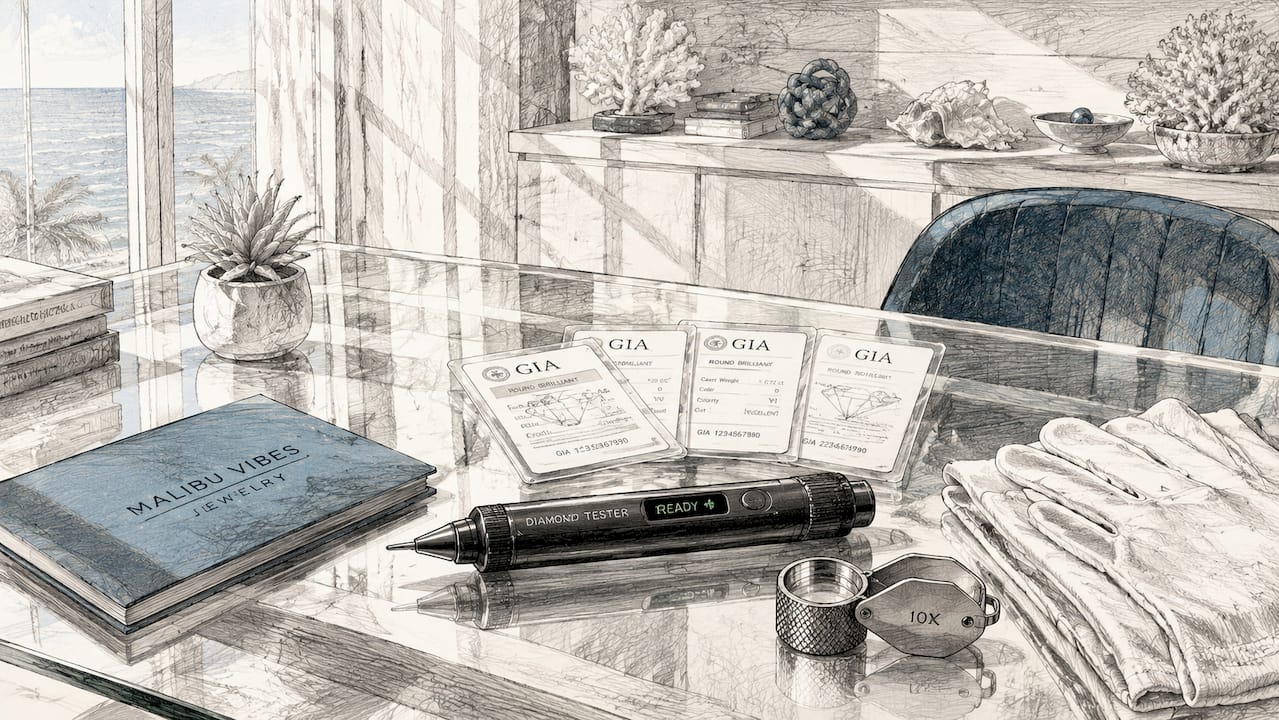
A well-lit environment is not optional. Sparkle, fire, and brilliance observations all depend on consistent lighting. Natural daylight near a window is the most reliable setting for visual tests.
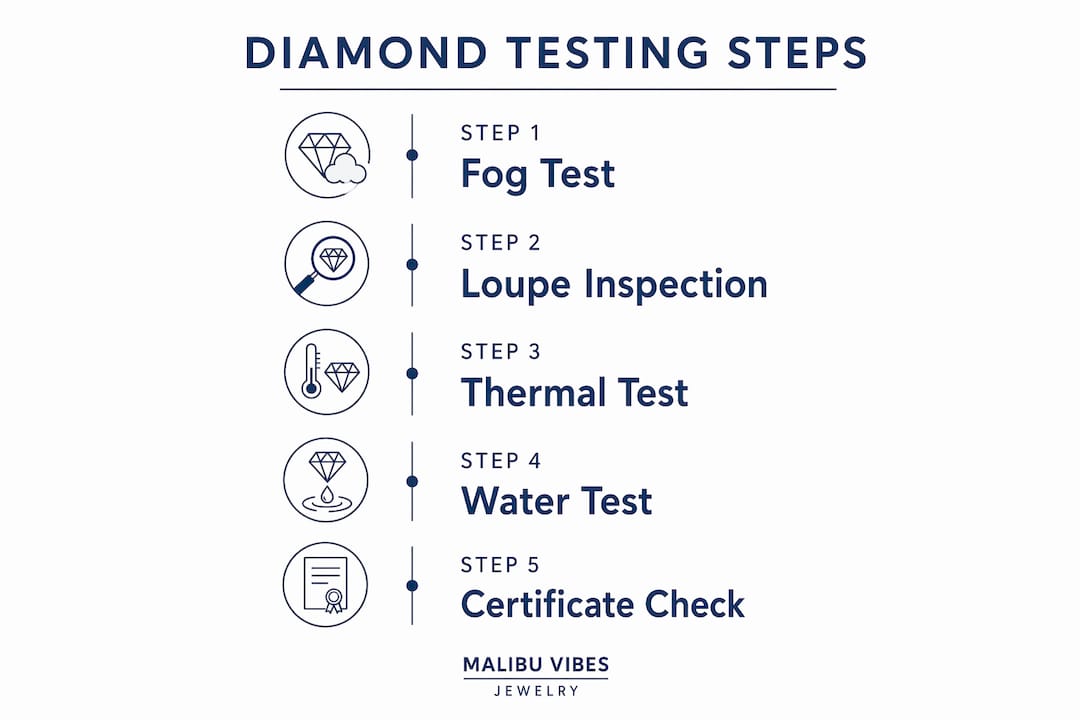
How to check diamond authenticity at home: step-by-step
Home tests give you a fast, practical first read on whether a stone is likely genuine. None of them are definitive on their own, but used together they build a strong picture.
-
Fog Test. Hold the stone close to your mouth and breathe on it like you are fogging a mirror. A real diamond disperses heat instantly, so the fog clears in one to two seconds. A simulant like cubic zirconia holds the fog for three to five seconds or longer. The fog test identifies 94% of cubic zirconia simulants accurately in 2026 testing across 50 common simulant types. That number reflects how reliably this simple test catches the most common fakes on the market.
-
Water Test. Drop the stone into a glass of water. A real diamond sinks because of its high density. Most fakes also sink, though, so this test has real limits. The water test is unreliable because density alone is a poor discriminator between diamonds and certain simulants. Use it as a quick first filter, not a conclusion.
-
Sparkle and Fire Observation. Hold the stone under a light source and tilt it slowly. Real diamonds produce white brilliance with subtle flashes of color called fire. Simulants like cubic zirconia produce intense rainbow reflections that look almost theatrical. If the stone throws off vivid, oversaturated color in every direction, that is a strong signal it is not a diamond.
-
Read-Through Test. Place the stone flat-side down on a printed page. If you can read the text through the stone, it is likely not a diamond. Real diamonds refract light so strongly that text appears distorted or invisible. This test works best with loose stones, not mounted ones.
-
Loupe Inspection. Examine the stone under 10x magnification. Natural diamonds almost always contain tiny inclusions, mineral traces, or growth patterns. Perfectly flawless stones under a loupe are rare and worth questioning unless accompanied by a grading report confirming flawless clarity.
Pro Tip: Run at least three of these tests in sequence. One passing result means little. Three consistent results pointing the same direction give you real confidence.
The critical limitation: lab-grown diamonds are chemically and physically identical to natural diamonds, so they pass every home test. If the origin of the diamond matters to you, certification is the only answer.
How does professional diamond verification work?
Professional verification is the gold standard for confirming diamond quality and origin. Certified gemologists use methods that no home test can replicate.
The three most respected grading labs are the Gemological Institute of America (GIA), the International Gemological Institute (IGI), and the American Gem Society (AGS). Each issues grading reports that document the 4Cs: cut, color, clarity, and carat weight. Third-party certification from GIA or IGI is the most reliable method for confident diamond purchases, according to professional jewelers.
Here is what a professional verification process includes:
- Dual conductivity testing: Professionals use testers that measure both thermal and electrical conductivity. This matters because thermal testers alone misidentify moissanite as diamond due to similar heat conduction. Only dual testers separate the two definitively.
- 10x magnification analysis: Certified appraisers examine inclusions, growth patterns, and surface characteristics. Multi-stage analysis with calibrated equipment identifies natural, lab-grown, and simulant diamonds in minutes.
- Laser inscription verification: Many certified diamonds have a microscopic report number laser-inscribed on the girdle. You can verify this number using the GIA Report Check tool online, which pulls up the official grading report for that specific stone.
- UV fluorescence testing: Some diamonds fluoresce blue under ultraviolet light. This is not a pass-or-fail test, but it adds one more data point to the overall picture.
| Verification Method | Who Performs It | What It Confirms |
|---|---|---|
| Fog Test | Buyer at home | Rules out most cubic zirconia |
| Water Test | Buyer at home | Basic density check only |
| Thermal Tester | Buyer or jeweler | Separates diamond from glass or CZ |
| Dual Conductivity Tester | Certified jeweler | Separates diamond from moissanite |
| GIA/IGI Grading Report | Gemological lab | Confirms 4Cs, origin, and authenticity |
Diamond certification documents the 4Cs but does not capture visual character like light performance or fluorescence behavior. Always request actual photos or video of the stone alongside the certificate. A report number and a real stone should match exactly.
For buyers purchasing online, Malibuvibesjewelry recommends reviewing the importance of certificates and appraisals before committing to any diamond purchase.
What are the most common diamond testing mistakes?
Most buyers make at least one of these errors. Knowing them in advance saves money and frustration.
“A single passing home test is not proof of authenticity. It is a starting point.”
The most frequent mistakes include:
- Trusting thermal testers alone. Basic thermal probes read moissanite as diamond because both materials conduct heat efficiently. Only dual testers measuring electrical conductivity catch this distinction. If a seller uses only a thermal tester to “prove” authenticity, that is not sufficient.
- Over-relying on the water test. The water test is the most widely shared home method online, yet it is also the least reliable. Dense simulants sink just like real diamonds. Treat it as a rough filter only.
- Assuming lab-grown diamonds are fake. Lab-grown diamonds pass all standard tests because they are chemically and physically real diamonds. The distinction between natural and lab-grown requires provenance documentation, not a fog test.
- Skipping certificate verification. A certificate without a matching laser inscription on the stone proves nothing. Always cross-reference the report number using GIA Report Check or IGI’s online portal.
- Accepting receipts as proof. A purchase receipt confirms a transaction, not a stone’s identity. Only a grading report from an independent lab confirms what you actually have.
Red flags from sellers include missing certificates, certificates from unknown labs, inconsistencies between the certificate description and the stone’s visible characteristics, and refusal to provide video or photos of the actual stone.
Home test vs. professional appraisal: which do you need?
The right verification method depends on what you are buying and what is at stake.
| Situation | Recommended Method | Estimated Cost |
|---|---|---|
| Checking a gift or inherited piece | Home tests (fog, sparkle, loupe) | Free |
| Buying a diamond under $500 | Home tests plus seller certificate | Free plus certificate review |
| Buying a diamond over $500 | Professional appraisal plus GIA/IGI report | $50–$150 for appraisal |
| Purchasing online without seeing the stone | Request GIA/IGI report and stone video | Free to verify online |
| Reselling or insuring a diamond | Certified appraisal required | $75–$200 |
Home tests work well as a first filter for low-stakes situations or when you already have a certificate and want a quick sanity check. For any purchase above a few hundred dollars, a grading report from GIA, IGI, or AGS is worth every cent. Professional jewelers consistently recommend third-party certification over home testing alone for confident purchases.
Finding a credible appraiser is straightforward. The American Society of Jewelry Appraisers (ASJA) and the National Association of Jewelry Appraisers (NAJA) both maintain directories of certified professionals. For online purchases, the diamond buying guide from Malibuvibesjewelry covers what to look for in seller transparency and certification standards.
Key takeaways
Reliable diamond verification combines at-home tests with professional certification, and no single method alone confirms authenticity for high-value purchases.
| Point | Details |
|---|---|
| Fog test is most reliable at home | The fog test identifies 94% of cubic zirconia simulants and takes under five seconds. |
| Dual testers beat thermal testers | Only testers measuring both thermal and electrical conductivity separate diamonds from moissanite. |
| Lab-grown diamonds pass all home tests | Certification and provenance documentation are the only way to distinguish lab-grown from natural. |
| GIA Report Check is free and definitive | Enter any certificate number at GIA’s website to confirm the grading report matches your stone. |
| Professional appraisal is worth the cost | For purchases over $500, a certified appraisal from ASJA or NAJA members protects your investment. |
What i’ve learned from years of watching buyers get this wrong
Most people approach diamond verification backwards. They run one home test, feel reassured, and stop there. The fog test is genuinely useful, but it only tells you what a stone is not. It does not tell you what it is.
The shift that changes everything is treating home tests as a screening step, not a conclusion. I have seen buyers walk away from perfectly real diamonds because a water test gave them pause, and I have seen others pay full price for moissanite because a basic thermal tester gave a green light. Both outcomes come from the same mistake: trusting one method too much.
The lab-grown diamond market has made this more complicated. A stone can be a real diamond in every scientific sense and still not be what a buyer expected. That gap is not a flaw in the stone. It is a gap in disclosure. Sellers who are transparent about origin, who provide GIA or IGI reports and let you verify inscriptions, are the ones worth buying from. Sellers who deflect those questions are not.
My honest recommendation: run the fog test and sparkle observation first. If both look right and the seller provides a verifiable grading report, you are in good shape. If either raises a question, pay for a professional appraisal before you commit. The cost of an appraisal is always less than the cost of a mistake.
— Ara
Shop certified diamond jewelry with confidence at Malibuvibesjewelry
Knowing how to verify diamond quality is only half the equation. The other half is buying from a seller who makes verification easy.

Malibuvibesjewelry sources and handcrafts fine diamond jewelry in Los Angeles, with a commitment to full transparency on materials and certification. Every piece in the diamond jewelry collection comes with detailed product descriptions, and the team provides photographic and video documentation of stones on request. Whether you are shopping for diamond rings or a gift for someone special, you can review the fine jewelry making process to understand exactly how each piece is crafted and certified. Buying confidently starts with a seller who has nothing to hide.
FAQ
What is the most reliable home test for a diamond?
The fog test is the most reliable at-home method, correctly identifying 94% of cubic zirconia simulants. Breathe on the stone and watch how quickly the fog clears.
Can a lab-grown diamond pass authenticity tests?
Yes. Lab-grown diamonds are chemically and physically identical to natural diamonds, so they pass every standard home test. Only a grading report with provenance disclosure distinguishes the two.
How do i verify a diamond certificate is real?
Enter the certificate number into the GIA Report Check tool at GIA’s official website. The report that appears should match your stone’s specifications and laser inscription exactly.
Do thermal testers work on moissanite?
No. Thermal testers alone read moissanite as diamond because both materials conduct heat similarly. A dual tester measuring electrical conductivity is required to tell them apart.
When should i get a professional diamond appraisal?
Get a professional appraisal for any diamond purchase above $500, for insurance purposes, or when reselling. Certified appraisers from ASJA or NAJA provide legally recognized documentation of a stone’s identity and value.
Recommended
- Diamond Buying Guide: How to Choose the Perfect Diamond – Malibu Vibes Jewelry
- Diamond Buying Guide: How to Choose Diamonds in 2026 – Malibu Vibes Jewelry
- How to identify quality jewelry: a 2026 buyer’s guide – Malibu Vibes Jewelry
- Navigate the Diamond Jewelry Buying Process: 5 Key Steps – Malibu Vibes Jewelry