

TL;DR:
- Choosing a ring stone depends on balancing durability, appearance, and personal meaning for daily wear. Hardness, toughness, and stability influence how well a gemstone withstands impacts, chemicals, and temperature changes over time. Sapphire and ruby offer optimal durability, while alternatives like moissanite provide great value and resilience for budget-conscious buyers.
The type of ring stones refers to the varieties of gemstones and materials selected for ring settings, evaluated primarily by durability, aesthetics, and personal meaning. Diamonds, sapphires, and emeralds are the industry benchmarks, but the full spectrum of popular ring stone varieties spans dozens of natural and lab-grown options. The stone you choose will determine how your ring looks, how it survives daily wear, and what it costs over a lifetime. This guide cuts through the noise so you can make that decision with confidence.
What are the main types of ring stones available?
Different types of gemstones used in rings fall into several distinct families, each with its own performance profile and visual identity. Understanding these categories is the fastest way to narrow your options before you ever walk into a store or browse a collection.
Diamonds and diamond alternatives remain the most requested stone options for rings worldwide. Natural diamonds sit at Mohs 10, the top of the hardness scale. Lab-grown moissanite and cubic zirconia offer visually similar results at a fraction of the price. Moissanite is always lab-grown and has become a leading budget-friendly choice because it combines near-diamond hardness with strong brilliance. Cubic zirconia is softer and less durable, making it better suited for fashion rings than everyday fine jewelry.
The corundum family includes sapphire and ruby, both rating Mohs 9. Sapphire comes in virtually every color, with blue sapphire being the most recognized. Ruby is the red variety of the same mineral, corundum, and carries one of the highest price-per-carat values among colored stones. Both are among the best stones for engagement rings because their hardness makes them genuinely practical for daily wear.
The beryl family covers emerald, aquamarine, and morganite. Emerald delivers a deep green that no other stone replicates. Aquamarine offers a cool blue-green tone at a more accessible price point. Morganite has surged in popularity over the past decade for its peachy-pink color and its compatibility with rose gold settings.
Other gemstone ring types worth knowing include:
- Tourmaline: Available in an extraordinary range of colors, including the prized Paraiba variety with its neon blue-green tone
- Garnet: Often associated with deep red, but also found in green (tsavorite) and orange (spessartine) varieties
- Spinel: A historically undervalued stone that mimics ruby and sapphire at a lower cost, now gaining serious collector interest
- Opal: Prized for its play-of-color effect, though it requires careful handling due to its softness
| Stone Family | Key Members | Mohs Hardness |
|---|---|---|
| Carbon | Diamond, moissanite | 10 / 9.25 |
| Corundum | Sapphire, ruby | 9 |
| Beryl | Emerald, aquamarine, morganite | 7.5–8 |
| Silicate | Tourmaline, spinel, garnet | 6.5–8 |
| Opal | Opal | 5.5–6.5 |
How does durability affect the choice of ring stones?
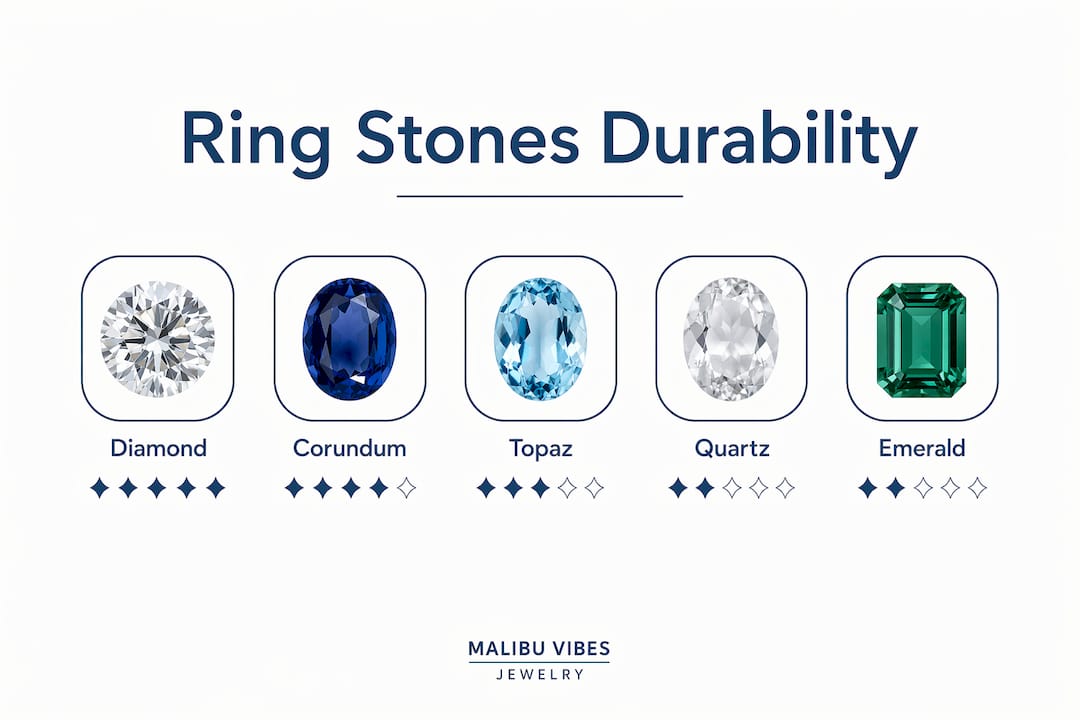
Durability is not a single measurement. IGI defines durability as a three-part framework covering hardness, toughness, and stability. Each factor governs a different failure mode, and ignoring any one of them leads to damaged stones and disappointed buyers.
Here is how each factor works in practice:
-
Hardness measures resistance to scratching, expressed on the Mohs scale. Stones rated Mohs 7 or above are generally recommended for daily-wear rings because they resist surface scratches from common materials like quartz dust found in everyday environments. Stones below Mohs 5 show visible wear within months of regular use.
-
Toughness measures resistance to chipping and splitting under impact. This is where the Mohs scale misleads buyers. The Mohs scale is not linear and gives no information about how a stone handles a sharp blow. Diamond scores a perfect 10 on hardness but has perfect cleavage planes. Diamond can chip if struck at the right angle, which surprises many buyers who assume hardness equals indestructibility.
-
Stability covers reactions to light, heat, and chemicals. Opals can crack from sudden temperature changes. Amethyst fades in prolonged sunlight. Emeralds are often treated with oils or resins to fill surface fractures, and harsh cleaning chemicals can remove those treatments, making the stone look worse over time.
“Durability is best approached as a three-factor checklist: hardness, toughness, and chemical or thermal stability, each governing different failure modes in ring stones.” — IGI
Emerald is the clearest example of why hardness alone misleads. Emerald rates 7.5–8 on the Mohs scale but is brittle due to its many natural inclusions, called jardin. A hard knock can fracture an emerald that would survive the same impact in a sapphire. This makes emerald a stone for people who understand its care requirements, not a casual everyday choice.
Pro Tip: When evaluating any ring stone, ask your jeweler about all three durability factors, not just the Mohs rating. A stone rated Mohs 8 with poor toughness can fail faster in daily wear than a Mohs 7 stone with excellent toughness.
Comparing popular ring stones by durability, cost, and style
Choosing between gemstone ring types comes down to matching the stone’s real-world performance to your lifestyle and budget. The table below gives you a direct comparison of the most common options.
| Stone | Mohs | Toughness | Daily Wear | Relative Cost |
|---|---|---|---|---|
| Diamond | 10 | Good (cleavage risk) | Excellent | High |
| Sapphire | 9 | Excellent | Excellent | Medium-High |
| Ruby | 9 | Excellent | Excellent | High |
| Moissanite | 9.25 | Excellent | Excellent | Low-Medium |
| Emerald | 7.5–8 | Poor | With care | Medium-High |
| Morganite | 7.5–8 | Good | Good | Low-Medium |
| Opal | 5.5–6.5 | Poor | Not recommended | Varies |
Sapphire and ruby are the strongest colored stone options for rings that see daily wear. They combine near-diamond hardness with excellent toughness, meaning they handle both scratches and impacts well. Colored gemstones in engagement rings provide vibrant alternatives to diamonds, but each requires a proper durability assessment based on gem family and any treatments applied.
Morganite has become a favorite for its soft color and affordability, but buyers should know it requires more frequent cleaning because its light color shows oils and residue quickly. Opal is genuinely beautiful and unlike any other stone, but stones softer than Mohs 7 require protective settings and gentler wear expectations. An opal in a bezel setting worn only on special occasions is a completely reasonable choice. An opal in a prong setting worn while cooking and gardening is not.
Pro Tip: Bezel and halo settings wrap around or buffer the stone’s edges, significantly reducing chip risk for softer stones like emerald, morganite, and opal. If you love a delicate stone, the right setting makes it wearable.
For buyers focused on gemstone rings with lasting value, sapphire and ruby consistently hold their appeal over decades because their color does not fade and their hardness keeps them looking polished.
How to select the right ring stone for your lifestyle
Matching a ring stone to your life requires honest answers to a few practical questions. The most beautiful stone in the world is a poor choice if it cannot survive your daily routine.
Consider these factors before deciding:
- Your work environment: Hands-on work involving tools, chemicals, or frequent hand-washing puts stones under real stress. Diamond, sapphire, and moissanite handle this best. Emerald and opal do not.
- Your care tolerance: Some stones need ultrasonic cleaning avoided, chemical exposure minimized, and periodic re-oiling. If you want a ring you can forget about, choose diamond, sapphire, or ruby.
- Color and personal meaning: Sapphire carries associations with loyalty and wisdom. Ruby signals passion. Emerald connects to growth and renewal. The meaning behind different gemstones matters to many buyers and adds a layer of intention to the purchase.
- Setting style: A bezel setting protects vulnerable edges on softer stones. A prong setting maximizes light exposure for brilliant stones like diamond and moissanite. The setting is not just aesthetic. It is part of the stone’s protection system.
- Budget: Moissanite delivers diamond-level durability at a significantly lower price. Spinel offers ruby-like color at a fraction of ruby’s cost. Knowing the alternatives lets you get more stone for your money without compromising on wearability.
The best stone for an engagement ring is the one that balances what you love visually with what your life actually demands. A nurse who washes her hands 40 times a day needs a different stone than someone who works at a desk. Neither choice is wrong. Both need to be informed.
For buyers exploring types of birthstone rings or stones tied to personal significance, the same durability framework applies. A birthstone in a protective setting can absolutely be worn daily if the right precautions are taken.
Key takeaways
Choosing the right ring stone requires evaluating hardness, toughness, and stability together, not hardness alone.
| Point | Details |
|---|---|
| Three-factor durability | Assess hardness, toughness, and stability before selecting any ring stone. |
| Mohs 7 is the daily-wear threshold | Stones below Mohs 7 show wear quickly and need protective settings for regular use. |
| Diamond can chip | Perfect cleavage planes mean even the hardest stone can split under a sharp impact. |
| Setting protects the stone | Bezel and halo settings reduce chip risk for softer stones like emerald and opal. |
| Alternatives are legitimate | Moissanite and sapphire offer near-diamond durability at lower or comparable cost. |
What I’ve learned from watching buyers choose the wrong stone
Most buyers who end up disappointed with their ring stone made the same mistake: they chose based on appearance alone and found out about durability the hard way. I have seen gorgeous emerald rings come back chipped within a year because nobody explained the brittleness issue. I have seen opal rings that looked stunning in the store and cloudy within six months because the buyer used standard jewelry cleaner on them.
The industry does not always make this easy. Hardness ratings get front-and-center placement in product descriptions, while toughness and stability get buried in footnotes. That gap in communication costs buyers real money and real heartbreak.
My honest recommendation: if you want a colored stone and you live an active life, start with sapphire or ruby. They give you everything, vibrant color, excellent durability, and a long history of use in fine jewelry, without the compromises that come with beryl family stones or opals. If budget is the primary concern, moissanite is not a consolation prize. It is a genuinely excellent stone that outperforms diamond in some optical measures.
The one thing I would push back on is the idea that softer stones have no place in rings. They do. An emerald in a bezel setting, worn with awareness of its limits, is a spectacular choice for someone who loves it. The key is going in with accurate information, not marketing language.
— Ara
Explore handcrafted ring stones at Malibuvibesjewelry
Malibuvibesjewelry brings together the full range of ring stone choices in handcrafted fine jewelry made in Los Angeles. Every piece is built with durability and aesthetics in mind, from the stone selection to the setting style.

Browse the solid gold gemstone rings collection featuring ruby, emerald, and sapphire set in 14k gold, or explore the fine diamond ring selection for classic brilliance that lasts a lifetime. If you want to understand how each piece is built to last, the jewelry making process page walks through every step from stone sourcing to final setting. Quality over quantity is not a slogan at Malibuvibesjewelry. It is the standard every piece is held to.
FAQ
What is the most durable stone for everyday rings?
Diamond, sapphire, and moissanite are the most durable options for daily wear, each rating Mohs 9 or above with strong toughness. Sapphire and moissanite are particularly reliable because they combine high hardness with excellent resistance to chipping.
Are lab-grown stones a good choice for rings?
Lab-grown moissanite and synthetic sapphires offer the same physical properties as their natural counterparts and are excellent ring stones. Moissanite in particular is always lab-grown and provides near-diamond durability at a significantly lower price point.
Why does emerald require special care in rings?
Emerald rates 7.5–8 on the Mohs scale but has poor toughness due to natural inclusions, making it prone to chipping under impact. Most emeralds are also treated with oils or resins that can be damaged by ultrasonic cleaners or harsh chemicals.
What setting best protects a softer ring stone?
A bezel setting, which wraps a metal rim around the stone’s edge, provides the most protection for softer or more brittle stones like emerald, morganite, and opal. Halo settings also add a buffer around the center stone and reduce direct impact risk.
How do I identify quality gemstones before buying?
Look for stones with consistent color saturation, minimal visible inclusions, and certification from recognized labs like GIA or IGI. Malibuvibesjewelry also provides a gemstone quality guide that walks through what to look for when buying fine jewelry online.