

Finding a bracelet that feels perfectly comfortable is more challenging than it looks, especially for those who care about quality and style. An ill-fitting piece can slide awkwardly or pinch, but accurate wrist measurement transforms the entire experience. Understanding how your wrist’s unique shape and the structure of materials like sterling silver and 14k gold impact fit helps you confidently select pieces you’ll love to wear. Discover how precise sizing lays the foundation for elegance and everyday comfort.
Table of Contents
- Wrist Size For Bracelet: Core Principles
- Measuring Your Wrist For Accurate Sizing
- Choosing The Right Fit And Bracelet Style
- Bracelet Types And How Sizing Affects Them
- Common Sizing Errors And Expert Tips
Key Takeaways
| Point | Details |
|---|---|
| Accurate Measurement is Crucial | Use a flexible measuring tape to ensure your wrist size is taken correctly for a comfortable fit. |
| Comfort Allowance is Necessary | Always add half an inch to your base wrist measurement to account for comfort when choosing a bracelet size. |
| Consider Bracelet Style | Different styles have unique fit requirements; rigid styles like bangles need precise measurements while flexible styles allow for some adjustment. |
| Avoid Common Sizing Errors | Common mistakes include measuring the wrong wrist or skipping the comfort allowance—double-check your measurements for accuracy. |
Wrist size for bracelet: Core principles
Getting your wrist size right is the foundation of a bracelet that actually feels comfortable to wear every day. An ill-fitting bracelet either slides around awkwardly or cuts off circulation, so understanding how to measure and what measurements mean is essential.
The first principle is accuracy. Your wrist isn’t a simple cylinder—it’s shaped by complex bone and tissue structures that affect how a bracelet sits. Taking a measurement matters, but understanding why that measurement matters is what separates a guessing game from a confident purchase.
Key Core Principles:
- Measure correctly – Use a flexible measuring tape snugly around your wrist at the wrist bone, not too tight or loose
- Account for the fit zone – Add approximately half an inch to your base wrist measurement for proper comfort
- Know the difference between tight and secure – A bracelet should sit with a slight gap you can fit a finger through, not wrap around like a bandage
- Consider the material – Precious metals like 14k gold and sterling silver don’t stretch, so sizing accuracy is non-negotiable
- Think about layering – If you plan to wear multiple bracelets together, you may need slightly more room
Why does this matter? Because ensuring comfortable and secure bracelet fit affects how you feel wearing your piece throughout the day. When a bracelet fits correctly, you’ll actually keep it on.
Another core principle involves understanding the relationship between your wrist’s unique shape and how different bracelet styles sit on it. A rigid bangle sits differently than a flexible chain or a solid cuff. Your measurement gives you the starting point, but style preference influences the final fit decision.
A properly fitted bracelet should allow one finger to slip underneath—comfortable enough to wear all day, secure enough that it won’t slip off.
Think about the occasions you’ll wear your bracelet, too. An everyday piece might need looser sizing for comfort during extended wear, while a special-occasion bracelet can sit slightly snugger. This is where understanding core principles becomes personal—your lifestyle shapes your sizing choice.
The connection between accurate measurement and satisfaction runs deeper than most people realize. When you get this right from the start, returns become unnecessary. You’re investing in quality handcrafted pieces, so taking time with sizing upfront protects that investment.
Pro tip: Measure your wrist at different times of day—morning and evening measurements can vary slightly due to natural swelling, so take your measurement in the afternoon when your wrist is at its typical size.
Measuring your wrist for accurate sizing
Accurate measurement is where precision jewelry starts. Without it, you’re essentially guessing, and guessing often leads to returns and frustration. Let’s walk through exactly how to measure your wrist so your bracelet arrives ready to wear.
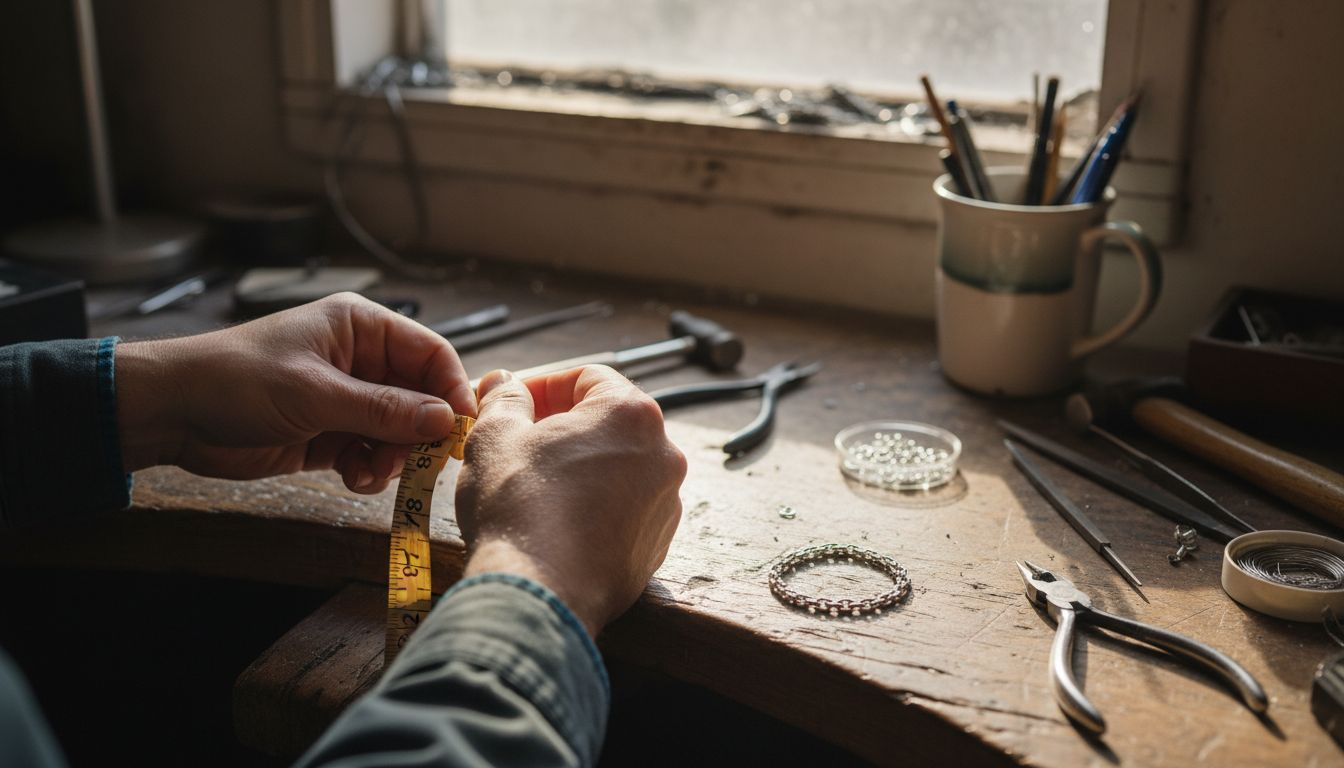
Start with the right tool. A flexible measuring tape works best, but you don’t need anything fancy. If you don’t have one at home, alternative materials like string or paper work just fine—you’ll just need a ruler afterward to convert the measurement.
Here’s the step-by-step process:
- Wrap the measuring tape snugly around your wrist at the widest part, typically where your wrist bones are most prominent
- Keep the tape flat and comfortable—not twisted, not digging in
- Make sure you can slip one finger underneath the tape; this prevents the measurement from being too tight
- Note the exact measurement in inches
- Add half an inch to this number for your actual bracelet size
Why add that extra half inch? Because measuring internal circumference accurately means accounting for comfort. Your bracelet shouldn’t sit like a rubber band around your wrist. That extra half inch creates the sweet spot between security and wearability.
The most common mistake is measuring too tightly. Your bracelet needs to move slightly on your wrist without being loose enough to slip off during daily activities.
Timing matters more than you’d think. Your wrist size fluctuates throughout the day—it’s slightly smaller in the morning and can swell by evening, especially on warm days. Measure in the afternoon when your wrist is at its typical size.
Consider your lifestyle when you measure. If you’re taking measurements for an everyday bracelet you’ll wear constantly, lean toward the slightly looser end of comfortable. For special-occasion pieces, you can be more precise to your exact measurement.
Document everything. Write down your measurement and the date you took it. This becomes your reference point for future bracelet purchases and helps you remember which bracelets work best for your wrist.
Pro tip: Measure your wrist three times on the same day and average the numbers—tiny variations happen naturally, and averaging gives you the most reliable measurement for your final bracelet size.
Choosing the right fit and bracelet style
Your measurement is just the starting point. The real magic happens when you match that measurement to a bracelet style that actually works for your wrist and lifestyle. Different styles behave differently, and picking the wrong style for your wrist is like picking the wrong shoe size.
Bracelet styles have distinct fit personalities. A rigid bangle requires more precision because it won’t adjust to your wrist. A flexible chain bracelet offers more forgiveness. Different bracelet styles affect fit in ways that go beyond just numbers on a measuring tape.
Here’s how to think about each style:
- Bangles and cuffs – These rigid pieces need exact sizing; they won’t budge once on your wrist, so precision matters enormously
- Chain bracelets – More flexible styles can sit slightly looser since the links move with your wrist
- Tennis bracelets – These sit flush against your skin and work best with snug sizing for security
- Wrap bracelets – Ultra-flexible wraps work across a wider range of sizes since they conform to your wrist shape
Consider how you’ll actually wear your bracelet. Will it be a daily piece you put on and leave alone, or something you’ll take off and put on multiple times? Daily bracelets benefit from slightly looser sizing for comfort during extended wear. Special-occasion pieces can fit more snugly.
Proper fit prevents spinning, slipping, and discomfort—three problems that make you hate wearing something you paid good money for. Your bracelet should stay in place without feeling like a constraint.
A bracelet that fits perfectly should move slightly on your wrist but stay put during normal hand movement—no spinning, no slipping, no cutting off circulation.
Material matters too. Precious metals like 14k gold and sterling silver don’t stretch, so sizing accuracy directly impacts wearability. If you’re choosing multiple bracelets to stack, consider whether you want them tight individually or if you’re building an intentional layered look with breathing room.
Think about your wrist shape and bone structure. Smaller-framed wrists might need more careful cuff selection because standard sizes can look oversized. Larger wrists might find bangles slip unless sized correctly.
Pro tip: When selecting a style, consider ordering from retailers with flexible return policies so you can test how the bracelet actually feels on your wrist before committing—measurements are helpful, but real-world comfort is what matters most.
Bracelet types and how sizing affects them
Not all bracelets are created equal. A bangle that fits perfectly might be completely wrong for another person, while a chain bracelet with a clasp offers flexibility that rigid styles can’t match. Understanding how each type responds to sizing makes all the difference in finding pieces you’ll actually love wearing.
Rigid bracelets demand precision. Bangles and cuffs have zero adjustment capability—what you measure is what you get. Once they’re on your wrist, they stay exactly that size. This is why rigid bangles require more accurate sizing than any other bracelet type. A quarter-inch off in measurement becomes immediately noticeable.
Chain and link bracelets offer more breathing room. Most feature clasps that allow you to adjust the length, giving you flexibility if your wrist size fluctuates slightly. The links move independently, which means they conform to your wrist’s natural shape rather than forcing a predetermined fit.
Here’s how different types compare:
Here’s how common bracelet types compare in terms of sizing and flexibility:
| Bracelet Type | Sizing Flexibility | Adjustment Needed | Best For |
|---|---|---|---|
| Rigid Bangles | None; fixed once sized | Precise measurement | Special occasions, daily wear |
| Chain with Clasp | Adjustable, up to 1 inch | Slight allowance | Everyday comfort |
| Tennis Bracelet | Minimal; sits flush | Snug fit | Secure, elegant style |
| Stretch Bracelet | Very flexible; stretches | Minimal concern | Active lifestyles, easy on/off |
| Wrap Bracelet | Highly flexible | Little to no adjustment | Layering, various wrist sizes |
- Bangles – Fixed size; must be measured with extreme precision; slip on over your hand
- Cuffs – Fixed size; open slightly to slide onto wrist; no adjustment once sized
- Chain bracelets – Adjustable via clasp; offer 0.5 to 1 inch of sizing flexibility
- Tennis bracelets – Relatively fixed; sit flush against skin; require snug, accurate sizing
- Beaded or stretch bracelets – Stretchy material accommodates varying wrist sizes naturally
- Wrap bracelets – Ultra-flexible; work across multiple wrist sizes without resizing
Material flexibility influences sizing too. Stretchy or adjustable designs offer more comfort flexibility for people whose wrist size varies. Precious metals like sterling silver and 14k gold don’t stretch, so you’re locked into your measurement.
The bracelet type you choose directly determines how forgiving your sizing can be—rigid styles need precision, while adjustable styles give you grace.
Consider your lifestyle when choosing a type. If you love changing your jewelry frequently, adjustable styles save you money since one bracelet works across a range of sizes. If you want a signature everyday piece, rigid styles offer that locked-in perfect fit that never shifts.
Small-framed wrists face unique challenges with standard-sized bangles, which often feel oversized and slide off. Wrap bracelets and stretchy styles become better solutions than rigid bangles in these situations.
Pro tip: Match your bracelet type to your lifestyle—choose adjustable styles for pieces you’ll wear daily and change frequently, but invest in precisely sized rigid styles for special-occasion jewelry you’ll keep forever.
Common sizing errors and expert tips
Most bracelet sizing mistakes happen because people rush through the measurement process or make incorrect assumptions about how bracelets should fit. These errors cost you money in returns and wasted time. Learning what to avoid saves you both.
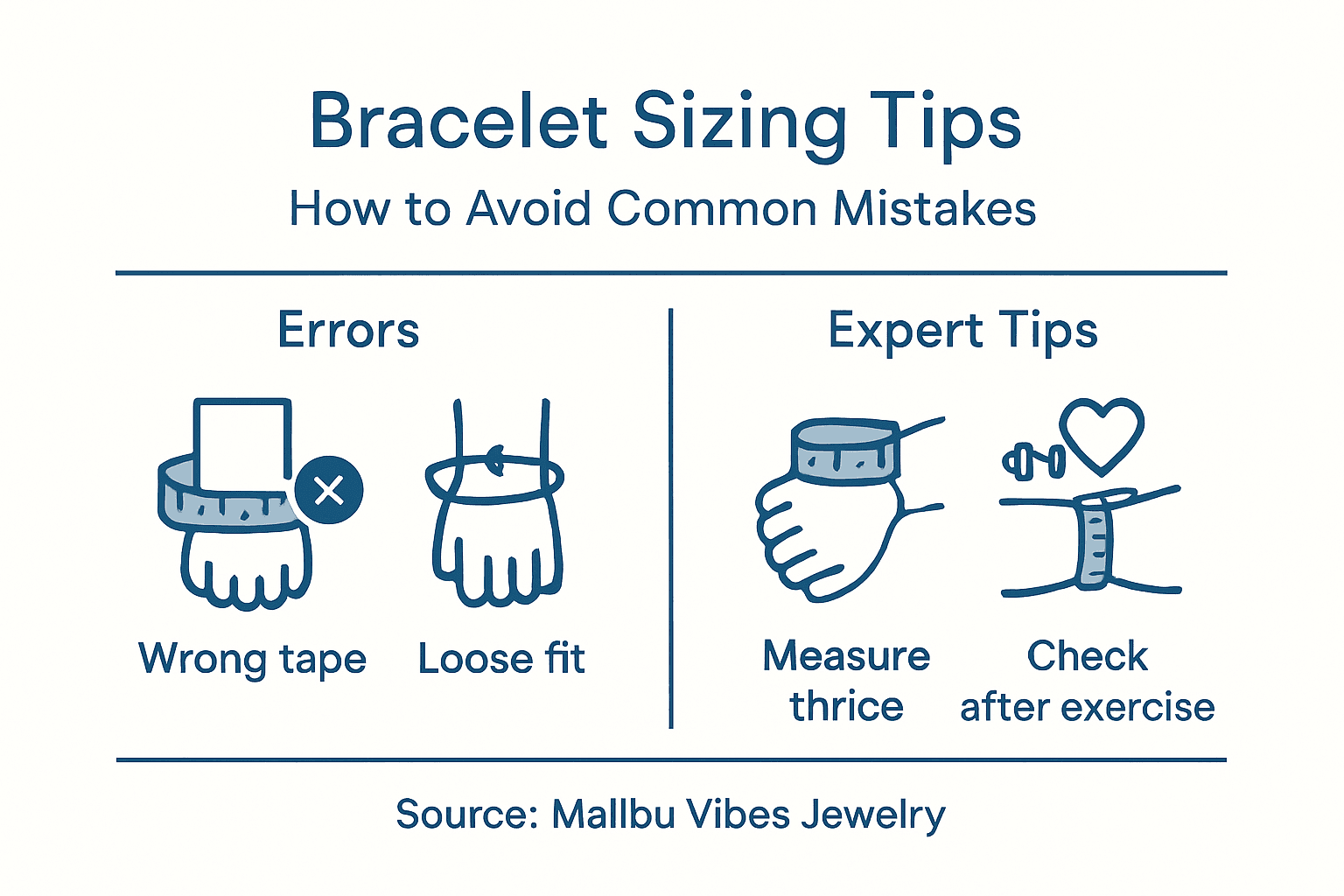
The biggest mistake? Measuring the wrong wrist. Sounds obvious, but people measure their dominant hand when their non-dominant wrist is actually smaller. Common measurement errors include using incorrect measuring tools or failing to add the comfort allowance. Always measure the exact wrist where you’ll wear the bracelet.
Here are the most frequent sizing errors:
- Measuring too tightly – Wrapping the tape snug against skin gives false readings that are too small
- Forgetting the half-inch allowance – This is non-negotiable for comfort; skipping it guarantees regret
- Using the wrong measuring tool – Rigid rulers don’t conform to wrist shape; use flexible tape
- Not rechecking your measurement – One measurement is never enough; verify at least twice
- Ignoring wrist swelling – Morning measurements differ from afternoon ones by up to a half inch
- Assuming all bracelets fit the same – Each style has different sizing requirements based on rigidity
Underestimating wrist circumference and not accounting for anatomical variations leads to ill-fitting bracelets that either slip off or feel uncomfortably tight. Your wrist has unique bone structure and soft tissue composition that affects fit.
This table highlights sizing errors and how to avoid them for better bracelet fit:
| Sizing Error | Consequence | How to Avoid |
|---|---|---|
| Measuring wrong wrist | Bracelet fits incorrectly | Always measure intended wrist |
| Too-tight measurement | Bracelet feels constrictive | Slip one finger under the tape |
| Skipping comfort allowance | Bracelet is too tight | Add 0.5 inch to measurement |
| Using rigid ruler | Measurement is inaccurate | Use a flexible measuring tape |
| Only measuring once | Risk of fluctuation error | Take and average multiple readings |
The most expensive mistake is buying without measuring at all. One incorrect purchase costs more than taking five minutes to measure properly.
Expert tips to get it right: Use a soft measuring tape, not paper or string. Keep the tape flat and parallel to the ground as you wrap it around your wrist. Add that half inch. Then measure again the next day to confirm consistency.
Consider your lifestyle too. If your wrists swell during workouts or on hot days, measure after these activities to capture your largest wrist size. Conservative sizing prevents future disappointment.
When ordering, note the retailer’s return policy. Even with perfect measurements, sometimes a bracelet feels different on than expected. Having a return window protects your investment while you verify the fit works for you.
Pro tip: Measure your wrist three separate times on different days and average the results—this accounts for natural daily fluctuations and gives you the most reliable sizing number for ordering.
Find Your Perfect Bracelet Fit with Malibu Vibes Jewelry
Understanding the exact wrist size to find a bracelet that fits comfortably and securely is essential. The article highlights common sizing challenges like measuring too tightly, forgetting comfort allowances, and choosing the wrong bracelet style. At Malibu Vibes Jewelry, we share your desire for both style and comfort by offering a curated selection of handcrafted bracelets made from precious metals like 14k gold and sterling silver that honor these sizing principles. Our collection is designed for everyday wear and special occasions where a perfect fit matters.

Explore our carefully crafted bracelets today at Malibu Vibes Jewelry and enjoy the confidence that comes with choosing jewelry made with precision and care. Don’t settle for bracelets that slip, spin, or feel restrictive. Check out our full range of pieces that balance luxurious craftsmanship with thoughtful sizing. Start your journey to flawless fit and lasting comfort by visiting Malibu Vibes Jewelry now and experience jewelry made just for you.
Frequently Asked Questions
How do I accurately measure my wrist for a bracelet?
To measure your wrist accurately, use a flexible measuring tape and wrap it snugly around the widest part of your wrist, near the wrist bones. Ensure that you can slip one finger underneath the tape and note the measurement. Then, add half an inch to this measurement for comfort.
Why is adding half an inch to my wrist measurement necessary?
Adding half an inch to your wrist measurement ensures comfort by preventing the bracelet from fitting too tightly. This extra allowance allows for slight movement and makes sure the bracelet doesn’t slip off easily.
What are the different types of bracelets and how does sizing affect them?
There are various types of bracelets, including rigid bangles, chain bracelets, tennis bracelets, and wrap bracelets. Rigid styles require precise sizing, as they don’t adjust, while chain and wrap bracelets offer more flexibility and can accommodate slight size variations.
What common mistakes should I avoid when measuring my wrist size?
Common mistakes include measuring too tightly, failing to add the comfort allowance, using a rigid measuring tool instead of a flexible tape, and not measuring multiple times to account for natural size fluctuations. Always measure the actual wrist intended for the bracelet to ensure the right fit.
Recommended
- Bracelet Size Guide: Finding Your Ideal Fit – Malibu Vibes Jewelry
- How to Measure Wrist for Bracelet? | Malibu Vibes Jewelry
- Bracelet Size Chart – Ensuring Perfect Fit and Style – Malibu Vibes Jewelry
- Jewelry Sizing Guide: Perfect Fit for Luxury Accessories – Malibu Vibes Jewelry
- La Importancia del Ajuste Perfecto en la Ropa Masculina