

TL;DR:
- Ethical jewelry is crafted using sustainable materials, fair labor practices, and transparent sourcing verified by independent certifications. Consumers should seek detailed proof, such as mine-level or full chain-of-custody traceability, rather than relying solely on logos or vague claims. Supporting brands with verified certifications and considering recycled, vintage, or secondhand pieces are the most responsible choices.
Ethical jewelry is defined as pieces crafted with sustainable materials, fair labor practices, and transparent sourcing across every step of the supply chain. Knowing how to shop ethical jewelry means going beyond a pretty design and asking harder questions: Where was this gold mined? Who cut this gemstone, and under what conditions? Certifications like Fairmined, Fairtrade, and the Kimberley Process exist precisely to answer those questions with verified evidence rather than marketing copy. The good news is that the tools to shop responsibly have never been more accessible, and brands that prioritize transparency are making it easier to align your purchases with your values.
What certifications and standards guarantee ethical jewelry?
Certifications are the most reliable shortcut to responsible jewelry shopping because they replace brand promises with independent audits. Four programs dominate the conversation in 2026, and understanding what each one actually covers prevents you from being misled by a logo on a website.
Fairmined and Fairtrade for mined gold and silver
Fairtrade and Fairmined certifications are credible third-party schemes that verify mined gold meets ethical labor and environmental standards through independent audits of mining operations. Both programs focus on artisanal and small-scale mining communities, ensuring workers receive fair wages, safe conditions, and a price premium that funds community development. If a brand claims Fairmined or Fairtrade gold, ask for the certificate number and cross-reference it on the program’s public registry.
Kimberley Process for conflict-free diamonds
The Kimberley Process Certification Scheme requires every rough diamond shipment to carry a government-issued certificate confirming it is conflict-free, with shipments refused entry at borders without valid documentation. This matters because it creates a legal paper trail at the point of import and export. However, the Kimberley Process has a well-documented limitation: its definition of “conflict diamond” covers only rough diamonds used by rebel groups, which means state-perpetrated abuses and post-mining labor conditions fall entirely outside its scope. A KP certificate is a starting point, not a complete ethical guarantee.
Responsible Jewellery Council standards
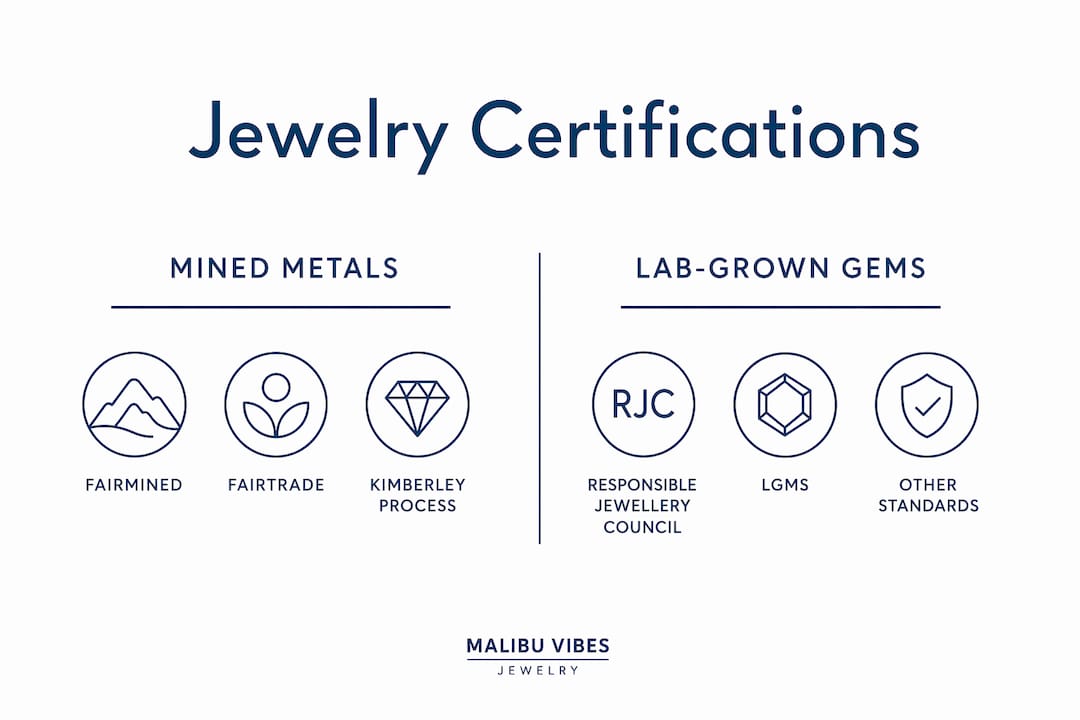
The RJC revised its Code of Practices in 2024, with the updated standards effective from January 2025, including third-party audits that verify ethical business practices and traceability from mining through to retail. The RJC’s Chain of Custody program is particularly useful because it tracks certified materials through each stage of production. Critically, RJC certification logos indicate company-level compliance but do not guarantee product-level provenance without accompanying traceability documentation. This distinction matters when you are evaluating a specific ring or necklace rather than a brand overall.
LGMS for lab-grown diamonds
The demand for responsible practices in lab-grown diamonds led to the Laboratory Grown Materials Standard, which focuses on transparent disclosure and minimizing environmental impacts in production and marketing. Lab-grown stones are not automatically ethical simply because they avoid mining. Energy-intensive manufacturing processes and misleading marketing claims are real concerns, and the LGMS addresses both by requiring verified disclosures.
Pro Tip: Before purchasing, search the brand’s certification number on the Fairmined, Fairtrade, or RJC public registries. A legitimate certification is always verifiable online within seconds.
How does traceability work in the jewelry supply chain?
Traceability is the ability to follow a material from its origin to the finished piece you wear, and traceability depth varies significantly: lot-level traceability tracks batches, mine-level traces origin to a specific mining site, and full chain-of-custody tracks every transfer step between extraction and sale. Higher traceability depth generally increases confidence in ethical claims and justifies price premiums. Understanding these levels helps you ask the right questions and evaluate whether a brand’s transparency is genuine or superficial.
Traceability levels compared
| Level | What it verifies | Consumer confidence |
|---|---|---|
| Lot-level | Batch origin, not individual mine | Low to moderate |
| Mine-level | Specific mine of origin | Moderate to high |
| Full chain-of-custody | Every transfer from mine to retailer | Highest |
Most brands operate at lot-level traceability at best. Full chain-of-custody documentation, such as what the Kimberley Process verification centers in Antwerp’s Diamond Office provide through physical inspection and resealing, represents the gold standard for provenance credibility. When a brand claims ethical sourcing, ask specifically which level of traceability they maintain and whether they can provide documentation.
What you should request from sellers before buying:
- A copy of the certification document, not just a logo
- The name of the mine or mining region for gemstones and metals
- The name of the third-party auditor and the date of the last audit
- Whether the brand participates in RJC’s Chain of Custody program
The honest challenge is that current certification systems have gaps. No single program covers every material, every country of origin, or every stage of production. Consumers who want full provenance should seek extended chain-of-custody documentation rather than relying on a single certification logo.
Pro Tip: Ask brands directly: “Can you tell me the mine of origin for the gold in this piece?” A brand committed to traceability will answer specifically. A brand that deflects to general certification language likely cannot trace beyond the lot level.
Practical steps for buying sustainable jewelry
Choosing sustainable jewelry is a decision made across three areas: the materials in the piece, the brand behind it, and the purchasing channel you use. Each area offers concrete ways to reduce harm and support better practices.
Choose materials with a lower footprint
Recycled gold and silver dramatically reduce environmental impact compared to new mining, making recycled metals one of the most straightforward eco-friendly jewelry options available. Look for pieces stamped with recycled content claims backed by certification, such as the Responsible Jewellery Council’s Chain of Custody for recycled materials. Lab-grown diamonds and gemstones offer another path, provided the manufacturer follows the LGMS standard for transparent disclosure. For colored gemstones like sapphires, rubies, and emeralds, ask specifically about sourcing ethical gemstones from regions with strong labor protections, such as Canadian diamonds or Montana sapphires.
Research brand reputation before you buy
Supporting ethical brands requires more than reading their “About” page. Follow these steps in order:
- Search the brand name alongside terms like “labor practices,” “sourcing,” or “audit” to surface any documented concerns.
- Check whether the brand is listed on the RJC member directory or holds a current Fairmined or Fairtrade license.
- Read the brand’s supply chain transparency report if one exists. Brands serious about ethics publish these annually.
- Look for specifics in product descriptions. Vague phrases like “responsibly sourced” without certification names are red flags.
- Check packaging claims. Brands committed to sustainability typically use recycled or minimal packaging and disclose this openly.
Consider secondhand and vintage jewelry
Vintage and secondhand pieces carry zero new mining footprint, making them among the most ethical purchases available. Estate jewelry, antique markets, and certified pre-owned programs from established jewelers all provide access to high-quality pieces without adding demand for new extraction. This is an underused option in responsible jewelry shopping conversations, and it deserves more attention.
Pro Tip: When evaluating a brand’s ethics claims, look for specificity over sentiment. “We use Fairmined-certified gold from the Chocó region of Colombia” is credible. “We care deeply about the planet” is not.
Common misconceptions about ethical jewelry claims
The most dangerous assumption in ethical jewelry shopping is that one certificate covers everything. It does not, and understanding where each program stops is as important as knowing what it covers.
“Conflict-free” does not mean fully ethical. The Kimberley Process definition of conflict diamond covers only rough diamonds used by rebel groups to finance wars against governments. State-perpetrated human rights abuses, dangerous working conditions, child labor, and environmental destruction in mining communities all fall outside this definition. A diamond can carry a KP certificate and still have a troubling supply chain story.
Grading certificates are not ethical certificates. GIA and IGI grading reports assess a gemstone’s cut, color, clarity, and carat weight. They say nothing about where the stone was mined, who mined it, or under what conditions. Consumers regularly confuse the two, assuming a GIA certificate implies ethical sourcing. It does not. Ethical sourcing requires separate certification paperwork entirely.
A brand’s RJC membership does not guarantee every product is traceable. As noted earlier, RJC logos signal company-level compliance, not product-level provenance. A company can hold RJC certification while selling individual pieces that lack full chain-of-custody documentation. Always ask about the specific piece, not just the brand.
Marketing language is not a standard. Terms like “ethically sourced,” “sustainable,” “eco-friendly,” and “responsibly made” have no legal definition in the jewelry industry. Any brand can use them without meeting any external standard. Your job as a buyer is to push past the language and ask for the documentation that backs it up. A jewelry buying checklist that includes certification verification is a practical tool for every purchase.
Key takeaways
Responsible jewelry shopping requires verified certifications, traceability documentation, and critical evaluation of marketing claims rather than brand promises alone.
| Point | Details |
|---|---|
| Certifications matter, but know their limits | Fairmined, Fairtrade, and RJC cover different scopes. No single certification covers everything. |
| Traceability depth determines confidence | Mine-level or full chain-of-custody documentation provides the strongest ethical assurance. |
| Grading is not sourcing | GIA and IGI certificates grade quality only. Ethical sourcing requires separate documentation. |
| Recycled and secondhand are strong choices | Recycled metals and vintage pieces eliminate new mining demand entirely. |
| Push brands for specifics | Vague sustainability language without named certifications or audit dates is a red flag. |
What I’ve learned from years of watching this industry evolve
I have followed the ethical jewelry space long enough to see both genuine progress and persistent greenwashing, and the gap between the two is wider than most buyers realize.
The RJC’s 2024 revisions represent a real cultural shift. Embedding sustainability into core business audits rather than treating it as a marketing add-on is meaningful progress, and brands that have pursued RJC certification have generally done so because their leadership actually cares. That matters when you are deciding where to spend your money.
What I find most useful is calibrating your own ethics threshold before you shop. If fair labor is your primary concern, Fairmined or Fairtrade gold is non-negotiable. If environmental impact drives your decisions, recycled metals and lab-grown stones with LGMS compliance are the clearest path. Trying to optimize for every variable simultaneously leads to paralysis. Pick your top two criteria and verify them rigorously.
The most underrated move a consumer can make is simply asking brands hard questions directly. Brands that are doing the work will answer with specifics. Brands that are not will give you a paragraph of values language and no documentation. That response alone tells you everything you need to know. The impact of ethical sourcing on communities and ecosystems is real, and your purchasing decisions are part of that story whether you engage with it or not.
— Ara
Shop ethical fine jewelry at Malibuvibesjewelry
Malibuvibesjewelry crafts every piece with a commitment to quality materials and transparent production rooted in Los Angeles. The brand’s approach to fine jewelry prioritizes craftsmanship over volume, which aligns directly with the principles of responsible jewelry shopping: fewer, better pieces made with intention.
Explore the fine jewelry crafting process to see how Malibuvibesjewelry approaches sourcing and production firsthand. If you are ready to shop, the solid gold necklace collection and 14K diamond rings offer beautifully crafted options in precious metals. For buyers who want to understand what makes a piece genuinely worth owning, the 2026 fine jewelry buyer’s guide is the right next step.
FAQ
What does ethical jewelry actually mean?
Ethical jewelry is defined by three criteria: sustainable or recycled materials, fair labor practices throughout the supply chain, and transparent sourcing verified by independent certification. A piece that meets all three criteria is genuinely ethical. A piece that meets only one is a starting point, not a complete answer.
Is a conflict-free diamond the same as an ethical diamond?
No. The Kimberley Process certifies that a diamond did not fund rebel warfare, but it does not cover labor conditions, environmental damage, or state-perpetrated abuses in mining communities. Buyers seeking fully ethical diamonds should request mine-level traceability or full chain-of-custody documentation in addition to a KP certificate.
Do GIA or IGI certificates verify ethical sourcing?
GIA and IGI certificates grade a gemstone’s cut, color, clarity, and carat weight only. They do not verify where the stone was mined or under what conditions. Ethical sourcing requires separate certification from programs like Fairmined, Fairtrade, or RJC’s Chain of Custody.
What materials are the most sustainable choice in jewelry?
Recycled gold and silver carry the lowest environmental footprint among metal options because they eliminate new mining entirely. Lab-grown diamonds produced under LGMS-compliant standards are a strong alternative to mined stones. Vintage and secondhand jewelry adds zero new extraction demand, making it one of the most ethical purchasing options available.
How do I verify a brand’s ethical claims before buying?
Search the brand’s name on the RJC member directory, Fairmined registry, or Fairtrade licensee list to confirm active certification. Ask the brand directly for the name of their third-party auditor and the date of their most recent audit. If they cannot provide specific answers, treat their sustainability claims with skepticism.
Recommended
- Jewelry buying checklist: essential tips for 2026 – Malibu Vibes Jewelry
- How to Buy Fine Jewelry Online: A 2026 Buyer’s Guide – Malibu Vibes Jewelry
- How to identify quality jewelry: a 2026 buyer’s guide – Malibu Vibes Jewelry
- Jewelry Gifting Guide 2025: Find Gifts They’ll Love – Malibu Vibes Jewelry