

TL;DR:
- The average bracelet size for women is between 7 and 7.5 inches, while men typically wear 8 to 8.5 inches. Accurate wrist measurement and fit preference guide the correct size, with most bracelets including a one-inch extender chain. Buying adjustable styles ensures a comfortable fit, especially when gifting or unsure of exact wrist size.
The average bracelet size is the length of a bracelet that comfortably fits most wearers, calculated by measuring wrist circumference and adding extra length based on fit preference. Standard sizing in the jewelry industry puts women’s average at 7 inches and men’s average at 8 inches, though the right size for any individual depends on wrist measurement, bracelet style, and how loose or snug they prefer the fit. Whether you are buying for yourself or choosing a gift, understanding these numbers takes the uncertainty out of the process entirely.
What is the average bracelet size for women, men, and children?
Standard bracelet sizes differ clearly across demographic groups. Women’s sizes typically fall between 7 and 7.5 inches. Men’s sizes run larger, averaging 8 to 8.5 inches. Children’s bracelets are considerably smaller, generally ranging from 5 to 6 inches depending on age.
These numbers represent finished bracelet length, not wrist circumference. A woman with a 6.5-inch wrist does not wear a 6.5-inch bracelet. She wears a 7 to 7.5-inch bracelet because the extra length creates the space needed for comfortable movement and wear.
The table below shows standard bracelet lengths by group and style. Chain bracelets allow more flexibility because of clasp adjustability. Bangles and cuffs require a closer fit to the actual wrist measurement.
| Group | Wrist circumference | Recommended bracelet length | Style notes |
|---|---|---|---|
| Women (S) | 5.5–6 inches | 6.5–7 inches | Chain, cuff, bangle |
| Women (M) | 6–6.5 inches | 7–7.5 inches | All styles |
| Women (L) | 6.5–7 inches | 7.5–8 inches | All styles |
| Men (M) | 7–7.5 inches | 7.5–8 inches | Chain, cuff |
| Men (L) | 7.5–8 inches | 8–8.5 inches | All styles |
| Children | 4.5–5.5 inches | 5–6 inches | Chain, adjustable |
95% of women fit within 6 to 8 inch bracelet sizes when extension chains are included. That single fact explains why most quality bracelets ship with a 1-inch extender chain as standard.
How to measure your wrist for bracelet sizing
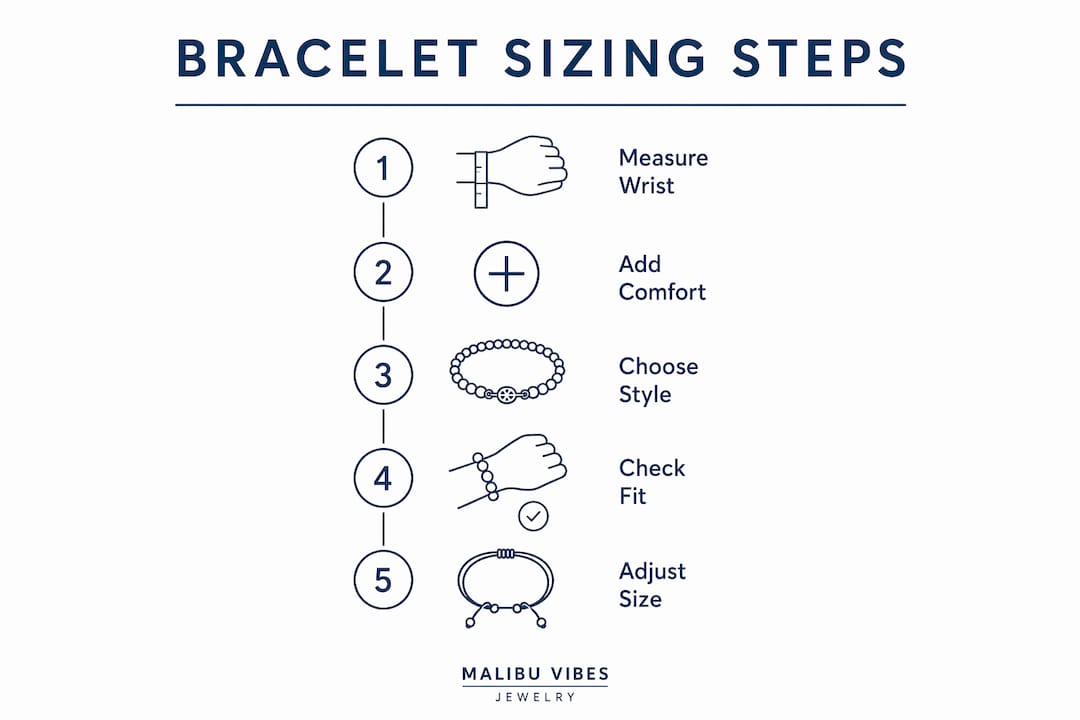
Accurate wrist measurement is the foundation of every good bracelet fit. The process takes under two minutes and requires no special tools.
Method 1: Soft tape measure
- Wrap a flexible tape measure around your wrist just below the wrist bone, where a bracelet naturally sits.
- Pull the tape snug but not tight. You should be able to slide one finger underneath.
- Note the measurement in inches. This is your wrist circumference.
- Add 0.5 to 1 inch to that number to get your bracelet size for a standard comfort fit.
Method 2: String or paper strip
- Cut a strip of non-stretchy string or paper about 10 inches long.
- Wrap it around your wrist at the same position as above.
- Mark the point where the strip overlaps with a pen.
- Lay the strip flat against a ruler and read the measurement from the end to your mark.
- Add your preferred fit allowance to get the final bracelet length.
Method 3: Existing bracelet
If you already own a bracelet that fits well, measure its total length from clasp end to clasp end. That number is your working bracelet size.
Pro Tip: Measure your wrist in the afternoon or evening. Wrists swell slightly throughout the day, and an afternoon measurement gives you a more accurate average size for all-day wear.
The most common measurement mistake is wrapping the tape too tightly. A bracelet measured against a tight wrist will feel restrictive the moment you put it on. Leave that one-finger gap every time.
Snug, comfort, and loose fit: how fit preference changes your size
Two people with identical 6.5-inch wrists can wear completely different bracelet sizes. The reason is fit preference, which determines how much length you add to your wrist measurement.
The three standard fit styles work like this:
- Snug fit: Add 0.25 to 0.5 inches to your wrist measurement. The bracelet sits close to the skin with minimal movement. This style suits tennis bracelets and fine chain styles where draping is not the goal.
- Comfort fit: Add 0.5 to 0.75 inches. The bracelet moves freely but does not slide toward the hand. This is the most common preference and the standard used in most bracelet sizing guides.
- Loose fit: Add 0.75 to 1 inch or more. The bracelet hangs with visible space and moves along the wrist. Beaded bracelets and charm bracelets often look best in this style.
A bracelet should fit with about one finger’s width of space between the wrist and the bracelet as a baseline for comfort fit. That single measurement check tells you immediately whether a bracelet is the right size.
Pro Tip: If you are between two sizes, always size up. A slightly loose bracelet is more comfortable and less restrictive than one that is too tight, and it is far easier to add an extender link than to remove metal.
Cuff bracelets follow slightly different rules. Because they do not have a clasp, they slide over the hand and rest on the wrist. For cuffs, measure your wrist and add only 0.25 to 0.5 inches. The cuff needs to hold its position without pinching.
Bracelet size chart: comparing sizes across styles
Not all bracelets size the same way. Chain bracelets, bangles, and cuffs each have distinct sizing logic, and knowing the difference prevents a frustrating return.
Chain bracelets are the most forgiving. Most come with a 1-inch extender chain, which means a 7-inch chain bracelet effectively fits wrists from 6 to 7 inches depending on where you clasp it. Choosing a size near the middle of the extender range gives you the most flexibility. This is why bracelets with clasps and extender chains reduce the pressure of getting the exact size right.
Bangle bracelets are rigid circles with no clasp. They must pass over the knuckles to reach the wrist. To size a bangle, measure the widest part of your hand when your fingers are pressed together, then choose a bangle with an inner diameter slightly larger than that measurement. Most standard women’s bangles have an inner diameter of 2.5 inches, which fits a medium wrist.
Cuff bracelets are open-ended and can be gently adjusted. A jeweler can squeeze or open a metal cuff slightly for a better fit. Cuff adjustments by a jeweler typically cost between $5 and $15 for link removal or minor reshaping. That is a small price for a perfect fit on a fine piece.
The bracelet size chart you use should always specify which bracelet style it applies to. A chart built for chain bracelets does not apply to bangles.
How to choose the right size when buying a bracelet as a gift
Buying a bracelet as a gift without knowing the recipient’s wrist size is the most common sizing challenge. The good news is that a few practical strategies cover most situations.
- Default to the average. For women, a 7-inch bracelet fits the majority of adult wrists. For men, 8 inches is the safe default. These sizes cover the middle of the size range for each group.
- Choose adjustable styles. Bracelets with extender chains or sliding knot closures remove the need for a precise measurement. The recipient can set the fit themselves.
- Ask indirectly. A casual question like “do you wear your bracelets loose or close to the wrist?” tells you the fit preference without revealing the gift.
- Check the return and resize policy. Before purchasing, confirm whether the retailer offers exchanges or resizing. Fine jewelry retailers often resize chain bracelets by adding or removing links.
- Avoid fixed-size bangles as blind gifts. Bangles require the most precise sizing and have the least flexibility. Unless you know the recipient’s exact hand measurement, a chain bracelet is the safer choice.
Sizing up is always safer when you are unsure. A bracelet that is slightly too large can be worn with a shorter clasp position or adjusted with an extender. A bracelet that is too small cannot be worn at all.
Pro Tip: For gift purchases, look for bracelets made in 14k gold or sterling silver with extender chains. These styles offer both quality and fit flexibility, which means the gift works even if the size is slightly off.
Custom bracelet sizes are also worth considering for meaningful gifts. Many fine jewelry brands, including Malibuvibesjewelry, offer custom sizing on select pieces. A custom-sized bracelet made in 14k gold or sterling silver becomes a genuinely personal gift rather than a generic one.
Key takeaways
The most reliable way to find the right bracelet size is to measure wrist circumference and add 0.5 to 0.75 inches for a standard comfort fit, then adjust based on bracelet style and personal preference.
| Point | Details |
|---|---|
| Average sizes by group | Women average 7–7.5 inches; men average 8–8.5 inches; children fit 5–6 inches. |
| Fit preference matters | Snug, comfort, and loose fits each require different added length beyond wrist measurement. |
| Measure accurately | Use a soft tape or non-stretch string below the wrist bone and add your fit allowance. |
| Style affects sizing | Chain bracelets allow more flexibility; bangles and cuffs require closer measurement. |
| Gift-buying default | Choose 7 inches for women and 8 inches for men when the exact wrist size is unknown. |
Why I always tell people to measure twice and buy once
Getting bracelet sizing right is genuinely simple once you understand the logic. But the number of people who skip the measurement step and rely on guessing still surprises me.
The most common mistake I see is treating bracelet size like clothing size. People assume a “medium” bracelet fits a medium-built person. It does not work that way. A petite woman with a 5.5-inch wrist and a tall woman with a 7-inch wrist are both “medium” by clothing standards, but they need completely different bracelet lengths.
The second mistake is ignoring bracelet style when sizing. I have seen people order the right length in a bangle when they needed a chain bracelet, and the bangle would not pass over their knuckles. The measurement was correct. The style logic was not.
My honest recommendation for first-time buyers and gift givers is this: buy adjustable when in doubt. A bracelet with a 1-inch extender chain in 14k gold or sterling silver gives the recipient room to find their own fit. It also signals that you thought about quality, not just size. Adjustable does not mean cheap. The finest chain bracelets in the world come with extenders.
For anyone buying for themselves, take five minutes to measure properly using the string method. Write the number down. Keep it in your phone. You will use it every time you shop for bracelets, and you will never second-guess a purchase again.
— Ara
Malibuvibesjewelry bracelets: sized for every wrist
Finding a bracelet that fits well starts with knowing your size. Malibuvibesjewelry carries handcrafted bracelets in 14k gold and sterling silver, with options across standard sizes and adjustable styles built for real wrists.

Every piece in the bracelet collection includes detailed sizing information so you can match your wrist measurement to the right length before you buy. The Los Angeles-made pieces range from delicate chain styles to bold cuffs, all crafted with the kind of quality that holds up to daily wear. If you want to go further, the sterling silver collection includes several adjustable bracelet options that work across a wide range of wrist sizes. Sizing support is available directly through the site for any piece you are considering.
FAQ
What is the average bracelet size for women?
The average bracelet size for women is 7 to 7.5 inches. This covers the majority of adult female wrists, which typically measure between 6 and 6.5 inches in circumference.
How do I measure my wrist for a bracelet at home?
Wrap a non-stretchy string or soft tape measure around your wrist just below the wrist bone, mark or note where it meets, then measure that length against a ruler. Add 0.5 to 0.75 inches for a standard comfort fit.
What size bracelet should I buy as a gift?
A 7-inch bracelet is the safest default for women and an 8-inch bracelet works for most men. Choosing a style with an extender chain gives the recipient flexibility to adjust the fit themselves.
What is the difference between snug, comfort, and loose bracelet fit?
Snug fit adds 0.25 to 0.5 inches to wrist measurement, comfort fit adds 0.5 to 0.75 inches, and loose fit adds 0.75 inches or more. The right choice depends on bracelet style and personal preference.
Can a bracelet be resized after purchase?
Chain bracelets can be resized by adding or removing links, and metal cuffs can be gently adjusted by a jeweler. Resizing typically costs between $5 and $15 depending on the work required.